
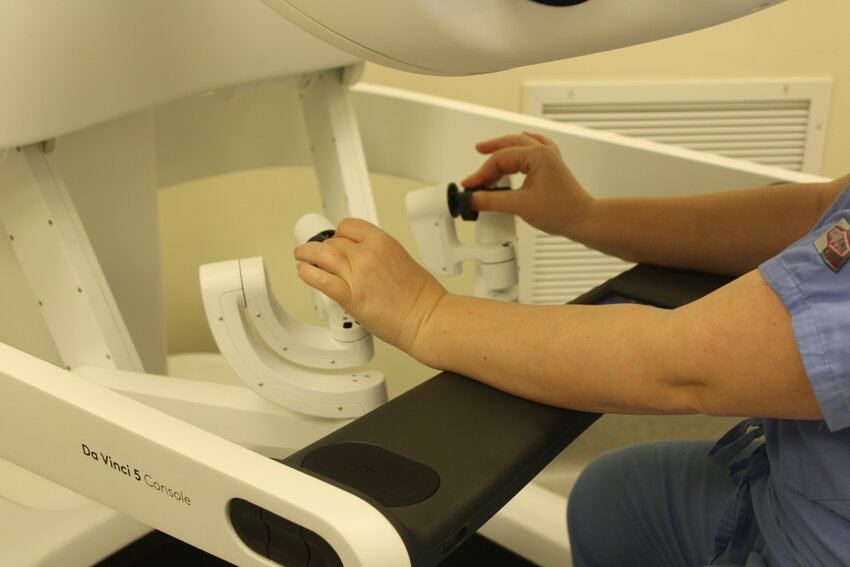
MIDDLEBURG — St. Vincent’s Clay County has introduced the Da Vinci 5 robotic surgical system, enhancing surgical procedures and promoting faster recovery times for patients. This state-of-the-art technology made its debut on February 12, 2024, when Dr. Lindsay Lindsey performed a routine surgery using the new system. While the fundamental steps of surgery remain unchanged, the introduction of robotics significantly improves the precision and efficiency of these operations.
The Da Vinci 5 is the first robotic surgical system of its kind in Clay County. It is designed to assist skilled surgeons in performing minimally invasive procedures, offering advanced technological capabilities compared to its predecessor, the XI model. According to Bryan Walrath, president and CEO of St. Vincent’s Clay County, “The Da Vinci 5 reflects our commitment to investing in state-of-the-art technologies that enhance our patients’ quality of care.”
Once a patient is anesthetized, the surgical team prepares by placing laparoscopic ports to dock the robot. The surgeon then operates from a console located across the room, utilizing hand controls and a high-definition screen. The robotic system’s four interactive arms serve as extensions of the surgeon’s hands, maintaining full control throughout the procedure.
“If I need different instruments, I ask my tech to remove them and replace them with new ones,” Dr. Lindsey explained. “After I finish the operation, I scrub back in and undock the robot, and we close all the little port sites.” This method ensures minimal incisions, typically less than an inch, leading to reduced pain and quicker recovery for patients.
The investment in the Da Vinci 5, which costs approximately $2.7 million, was driven by a collective decision among surgeons who recognized the potential benefits for patient care. “That’s a really key thing, how much support this hospital has for us as surgeons so that we can give the best for our patients,” Dr. Lindsey stated.
Surgeons at St. Vincent’s are now using the robot for a variety of procedures, including gall bladder and appendix removals, hernia repairs, and colectomies. The system’s design allows for enhanced feedback on tissue tension, reducing strain by up to 40% during surgery. This capability contributes to a gentler surgical process, which is crucial for patient outcomes.
In addition to its numerous advancements, the Da Vinci 5 features over 150 enhancements from the original model, including improved accuracy, precision, and a 3-D display for better visualization. It also boasts ten thousand times more computing power, allowing for sophisticated imaging and data analysis.
“The video of the surgery goes immediately to my phone. I can review it like a golfer looks at a swing,” Dr. Lindsey remarked. This real-time feedback enables surgeons to refine their techniques and improve outcomes. “Surgery is a game of millimeters. Precision can be the difference between a good outcome and a bad outcome.”
The Da Vinci 5 also facilitates telepresence, enabling collaboration with other medical professionals and institutions at the click of a button. This feature is particularly beneficial for complex cases requiring expert input from specialists.
As St. Vincent’s looks to the future, hospital leadership is optimistic about the long-term impacts of the Da Vinci 5 on patient care. “We believe really strongly that Day 365, three years and five years, this is going to have a huge impact for patients in Clay,” Dr. Lindsey concluded, highlighting the potential for ongoing advancements in surgical outcomes through technology.


