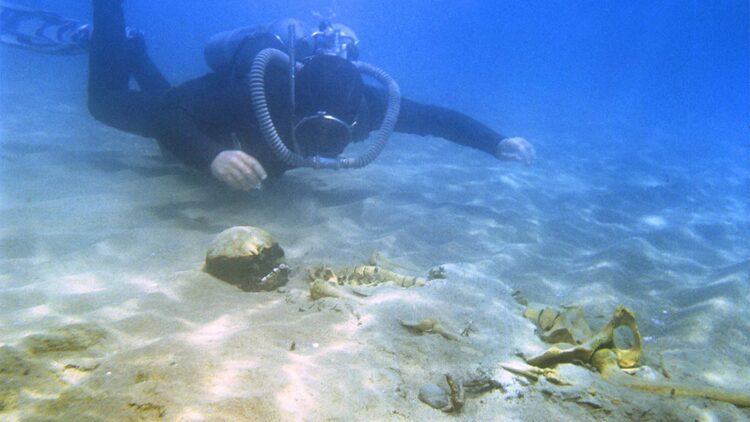
Archaeologists have confirmed the discovery of a medieval city submerged beneath the waters of Lake Issyk-Kul in Kyrgyzstan. This site, believed to have flourished along the historic Silk Road, offers new insights into the region’s past and its role in trade and cultural exchange. The findings challenge existing narratives about the history of Central Asia, revealing a complex urban center that may have existed from the 10th to the 15th century.
Located on the northwest shore of Lake Issyk-Kul, surrounded by the stunning Tien Shan mountains, the underwater site at Toru-Aygyr has yielded significant archaeological evidence. Researchers have documented large ceramic vessels, remnants of baked brick structures, and parts of grain mills. These artifacts suggest the presence of public buildings such as madrasas, mosques, and ritual baths, indicating that this city was a hub for traders, tourists, and pilgrims traveling between China and the Islamic world.
Unveiling a Rich Historical Tapestry
The team explored the area at depths ranging from one to four meters, revealing wooden structures and crumbling stone walls that point to a carefully designed urban environment. The use of Accelerator Mass Spectrometry (AMS) and dendrochronology has allowed researchers to accurately date the wooden materials and other samples, linking the settlement to the Kara-Khanid dynasty, a Turkic ruling house instrumental in spreading Islam in the region.
This city was not only a center of Islamic culture but also a melting pot of various religious beliefs, including Buddhism and Nestorian Christianity. The archaeological evidence indicates a long history of religious diversity before the rise of Islam, showcasing the region’s vibrant cultural landscape.
The Catastrophe and Its Legacy
The city suffered a catastrophic collapse during a powerful earthquake in the 15th century, submerging much of it beneath Lake Issyk-Kul. Interestingly, archaeological findings suggest that some residential areas were abandoned prior to this disaster, indicating a complex history of habitation. The remains of a large Muslim cemetery, dating to the 13th and 14th centuries, have been discovered, covering approximately 60,000 square meters. The graves respect Islamic burial customs, with bodies oriented towards Mecca, and initial finds include a male and a female skeleton, which may provide insights into their diets and origins.
Additional artifacts, such as medieval ceramics and a significant grain storage vessel known as a khum, further underscore the city’s historical importance. Nearby graves indicate that the area was occupied long before the rise of Islam, revealing layers of cultural history.
Mapping the Future of Archaeological Research
Employing cutting-edge technology, including underwater drones and advanced navigation systems, archaeologists are meticulously mapping these submerged ruins. Their goal is to create an interdisciplinary project that encompasses funerary studies, urban archaeology, and the tectonic and climatic history of Lake Issyk-Kul.
Researchers believe that substantial portions of the city remain undiscovered, with future excavations holding the potential to reshape our understanding of Central Asia’s role in world history since the Middle Ages. The ongoing study of this underwater city not only highlights its historical significance but also emphasizes the importance of preserving such cultural heritage for future generations.