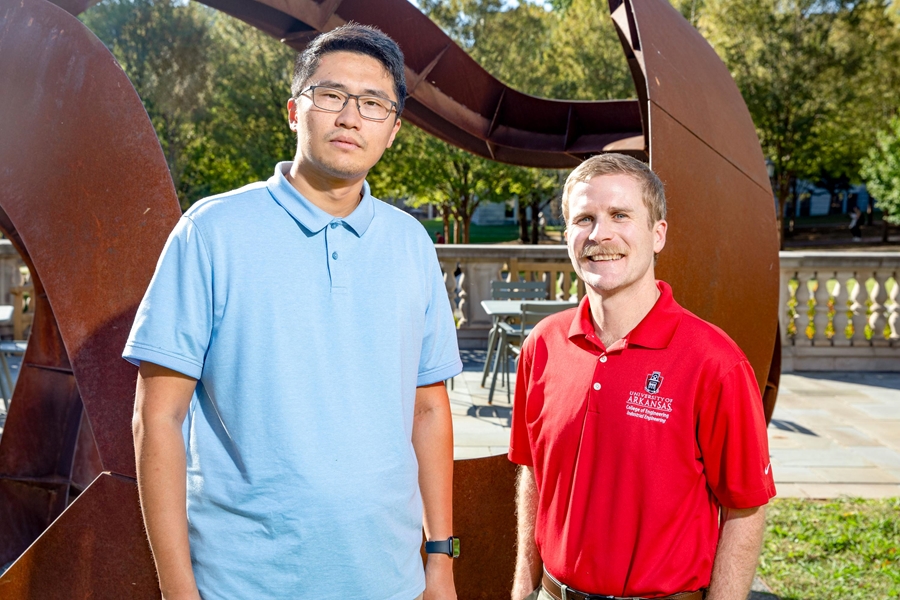
The U.S. Air Force Office of Scientific Research has awarded approximately $588,000 to researchers at the University of Arkansas for a project aimed at enhancing the protection of critical networks during disruptive events. This funding will support a study led by assistant professors Haoming Shen and Robert Curry, who are focusing on the role of information in safeguarding infrastructure during crises such as natural disasters and cyberattacks.
The project intends to develop mathematical models that guide the collection, sharing, and protection of information in times of crisis. Shen, who serves as the principal investigator, emphasizes the importance of understanding how the flow and accuracy of information can influence a community’s ability to respond effectively to disruptions. The research will also explore strategies for the optimal allocation of limited resources, including sensors and drones, to detect threats and protect vital infrastructure.
Shen and Curry will investigate two primary questions: How can defenders leverage information to anticipate and detect potential attacks? Additionally, how might misinformation or strategic sharing of information be utilized to deter threats? “In simpler terms, we’re trying to make data-informed decisions under conditions of uncertainty,” Curry remarked on the project’s objectives.
While the study will primarily focus on theoretical modeling, its implications could significantly enhance future crisis planning and infrastructure protection, particularly within transportation and logistics networks. “We want to proactively configure sensor networks to detect any potential disruptions,” Shen explained. “However, deploying sensors and conducting sensing tasks require investment, and funding is always limited. Our goal is to identify the best strategies for resource allocation to detect attacks and safeguard our infrastructure.”
This grant has been awarded through the Defense Established Program to Stimulate Competitive Research (DEPSCoR), a Department of Defense initiative designed to build research capacity at universities in underrepresented states. U.S. Senator John Boozman, a supporter of DEPSCoR, remarked, “This project provides an opportunity to pursue high-quality research with real-world applications like protecting critical infrastructure. Investing in this project reinforces and enhances our largest institution’s significant role in supporting national security.”
In a related development, the University of Arkansas announced in October 2023 that it has joined a national research team tasked with developing advanced video object tracking technology. This initiative is part of a contract with the Defense Advanced Research Projects Agency (DARPA), which could potentially bring up to $6 million in federal funding to the university.
The collaboration between the U.S. Air Force and the University of Arkansas highlights the growing emphasis on research that directly contributes to national security and infrastructure resilience. As the landscape of threats evolves, initiatives like these aim to bolster the capacity for informed decision-making and proactive measures in the face of uncertainty.