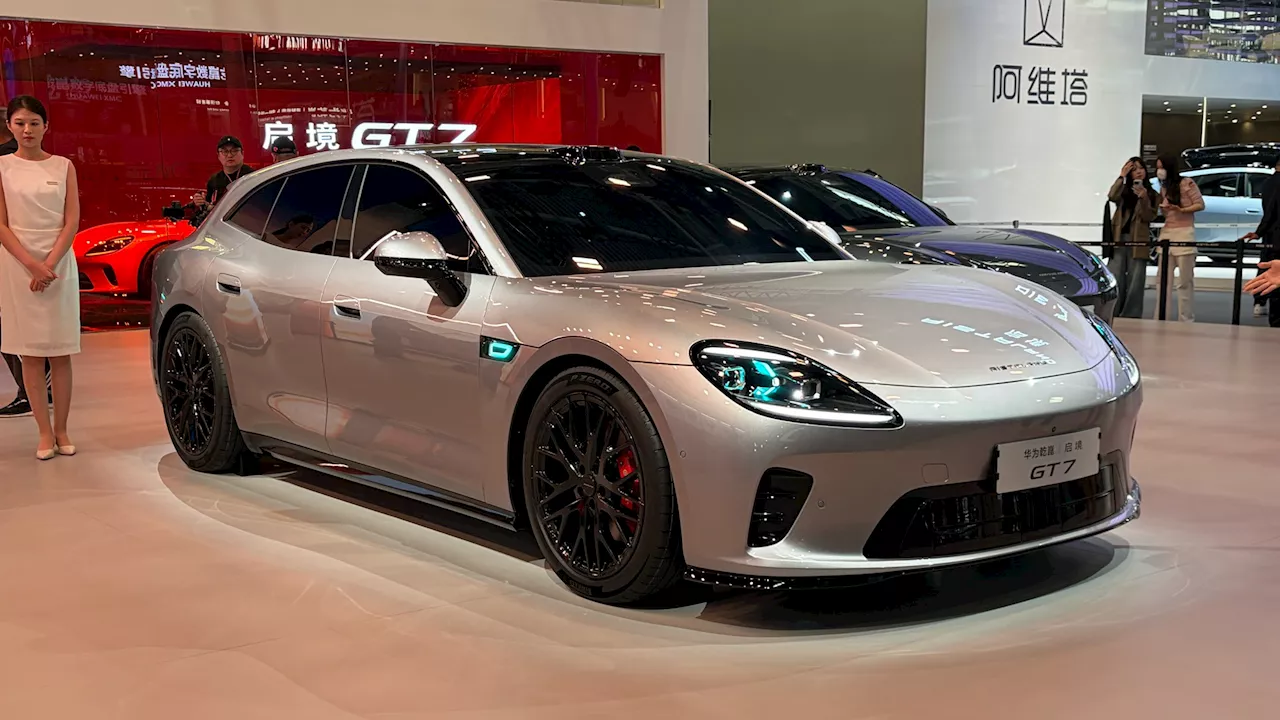
Huawei and Chinese automaker GAC have jointly unveiled the Aistaland GT7, an electric vehicle that closely mimics the Porsche Panamera’s iconic size and design, signaling a bold new entry into China’s EV market with advanced tech from one of the world’s leading tech giants.
The Aistaland GT7 — also branded as Qijing in China — was revealed this week at the Beijing Auto Show and immediately caught attention for its striking resemblance to Stuttgart’s Panamera in both dimensions and styling. The GT7 measures 5050mm in length and has a wheelbase of 3000mm, almost identical to Porsche’s Panamera, underscoring a design strategy clearly inspired by Germany’s luxury sports sedan.
This launch is urgent news for EV buyers and tech enthusiasts in the U.S. and California especially, as Huawei’s technology promises to push electric vehicles further ahead in safety and intelligence, areas that remain front and center in the evolving EV landscape.
Leading-Edge Technology Powers Aistaland GT7
The GT7 operates on an 800-volt architecture and integrates a dual-motor all-wheel-drive layout. It will be available both as a pure battery electric vehicle (BEV) and a range extender (REX) model — a configuration still highly favored within the Chinese market. The range extender’s combustion engine is reported to be positioned above the front axle, optimizing weight distribution for superior performance.
Battery cells powering the GT7 come from CATL, the Chinese lithium-ion titan, ensuring competitive range and charging speeds aligned with global EV benchmarks.
Huawei’s Advanced Safety and Lighting Tech
Huawei’s influence on the GT7 goes beyond powertrain tech. The vehicle features intelligent Xpixel projection headlights capable of projecting warning symbols directly onto the road, a feature paralleled only by luxury brands like Mercedes-Benz. This functional lighting innovation enhances night-time driving safety significantly.
Moreover, the GT7 is equipped with a state-of-the-art Lidar system boasting 896 scan lines, far outperforming the 192-line systems common in many competitor models. This Lidar can detect objects as tiny as 14cm from up to 122 meters away even in low-light conditions — a substantial leap forward for autonomous driving assistance and collision avoidance technologies.
Market Launch and Broader Impacts
The vehicle is poised for release in China in the coming month, though no immediate plans exist to launch it in the U.S. or California markets. Still, its emergence signals a competitive shift as Chinese manufacturers and tech giants like Huawei ramp up electric vehicle innovation. The GT7 may set new benchmarks on how digital intelligence integrates with automotive performance.
“Huawei and GAC’s Aistaland GT7 merges cutting-edge technology with bold design,” said Curtis Moldrich, Digital Editor at CAR magazine. “Its launch underlines China’s growing dominance in the EV space and their increasing challenge to established European luxury manufacturers.”
For California readers, the GT7’s debut highlights the importance of tech-driven electric vehicles as the state accelerates its zero-emission vehicle goals. While this model currently targets the Chinese market, similar innovations could soon influence U.S. EV offerings, especially in areas of intelligent safety systems and advanced driver aids.
What’s Next?
The auto industry should watch closely as Huawei and GAC expand their EV lineup and potentially explore international markets. The GT7’s advanced features — particularly its lidar and intelligent headlights — may set new safety standards globally if adopted widely.
Meanwhile, California’s dynamic EV ecosystem is likely to engage with this new wave of tech-heavy vehicles indirectly through software partnerships and potential technology licensing, given Huawei’s leadership in consumer electronics and AI.
The Aistaland GT7 launch is a vivid signpost of where electric mobility is headed: high-tech, safety-focused, and coded for intelligence. For U.S. consumers seeking the next generation of electric cars, it’s a story unfolding now with global ripple effects.