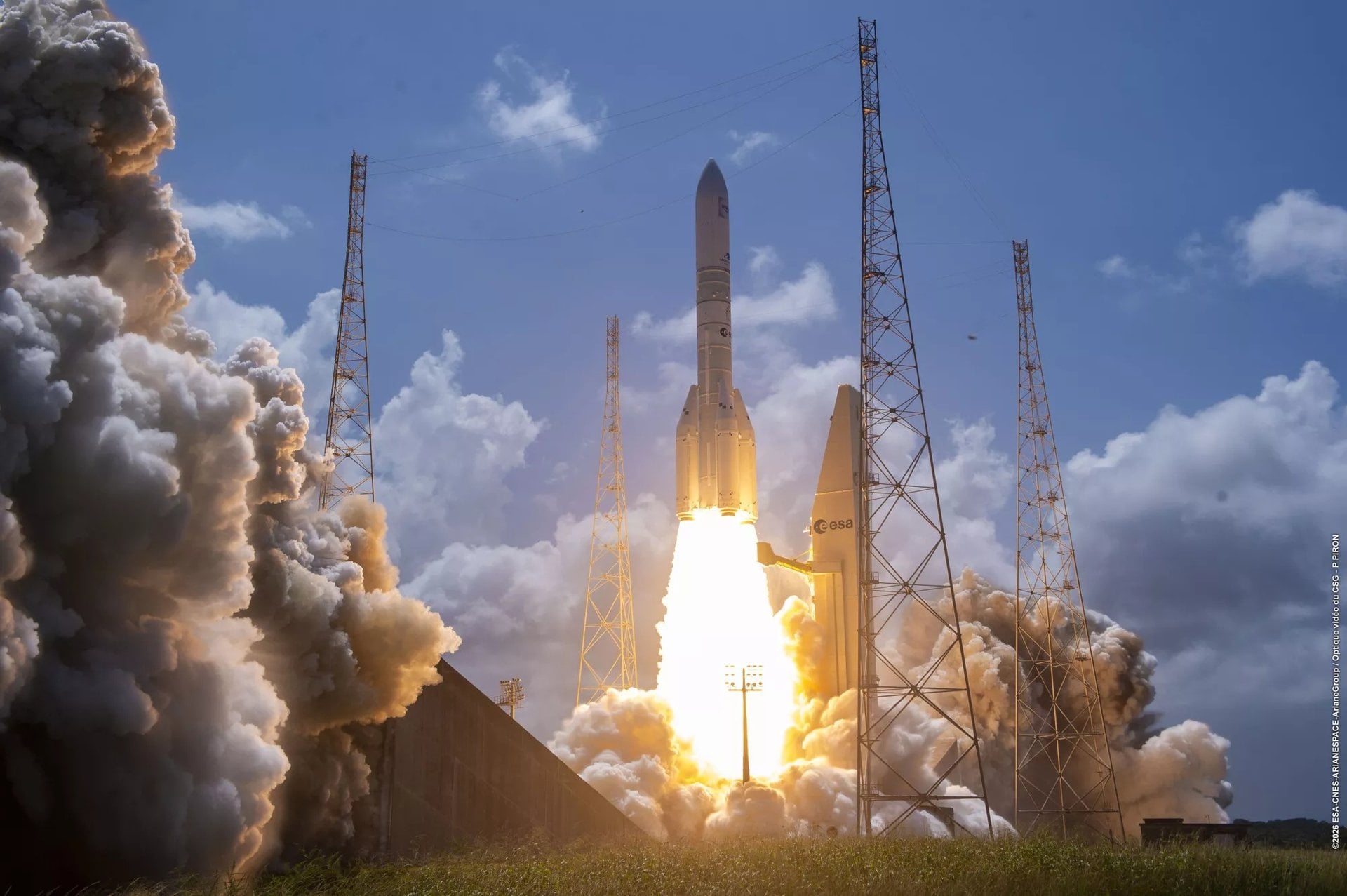
The European Space Agency (ESA), in collaboration with Arianespace and ArianeGroup, successfully launched the Ariane 6 rocket on February 12, 2025. This significant event took place at Europe’s Spaceport in Kourou, French Guiana, marking a pivotal moment for the ESA and Europe’s ambitions in space exploration. The Ariane 6 rocket is designed to enhance payload capacity and versatility compared to its predecessor, the Ariane 5.
The Ariane 6 rocket features a three-stage expendable launch system, consisting of a main stage, an upper stage, and strap-on boosters. In its initial configuration, the Ariane 62 was equipped with two strap-on boosters, allowing it to carry a medium payload of 10,350 kg (22,820 lb) to Low Earth Orbit (LEO) and 4,500 kg (9,900 lb) to geostationary orbit (GSO). The latest configuration, the Ariane 64, unveiled during the launch, includes four strap-on boosters, significantly increasing its heavy-lift capacity to 21,650 kg (47,730 lb) to LEO and 11,500 kg (25,400 lb) to GSO.
The maiden flight of the Ariane 6, designated VA267, successfully launched at 13:45 local time (UTC-3), carrying a payload of 32 satellites as part of Amazon’s Leo constellation. This mission represents a historic achievement, as it is the first time a European launcher has serviced a satellite constellation. It also marks the beginning of an ambitious plan, with a total of 18 launches planned to support Amazon’s satellite network.
With the introduction of the Ariane 64, the ESA expands its capabilities, enabling it to offer launch services to commercial partners, a significant shift from its previous focus on government and scientific missions. As David Cavaillolès, CEO of Arianespace, stated, “The P120C solid rocket booster is one of the largest and most powerful currently in operation.” This booster features a carbon-fiber design and carries approximately 143.6 metric tons (158.3 U.S. tons) of propellant, generating an impressive thrust of around 4.5 meganewtons (1,000,000 lbf).
Future Missions and Opportunities
The capabilities of the Ariane 6 extend beyond commercial launches. The ESA has plans for several high-profile missions, including the exoplanet-hunting satellite, the PLAnetary Transits and Oscillations of stars (PLATO), scheduled for launch in January 2027. This mission aims to enhance the current understanding of exoplanets by measuring their sizes, detecting exomoons and rings, and characterizing the host stars to assess the habitability of these distant worlds.
Additionally, the ESA is working on the Argonaut lunar lander, which is essential for future lunar exploration endeavors. The agency envisions deploying numerous landers to deliver cargo to the Moon’s surface, supporting both robotic and crewed missions, including NASA’s Artemis program. The ultimate goal is to establish an international lunar outpost, providing valuable access to the Moon’s resources.
As the ESA embarks on this new chapter with the Ariane 6, the successful launch demonstrates a commitment to advancing Europe’s role in global space initiatives. With increased payload capacities and a broader mission scope, the ESA is well-positioned to lead in both scientific exploration and commercial ventures in the ever-evolving landscape of space travel.