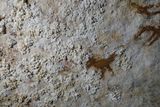
Researchers have identified the oldest known rock art, dating back approximately 67,800 years, on the Indonesian island of Sulawesi. This discovery, detailed in a recent study published in Nature, provides significant insights into early human migrations, particularly those leading to Australia. The artwork, a faint stencil resembling a human hand, was found in the Liang Metanduno cave, suggesting that the site may have played a crucial role in the movements of early human populations.
The hand stencil, which has a somewhat claw-like appearance, offers evidence that Sulawesi hosted one of the globe’s most enduring artistic cultures. “It is now evident from our new phase of research that Sulawesi was home to one of the world’s richest and most longstanding artistic cultures,” stated Maxime Aubert, a researcher at the Griffith Centre for Social and Cultural Research at Griffith University in Australia. This culture likely traces back to the island’s first human inhabitants around 67,800 years ago.
Significance of Sulawesi in Human History
Sulawesi has long been recognized as an important location for understanding human history. It has preserved some of the most ancient cave art discovered to date, including depictions of both human and animal figures. This region may have served as a pivotal point for early migrations of Homo sapiens moving from Asia toward Sahul, the ancient landmass that once connected Australia, New Guinea, and Tasmania.
The study revealed not only the hand stencil but also several other ancient artworks, including additional stencils of human hands. Using advanced dating techniques such as uranium-series dating and mineral deposit analysis, researchers confirmed that the claw-like stencil was created around 67,800 years ago, predating earlier rock art discoveries in the region by approximately 16,600 years.
Connecting Ancient Populations to Australia
The findings suggest a direct connection between the artists of Sulawesi and the ancestors of Aboriginal Australians. “It is very likely that the people who made these paintings in Sulawesi were part of the broader population that would later spread through the region and ultimately reach Australia,” explained Adhi Agus Oktaviana from Indonesia’s National Research and Innovation Agency. The research supports the hypothesis that the ancestors of the First Australians were present in Sahul by at least 65,000 years ago.
Previous studies proposed two timelines for the arrival of Homo sapiens in Sahul: the “long chronology” around 65,000 years ago and the “short chronology” around 50,000 years ago. These studies also indicated that migrations occurred via two primary routes: the northern route through Sulawesi and the southern route via Timor.
According to the latest findings, the Liang Metanduno cave appears to have been occupied for a substantial duration, with evidence of continuous human presence spanning potentially over 35,000 years. The ancient rock art thus serves as the oldest direct evidence of modern humans using this northern migration corridor into Sahul.
Researchers aim to continue exploring the rich archaeological landscape of Indonesian islands, particularly those situated between Sulawesi and New Guinea. “These discoveries underscore the archaeological importance of the many other Indonesian islands between Sulawesi and New Guinea,” Aubert noted, indicating a promising avenue for further investigation into early human history and migration patterns.
This groundbreaking research not only sheds light on the artistic capabilities of our ancient ancestors but also provides critical insights into the routes they may have taken as they dispersed across the globe. The findings are a testament to the complexity of human history and the enduring legacy of early artistic expression.