MTA Launches Aggressive Phone and Card Scanning to Fight Fare Evasion
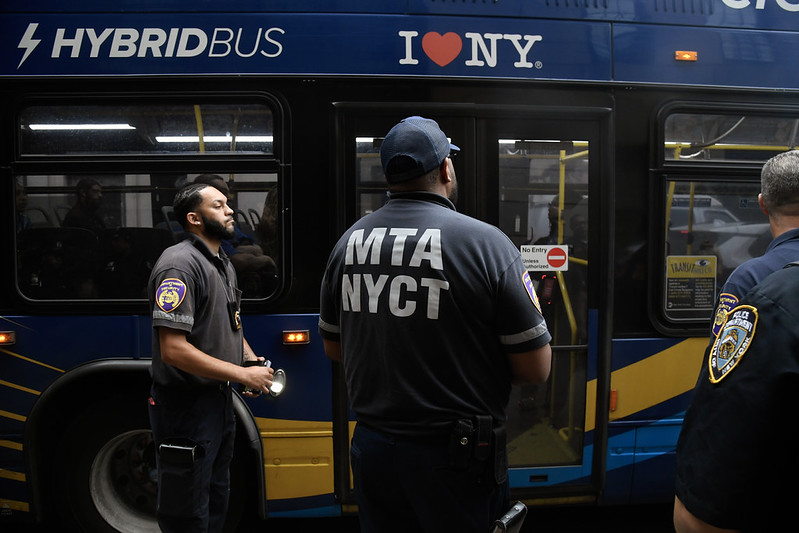
The MTA is cracking down on fare evasion with a bold new “European-model” enforcement tactic that scans riders’ phones and credit cards to prove payment, MTA Chair and CEO Janno Lieber announced following the April 29 MTA board meeting. The move represents a sharp shift in bus fare enforcement, aiming to reclaim lost revenue and finally enable all-door boarding on local buses.
Lieber defended the rollout of handheld scanning devices used by civilian fare agents on local buses after the technology was piloted on Select Bus Service (SBS) routes. The enforcement teams, known as EAGLE (Evasion And Graffiti Lawlessness Eradication) units, verify payments through the OMNY contactless fare system by scanning passengers’ phones, credit/debit cards, or fare cards.
High Compliance but Pushback Possible
Lieber said most riders have complied when approached, but he acknowledged potential resistance as some passengers may hesitate to present their devices on demand.
“We haven’t gotten a lot of pushback. It may happen,” Lieber said. “This is the right way to validate fares in the 21st Century in the Western world.”
NYC Transit President Demetrius Crichlow confirmed agents are receiving training on customer interaction, emphasizing respectful communication for encounters where riders refuse to show proof of payment.
“Employees are being trained how to deal with customers, what to say in instances where they encounter a customer that may not necessarily be readily willing to present their information,” Crichlow explained.
Extensive Rider Education Underway to Prevent Surprises
To ease tensions and build awareness, the MTA is conducting outreach through leaflets, customer information screens, and bus signage to alert riders before enforcement ramps up on all local buses.
“We’re also doing the work up front, having the teams go out there and do leaflets, talk to customers in advance,” Crichlow said. He stressed the scanning devices do not store personal data, addressing privacy concerns.
Critical Revenue Recovery Effort
The crackdown responds to a staggering $568 million revenue loss in 2024 due to fare evasion on buses, according to a recent report by the Citizens Budget Commission.
Since the MTA stopped selling MetroCards at the end of last year and mostly phased out coin payments, it has fully adopted the OMNY tap-to-pay system, making this scanning method possible and necessary.
Transforming Bus Boarding and Future Enforcement
Lieber highlighted that successfully verifying fares with scanners will allow full implementation of all-door boarding on local buses, a long-awaited change to speed up service and reduce delays.
“We’ve been testing it out…and it’s working fine,” Lieber said. “There is a very high rate of customer compliance.”
As the scanning rollout expands, transit riders in New York—and observers across the U.S., including California—should brace for stricter checks and evolving approaches to fare enforcement that may influence other transit agencies dealing with fare evasion losses.