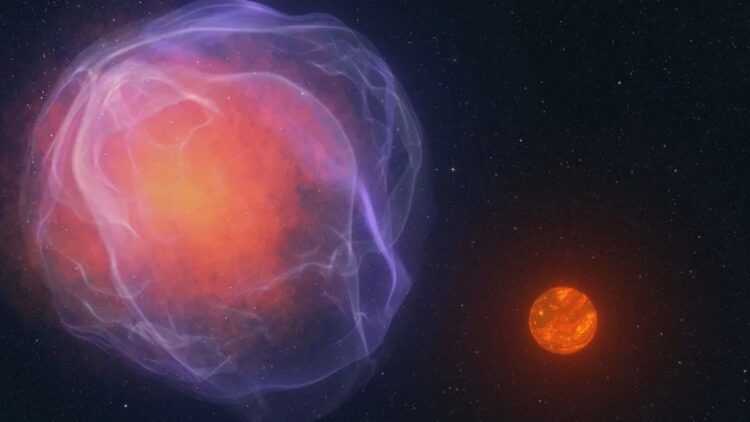
A team of scientists and astronomers from NASA has identified a remarkable celestial body known as CWISE J1249, which is traveling at an astonishing speed exceeding 1 million mph across the Milky Way. This ultrafast object, detected by the WISE telescope, has become a focal point of research due to its unique characteristics, prompting questions about its origin and future trajectory.
Significant Findings from the WISE Telescope
The research team, led by Martin Kabatnik, focused on analyzing the properties of CWISE J1249. Initial observations revealed that this object has a notably low mass and a minimal metal content, complicating its classification as either a star or a planet. Current data suggests it may be classified as a rogue planet, a designation that reflects its solitary journey through space without orbiting a star.
Using advanced telescopes and supercomputers, scientists have been able to detect anomalies in the cosmos. The WISE telescope, renowned for its ability to survey the infrared spectrum, played a crucial role in identifying CWISE J1249, a discovery that has sparked international interest among astronomers and scientists alike.
Theories on CWISE J1249’s Origin
The perplexing speed and physical characteristics of CWISE J1249 have led researchers to propose two main theories regarding its origin. The first theory suggests that it may be the remnant of a white dwarf supernova. Such an explosion could have provided the necessary gravitational thrust to propel the red sphere to its current velocity, possibly resulting in a significant loss of mass.
The second theory posits that CWISE J1249 might be a failed stellar body—an object that never ignited as a star—or a rogue entity that has been ejected from its original system due to gravitational interactions. Both theories remain unconfirmed, leaving much to be explored about this mysterious object.
The challenge for NASA researchers now lies in determining where CWISE J1249 originated and where it is headed. Currently identified as a rogue planet, tracing its trajectory will require detailed analysis to ascertain its point of origin. The research team aims to search for elements in situ, which could lead to the identification of its parent sources.
As the work continues, scientists express optimism about uncovering more rogue objects like CWISE J1249. The discoveries related to this celestial body could significantly enhance our understanding of stellar formations and the dynamics of the galaxy. With each new finding, the quest for knowledge about our universe becomes more profound, illuminating the mysteries that lie beyond our planet.