Myanmar’s military rulers are moving ahead with plans for staggered general elections set to begin on December 28, 2023, and conclude in late January 2024. This initiative aims to restore some semblance of stability in a nation plagued by a violent civil war that erupted following the military coup in February 2021. As the junta tries to navigate its international isolation, the elections are widely viewed as a facade amid ongoing turmoil, including widespread human rights abuses.
The backdrop of these elections is dire. Since the coup, the military has faced fierce resistance, including bombings that have targeted civilians, mass incarcerations, and the displacement of millions. Humanitarian agencies report that over 11 million people in Myanmar currently face food insecurity. During a recent Association of Southeast Asian Nations summit, United Nations Secretary-General António Guterres questioned the viability of free and fair elections under such conditions, stating, “It is quite obvious that in the present state of conflict… the conditions for free and fair elections are not there.”
To manipulate the electoral process, the military has enacted a new law prohibiting what it terms “interference” in elections. According to Human Rights Watch, nearly 100 people were detained under this law by November, a number that has since more than doubled. Individuals have been charged for merely expressing opinions about the elections on social media, facing the threat of lengthy prison sentences.
The military’s electoral strategy appears focused on establishing a parliament that favors the Union Solidarity and Development Party (USDP), the military’s proxy party. This party suffered a significant defeat in the 2020 elections against the National League for Democracy (NLD), which is now banned, and its leaders, including Aung San Suu Kyi, are imprisoned. Her son, Kim Aris, has expressed concerns regarding her wellbeing, saying, “For all I know, she could be dead.”
Efforts by the military to regain territory lost to opposition forces have intensified in recent months. According to Morgan Michaels, a security analyst at the International Institute for Strategic Studies in Singapore, the military has regained the initiative through conscription, improved organization, and the use of advanced drones. However, the opposition remains fractured, struggling with strategic missteps.
China’s stance on the situation is complex. While it does not support the military coup, it views the junta as a stabilizing force necessary for its economic interests in Myanmar. The civil unrest threatens Chinese infrastructure projects, including gas and oil pipelines. Yun Sun, director of the China program at the Stimson Center, notes that “Myanmar being China’s corridor leading to South Asia, Southeast Asia, and also to the Indian Ocean” is vital for Chinese geopolitical ambitions. Consequently, China has pressured ethnic armed groups to yield territory to the junta.
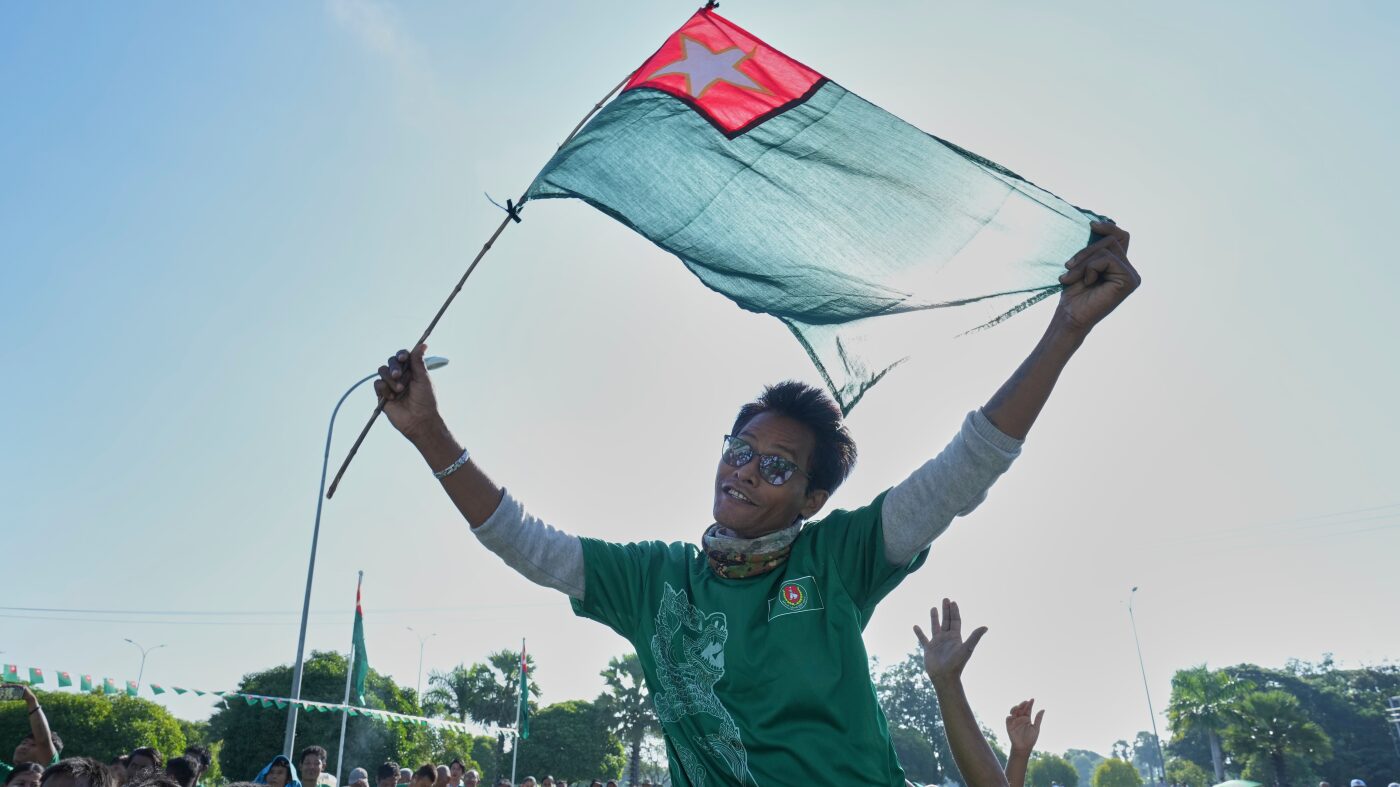
As the civil war drags on, fatigue is setting in among the populace. Analyst Min Zaw Oo points out that many young fighters are now seeking refuge in neighboring Thailand, indicating a shift away from armed struggle. Yet, some remain committed to the cause. Rebel commander Ko Ta Mar, who abandoned his career as a doctor to fight, expresses frustration with the opposition’s lack of unity, asserting, “There are good times and bad times in this revolution.”
Despite the bleak outlook, some citizens are looking for any form of relief from the ongoing crisis. Longtime Myanmar analyst David Mathieson observes a growing sentiment among the people, expressing that they may not desire democracy but are willing to accept a government that offers a path to stability. As the military prepares for the second and third rounds of elections in January, it is gambling that the promise of order will be enough to quell dissent and ease its diplomatic isolation.
The upcoming elections, while fraught with controversy and skepticism, highlight the precarious balance of power in Myanmar as the military seeks to consolidate its hold amid a fractured opposition and ongoing conflict.