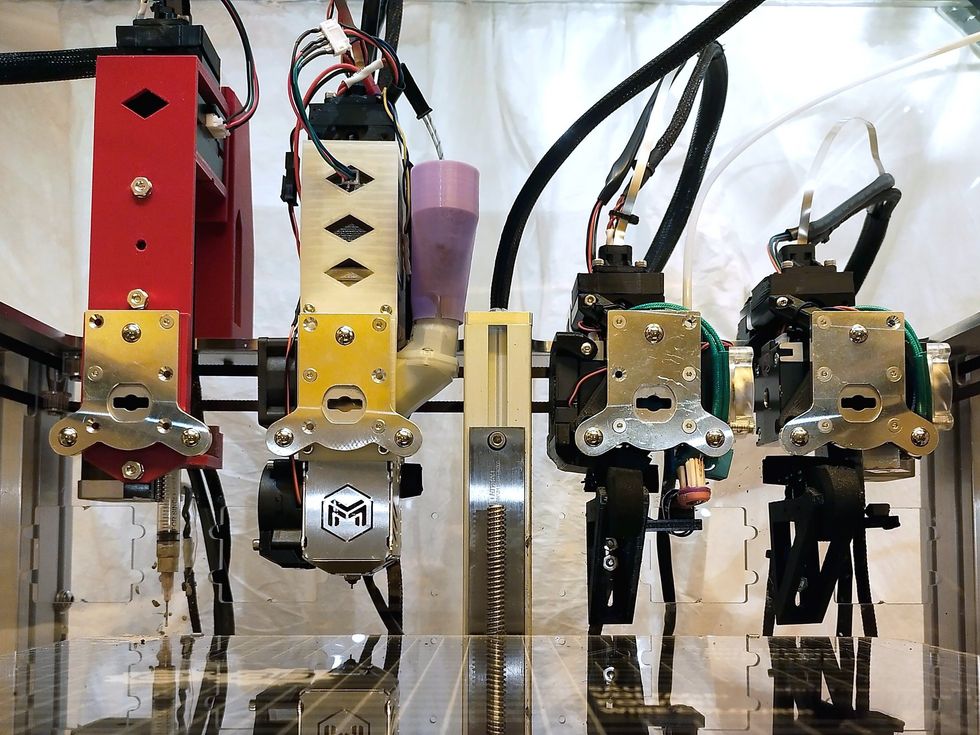
A research team at MIT has unveiled a groundbreaking 3D-printing system capable of producing a functional electric linear motor in just three hours. This innovation, detailed in a paper published in Virtual and Physical Prototyping last month, aims to transform the landscape of hardware production by integrating various materials in a single print process.
Traditional 3D printers primarily focus on creating plastic components, often limited to prototypes or decorative items. However, building complex devices like electric motors requires a multi-functional approach. These motors must utilize materials that can conduct electricity, insulate it, generate magnetic fields, and provide structural support. The new MIT platform addresses these challenges by processing five distinct functional materials during the printing process.
The cost of producing each motor is approximately $0.50 in raw materials. Researchers believe this could significantly reduce hardware engineering expenses and make production more resilient against supply chain disruptions. In contrast to conventional methods that involve several manufacturing steps and separate components, the MIT system streamlines production by printing the motor in one continuous build, requiring only a single post-print step to magnetize the hard magnetic parts.
Transforming 3D Printing with Multimaterial Techniques
3D printing technology has advanced significantly from its early days of rapid prototyping. Yet, many current printers still operate as single-material systems, primarily designed for plastics. Even those marketed as “multi-material” often utilize the same polymer in different colors rather than a range of distinct materials. According to Luis Fernando Velásquez-García, principal research scientist at MIT Microsystems Technology Laboratories, effective hardware production necessitates the use of varied materials.
The MIT prototype features a multimaterial extrusion approach that enables the printer to switch between four tools, accommodating feedstocks with diverse properties. This includes a heater for curing ink, a filament extruder, a custom ink extruder, and a modified pellet extruder. The latter is particularly noteworthy as it permits higher concentrations of magnetic particles, improving the magnetic performance of printed components.
Velásquez-García emphasized the importance of using capable materials over merely printable ones. Compromising on material quality can lead to diminished performance in the final product. “If you need something with optical clarity, for example, it has to be very clear or it won’t work,” he stated. The overarching goal is to produce hardware that fulfills user needs, thereby making 3D printing a viable option for complex hardware manufacturing.
Demonstrating the Linear Motor’s Capabilities
The MIT team initially focused on creating a linear motor, a device commonly employed in precision applications such as chip wafer manufacturing and medical imaging. This choice also serves as an effective platform for testing printed electromagnetics. The prototype system was developed using a combination of off-the-shelf and custom components, costing around $3,000 to construct.
The printed linear motors demonstrated performance that rivals or exceeds traditional multi-step fabrication methods, while only necessitating one additional step to magnetize the motor post-printing. The researchers also noted that their design could generate more actuation than typical linear systems that rely on hydraulic amplifiers. Despite these advancements, Velásquez-García cautioned against expectations of immediate application in electric vehicles. The transition from linear to rotating motors introduces more complex challenges regarding coil density, thermal management, and mechanical durability.
Looking ahead, the team aims to refine their technology by incorporating magnetization directly into the printing process and expanding the system with additional tools. The ultimate goal is to demonstrate fully 3D-printed rotary motors, which would represent a significant leap toward creating more sophisticated electronic systems on a single platform.
Velásquez-García expressed enthusiasm about the long-term implications of this research. He noted that the full system could empower engineers to combine different materials in a single print, enabling functional electromechanical designs to be manufactured remotely, independent of traditional manufacturing hubs. This could facilitate on-site fabrication of specialized components, enhancing efficiency and responsiveness in various industries without relying on global supply chains.