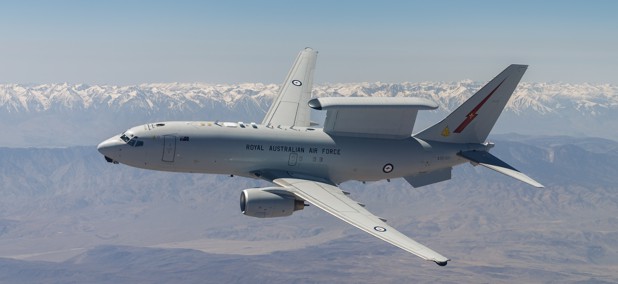
Funding for the Air Force’s new E-7 Wedgetail radar jet has been secured as part of a bipartisan agreement reached on Sunday evening, effectively ending the longest government shutdown in U.S. history. This agreement includes a nearly $200 million allocation for “continued rapid prototyping activities to maintain program schedule and transition to production” of the E-7 program. The funding is part of a 31-page continuing resolution that will finance the government through January 30, 2024.
Despite the funding, the military has expressed intentions to reduce support for the E-7 program. The inclusion of funding for the radar jet is significant as it continues a trend seen in the National Defense Authorization Act and various appropriations bills this summer. Senator Susan Collins, a Republican from Maine and chair of the Senate Appropriations Committee, emphasized the importance of this legislation, stating, “I look forward to voting for this legislation and ending the unnecessary harm to the security of our families and our nation.”
While procedural hurdles remain before the agreement is finalized, the inclusion of the E-7 funding represents a strategic victory for Boeing, the aircraft’s manufacturer. However, a Boeing spokesperson has not commented on the latest developments, and the Air Force did not respond to inquiries.
Congress’s ongoing support for the E-7 Wedgetail amid the shutdown contrasts with Defense Secretary Pete Hegseth’s earlier criticisms regarding the radar jet’s survivability. The Air Force’s budget request for 2026 includes plans to eliminate funding for the E-7, which was designed as a successor to the aging E-3 Sentry aircraft. Defense officials cited delays and cost overruns as reasons for reconsidering the program. Recent figures indicate that the projected costs for two test planes have escalated by $884 million, marking a 33 percent increase.
The decision to allocate funds for the E-7 suggests that lawmakers remain skeptical about the speed at which the U.S. Space Force can deploy its Airborne Moving-Target Indication (AMTI) systems. According to Todd Harrison, a defense budget expert at the American Enterprise Institute, this funding reflects a congressional strategy to hedge bets on airborne warning capabilities as opposed to investing solely in space-based alternatives. “If it passes, this is a big win for Boeing, and it shows that many in Congress still have doubts about how quickly the Space Force can deploy the AMTI system,” Harrison remarked.
In September, the British government announced plans to construct the two E-7 prototypes in the United Kingdom, further emphasizing the international collaboration surrounding this military technology. The E-7 program, initially projected to enhance the U.S. military’s aerial surveillance capabilities, now faces scrutiny as both financial and operational challenges continue to mount.
As the Senate and House of Representatives work on the remaining appropriation bills, the funding for the E-7 Wedgetail remains a focal point in discussions about the future of U.S. defense strategy. The outcome of these deliberations will be crucial in determining the viability of the E-7 program and the broader implications for military readiness.