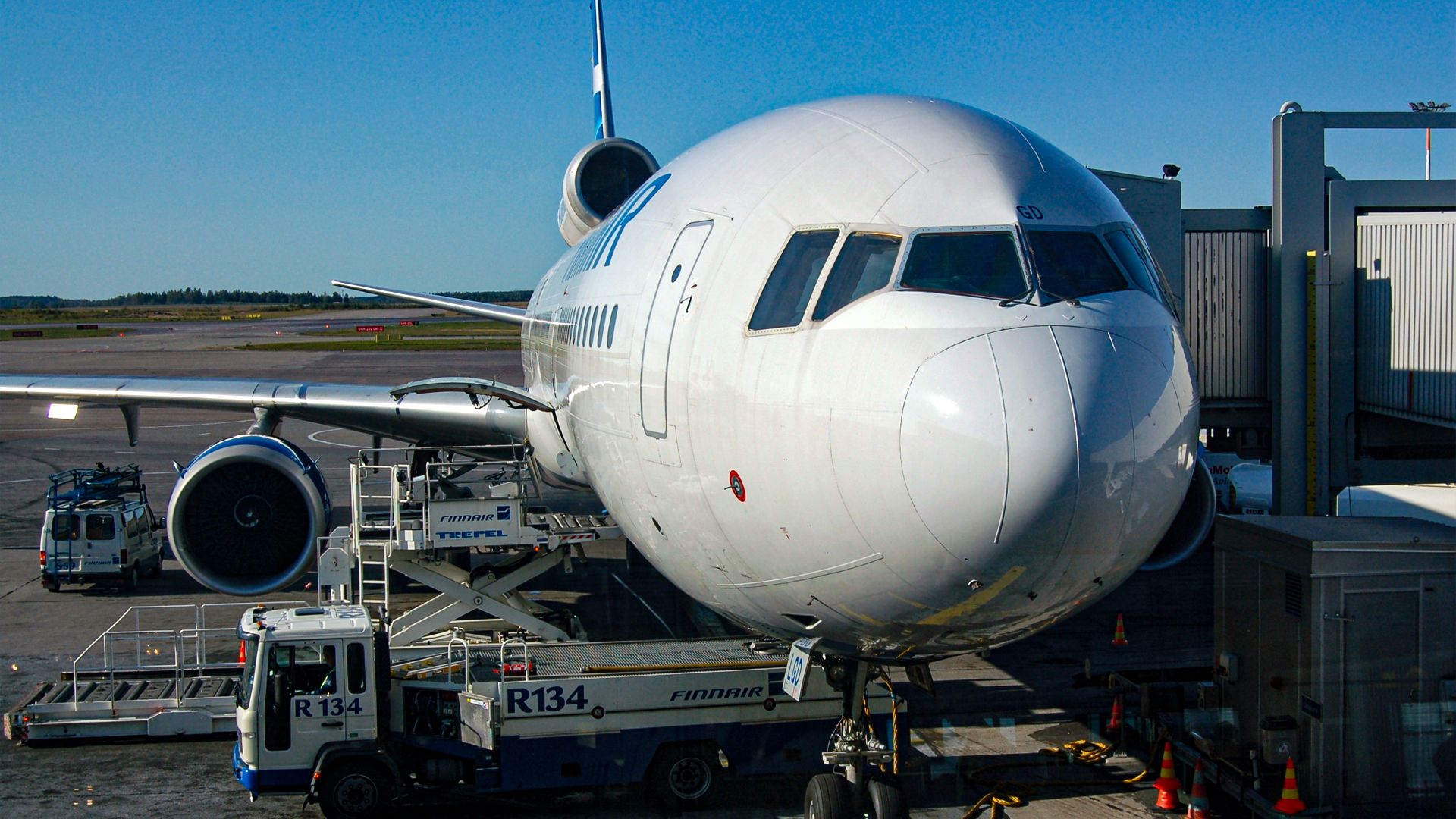
The McDonnell Douglas MD-11, an ambitious aircraft that aimed to revolutionize long-haul travel, ultimately saw only 200 units produced before its production ended in 2000. While it was designed as a modern successor to the DC-10, the MD-11 faced significant challenges in the competitive landscape of commercial aviation. Despite its advanced features and unique three-engine configuration, the aircraft struggled to achieve the success its manufacturer envisioned.
From DC-10 to MD-11: A Legacy Begins
The journey of the MD-11 begins with its predecessor, the DC-10, which made its debut in 1971. Developed by McDonnell Douglas to meet the growing demand for widebody aircraft, the DC-10 provided airlines with the flexibility to operate on medium- to long-haul routes. Its tri-engine design, featuring two engines under the wings and one at the tail, offered the performance needed for long-distance flights and positioned it as a popular choice for carriers worldwide.
However, by the 1980s, advancements in aviation technology began to outpace the capabilities of the DC-10. Airlines sought greater fuel efficiency and longer range, leading McDonnell Douglas to develop the MD-11. This new aircraft retained the DC-10’s tri-jet layout while incorporating significant aerodynamic and technological upgrades, such as a redesigned wing and a two-crew glass cockpit, which improved operational efficiency.
The MD-11 completed its first flight on January 10, 1990, and entered service later that year with Finnair as its launch customer. Despite initial enthusiasm, the aircraft faced stiff competition from more fuel-efficient twin-engine widebodies, which began to dominate the long-haul market.
Production and Commercial Challenges
MD-11 production took place at McDonnell Douglas’s facility in Long Beach, California, where the previous DC-10 had been manufactured. The early 1990s saw a strong start for the aircraft, with passenger variants initially making up the majority of deliveries. However, as the decade progressed, market preferences shifted toward twin-engine models like the Boeing 777 and Airbus A330, which offered similar range capabilities at lower operating costs.
The MD-11 was unable to meet the performance expectations set by McDonnell Douglas. It often burned more fuel than advertised, which led to higher operational costs for airlines. As a result, many carriers, including Delta Air Lines and American Airlines, phased out their MD-11 fleets in favor of more efficient models. The aircraft’s commercial struggles were further exacerbated by the 1997 merger of Boeing and McDonnell Douglas, which left the MD-11 outside of Boeing’s core strategy.
Despite the challenges in passenger service, the MD-11 found a renewed purpose in cargo operations. Many of the aircraft were converted to freighters, and companies like FedEx Express and UPS Airlines utilized the MD-11F for its long-range capabilities and substantial payload capacity. The freighter version became one of the most recognizable in the industry.
The MD-11’s freight operations faced a significant setback following a tragic incident on November 4, 2025, when a UPS-operated MD-11F crashed shortly after takeoff from Louisville Muhammad Ali International Airport, resulting in the loss of 14 lives. In response, the Federal Aviation Administration (FAA) grounded all MD-11 aircraft for safety inspections, prompting UPS to retire its entire fleet by January 2026.
Ultimately, while the MD-11 did not achieve the commercial success of its predecessors or successors, its impact on aviation remains significant. The aircraft introduced innovations that shaped the future of both passenger and cargo operations, marking it as a distinct part of aviation history. The legacy of the MD-11 continues to resonate, serving as a reminder of the complexities and challenges of evolving air travel.