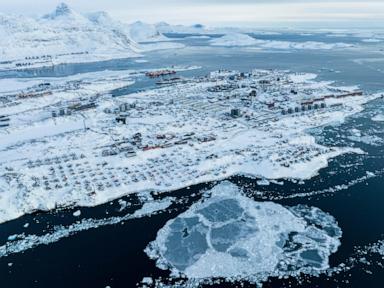
Denmark is preparing for an important meeting with the United States next week to discuss President Donald Trump’s renewed interest in Greenland, the strategically significant and mineral-rich Arctic island. Danish Defense Minister Troels Lund Poulsen emphasized the significance of this dialogue, stating, “This is the dialogue that is needed, as requested by the government together with the Greenlandic government,” during an interview with Danish broadcaster DR.
The meeting was confirmed by U.S. Secretary of State Marco Rubio, who did not disclose specific details about timing or participants but assured that discussions regarding Greenland would take place. “I’m not here to talk about Denmark or military intervention. I’ll be meeting with them next week, we’ll have those conversations with them then,” Rubio informed reporters at Capitol Hill.
Greenland’s government has expressed its intent to participate actively in these discussions. Vivian Motzfeldt, Greenland’s Foreign Minister, stated, “Nothing about Greenland without Greenland. Of course we will be there. We are the ones who requested the meeting.” The island, which is predominantly inhabited by around 56,000 Inuit people, plays a pivotal role in Arctic geopolitics.
U.S. Vice President JD Vance highlighted the perceived inadequacies of Denmark’s management of Greenland, stating that Trump “is willing to go as far as he has to” to safeguard American interests in the Arctic. Vance reiterated Trump’s claims that Greenland is crucial to U.S. national security, asserting that “the entire missile defense infrastructure is partially dependent on Greenland.” He added, “Just because you did something smart 25 years ago doesn’t mean you can’t do something dumb now,” referring to Denmark’s historical military alliance with the U.S.
The discussions come in the wake of growing tensions over Greenland’s sovereignty. Antonio Costa, President of the European Council, reinforced the idea that “Greenland belongs to its people,” emphasizing that decisions involving Denmark and Greenland cannot occur without their consent. Costa asserted, “They have the full solid support and solidarity of the European Union.”
In solidarity with Denmark, leaders from Canada, France, Germany, Italy, Poland, Spain, and the United Kingdom joined Prime Minister Mette Frederiksen in defending Greenland’s sovereignty after Trump’s recent comments. The growing focus on Greenland coincides with a historical context; Danish Foreign Minister Lars Løkke Rasmussen previously published a video outlining the 1951 defense agreement between Denmark and the U.S., highlighting the reduced American military presence on the island over the decades.
Currently, the American military presence in Greenland has dwindled from thousands of soldiers at 17 bases to approximately 200 soldiers stationed at the remote Pituffik Space Base. This base is integral to U.S. and NATO operations, including missile warning and space surveillance. Rasmussen noted that the 1951 agreement “offers ample opportunity for the United States to have a much stronger military presence in Greenland,” urging open discussions about this potential.
In recent developments, Denmark’s parliament passed legislation allowing for U.S. military bases on Danish soil, expanding a previous agreement made with the Biden administration. This legislation enables U.S. troops broader access to Danish air bases, reflecting Denmark’s commitment to enhancing its military capabilities in the Arctic region. Last year, the Danish government announced a 14.6 billion-kroner (approximately $2.3 billion) agreement aimed at improving surveillance capabilities and maintaining sovereignty in the North Atlantic.
The plan entails acquiring three new Arctic naval vessels, two long-range surveillance drones, and enhanced satellite capacity. Denmark’s Joint Arctic Command, headquartered in Nuuk, is responsible for the surveillance and military defense of both Greenland and the Faroe Islands, underscoring the strategic importance of these territories.
As the meeting approaches, the focus remains on maintaining a collaborative approach to Greenland’s future, ensuring that its people are central to any discussions regarding their land. The outcome of this dialogue may have significant implications for the geopolitical landscape in the Arctic and beyond.