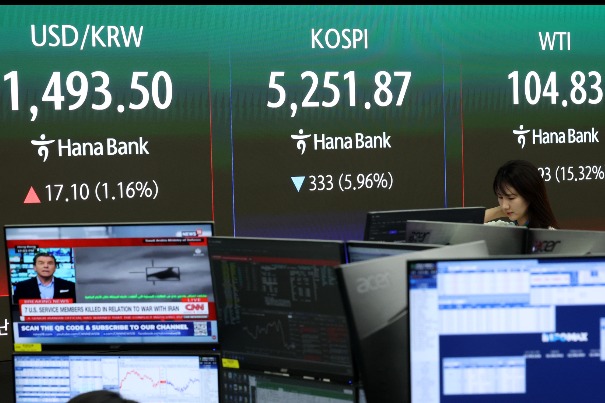
URGENT UPDATE: South Korean stocks are in freefall as the Kospi index plummeted more than 8% on Monday, March 9, 2023, triggering a 20-minute trading halt amid rising oil prices and escalating tensions in the Middle East. The benchmark index closed down 6% at 5,251.87 after briefly dipping below 5,100, while the tech-heavy Kosdaq fell 4.5% to 1,102.28.
Investors are fleeing risk assets as the price of West Texas Intermediate crude surged nearly 26% to $114.49 per barrel, the highest level since July 2022. This spike is linked to fears surrounding the ongoing US-Israel-Iran conflict, raising concerns over the stability of oil supply routes critical to South Korea’s energy-dependent economy.
“Given South Korea’s heavy dependence on energy imports from the Middle East, a spike in oil prices amid a closure of the Strait of Hormuz could intensify risk-averse sentiment,” warned Lee Sung-hoon, an analyst at Kiwoom Securities Co. As of 9 a.m. local time, average gasoline prices in South Korea rose to 1,897.7 won per liter, further straining consumers.
The Korean won also weakened significantly, trading at 1,495.50 per dollar, nearing the psychologically important 1,500 level. This marks its lowest value since March 12, 2009, during the global financial crisis. Foreign investors led the market’s retreat, dumping a net 3.2 trillion won (approximately $2.1 billion) of shares, while institutions sold 1.5 trillion won.
The selloff affected major corporations, with notable losses among key players:
– SK Hynix Inc.: down 9.5%
– Hyundai Motor Co.: down 8.3%
– Samsung Electronics Co.: down 7.8%
The broader implications of this market crash extend beyond South Korea. On the global stage, the Dow Jones Industrial Average fell over 400 points last Friday, with the S&P 500 and Nasdaq also closing down as investors reacted to surging oil prices and poor US labor data.
Analysts are divided on the outlook for Korean equities. While some argue that the sharp decline has pushed the market into a deep-value zone, others caution that the market may face continued volatility due to external pressures. “In past episodes of sharp market declines, a V-shaped rebound has been rare,” noted Lee Eun-taek of KB Securities Co.
As the situation develops, investors are urged to stay vigilant. The potential for further swings in oil prices linked to geopolitical tensions could lead to more turbulence in the stock markets.
Stay tuned for further updates as this situation unfolds.