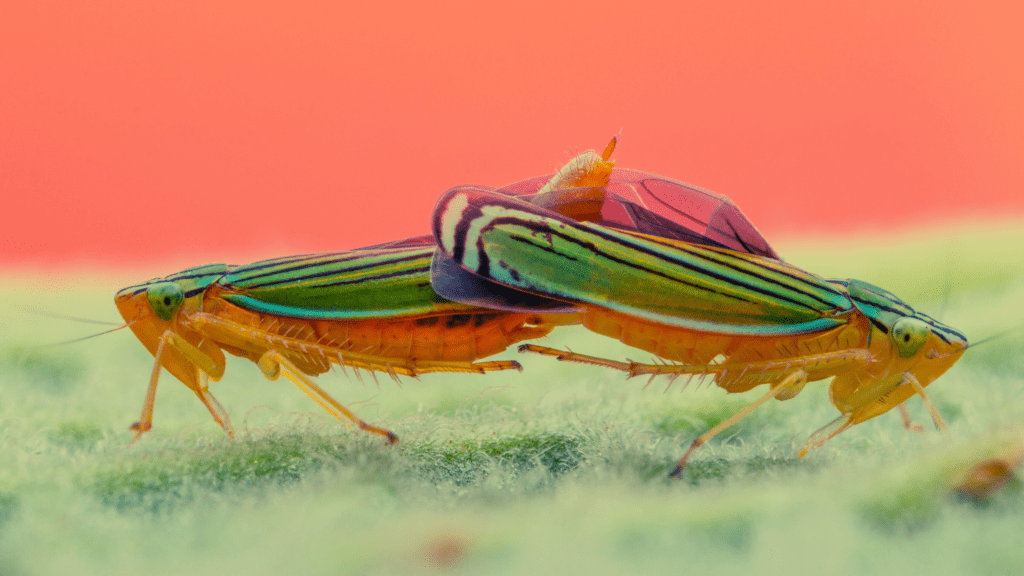
BREAKING: Scientists at Penn State University have successfully replicated the remarkable ability of leafhoppers to become nearly invisible by mimicking their natural camouflage techniques. This urgent development was detailed in a new study published in ACS Nano and signifies a potential breakthrough in multiple industries.
Leafhoppers, small green insects often unnoticed by the naked eye, utilize microscopic particles on their bodies to drastically reduce glare, making them difficult for predators to detect. The researchers found that these particles can cut reflected light by an astonishing 80 to 96 percent, enhancing their ‘invisibility.’
The Penn State team engineered tiny hollow particles known as brochosomes, which are naturally produced by leafhoppers. In their lab, they developed a cutting-edge microfluidic system capable of producing over 100,000 particles per second. This rapid production rate could revolutionize nanoscale manufacturing and open doors to practical applications beyond the laboratory.
By utilizing a unique chemical approach, researchers were able to create these brochosomes with precise patterns that mimic those found in nature. Some designs reflect the intricate pentagon and hexagon shapes seen in actual leafhoppers, while others incorporate circular openings. The study successfully recreated five distinct designs, each measuring between a few hundred nanometers up to about two micrometers.
The implications of this research are profound. Potential applications could include advancements in energy devices with surfaces that reflect less light, improved optical materials for glare control, and even military camouflage. While the researchers acknowledge that more testing is needed for practical uses, the possibilities are exciting.
Moreover, the study hints at potential biomedical applications, such as drug delivery systems utilizing the unique shape and surface properties of the particles. However, this aspect remains in the exploratory phase.
What makes this development particularly compelling is the ordinary source of inspiration: a common backyard insect. The leafhopper’s evolutionary adaptation to manage light has now sparked innovative research capable of changing various scientific fields.
As this story unfolds, the scientific community eagerly anticipates how these findings will be implemented in real-world applications. The rapid pace of particle production and the versatility of the designs suggest a transformative impact across technology and medicine.
Stay tuned for more updates on this groundbreaking research and its potential effects on industries worldwide.