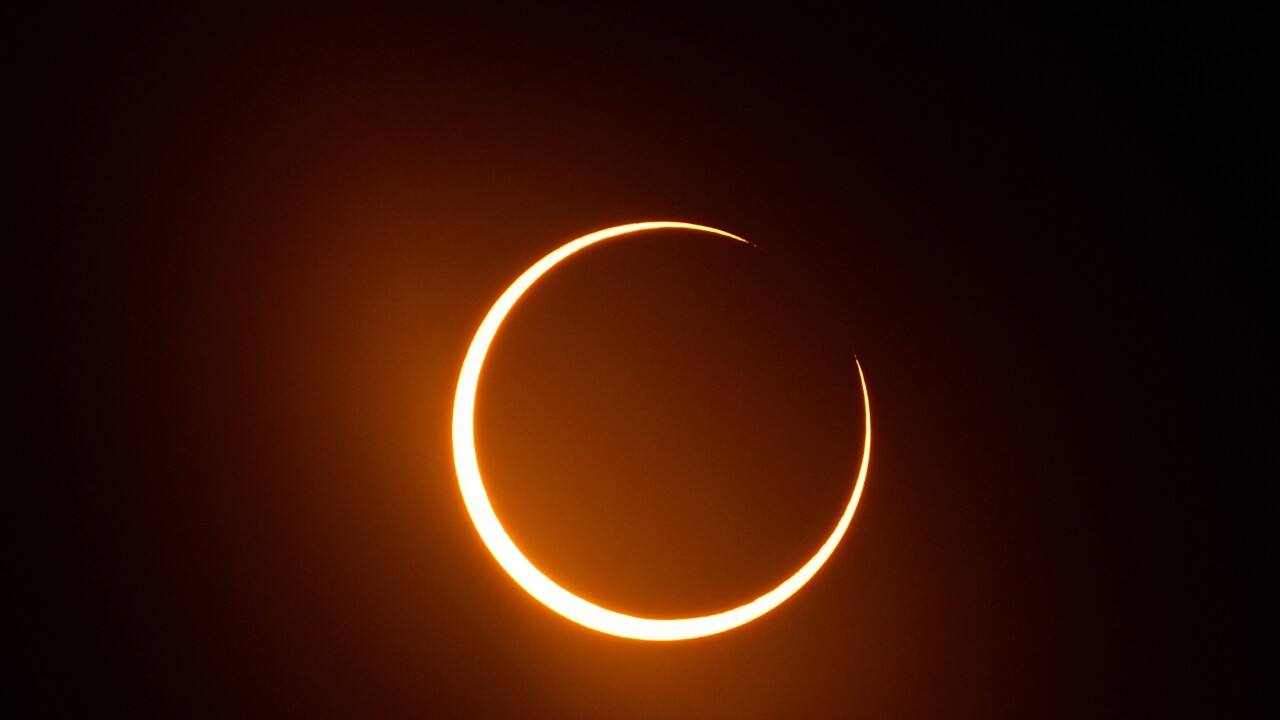
A rare astronomical event will unfold on Tuesday when an annular solar eclipse, commonly referred to as a “ring of fire,” will be visible in Antarctica. This unique phenomenon occurs when the moon is positioned farther away from Earth in its orbit, allowing only a thin ring of sunlight to remain visible around the moon.
According to Joe Llama, an astronomer at the Lowell Observatory, the spectacle promises to be a remarkable experience for wildlife in the region, particularly the local penguin population. “The penguins down there are going to have a great show,” he remarked, highlighting the intersection of nature and celestial events.
While the annular eclipse will be most prominently visible in Antarctica, observers in parts of South America, specifically the southern tips of Chile and Argentina, will also be able to witness a partial eclipse. Portions of southeastern Africa, including Madagascar, Lesotho, and South Africa, will see the moon take smaller bites out of the sun.
Understanding the Eclipse
Solar eclipses occur when the sun, moon, and Earth align perfectly, with the moon casting a shadow on Earth that can either partially or completely block sunlight. Astrophysicist Emily Rice from the City University of New York explained the rarity of such events, stating, “It’s this beautiful coincidence between the size and the distance of the moon and the sun.”
During an annular eclipse, the moon does not completely obscure the sun. Instead, the visible portion of the sun appears as a bright ring surrounding the moon, hence the term “ring of fire.” This phenomenon is distinct from total solar eclipses, which occur when the moon completely covers the sun.
Safety Precautions and Future Eclipses
Solar eclipses, while visually stunning, pose risks to observers who may look directly at the sun. To ensure safety during the eclipse, it is essential to use specially designed eclipse glasses. These glasses block harmful ultraviolet light and nearly all visible light, offering protection that regular sunglasses and binoculars cannot provide. Proper eclipse glasses should comply with ISO 12312-2 standards.
In addition to viewing the eclipse directly, there are alternative methods to enjoy the spectacle indirectly. Creating a pinhole projector from everyday materials or using a colander or cheese grater to view images projected onto the ground are simple yet effective techniques.
Looking ahead, another significant solar event is scheduled for August 2024, when a total solar eclipse will be observable from regions including Greenland, Iceland, parts of Spain, Russia, and parts of Portugal. During this event, many countries in Europe, Africa, and North America will experience a partial eclipse, allowing a broader audience to participate in this celestial celebration.
As the excitement builds for this week’s annular eclipse, both nature enthusiasts and seasoned astronomers alike will have their eyes turned towards the sky, ready to witness a stunning display of cosmic alignment.