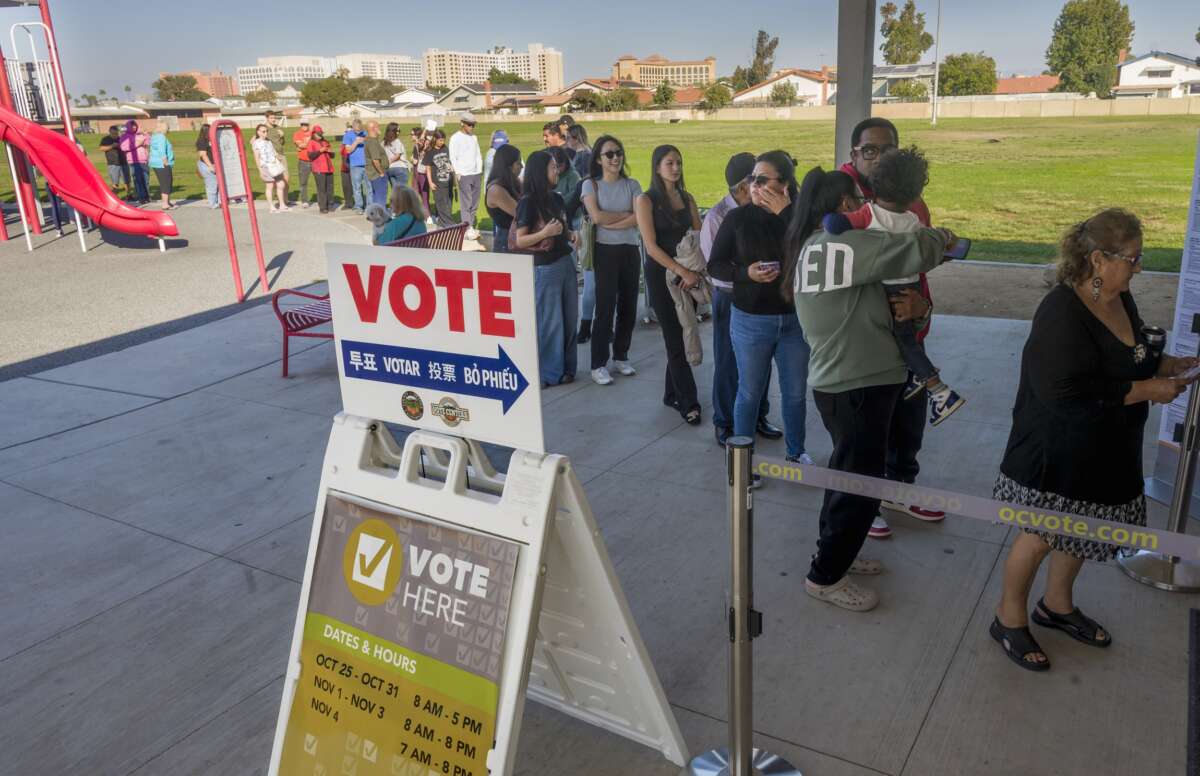
UPDATE: California Republicans have launched an urgent lawsuit just hours after voters overwhelmingly supported Proposition 50, a ballot initiative aimed at curbing Republican gerrymandering. The initiative passed on October 22, 2025, with 63.8% of the vote, allowing Democrats to potentially gain five additional seats in the House of Representatives by redrawing district maps ahead of the 2026 midterm elections.
The lawsuit targets California Governor Gavin Newsom and Secretary of State Shirley Weber, alleging that the new maps violate the 14th and 15th Amendments of the U.S. Constitution. This legal challenge, filed in federal court, claims that the redistricting process unfairly advantages Latinx voters, a move critics argue is an attempt to undermine the voter-supported measure.
In an unprecedented response to the growing Republican gerrymandering efforts nationwide, Newsom championed Proposition 50 to ensure fair representation. The initiative temporarily suspends California’s independent redistricting commission, aiming to counteract what many view as a political strategy by the GOP to retain control in Congress.
With more than 6 million ballots counted, the significant voter support indicates a public mandate for change. Republican plaintiffs, including Assemblymember David Tangipa and attorney Mike Columbo, who is associated with Republican activist Harmeet Dhillon, argue that the initiative could skew electoral outcomes in favor of Democrats.
In response to the lawsuit, Newsom’s office expressed confidence in the legality of the new maps. A spokesperson remarked, “If it’s from the California Republican Party and Harmeet Dhillon’s law firm, it’s going to fail.” Legal experts agree that the plaintiffs face a tough uphill battle. Harvard law professor Nicholas Stephanopoulos stated, “If there’s a properly adopted map and there’s some uncertainty over the law, typically the map will stay in effect.”
The stakes are high; the Supreme Court is currently deliberating a case concerning Section 2 of the Voting Rights Act, which could dramatically impact redistricting efforts across the nation. If the court were to rule against this section, it could jeopardize not only California’s new maps but also the political landscape in Republican-controlled states.
The implications of this legal battle extend far beyond California. Experts warn that a ruling against Section 2 could lead to the dismantling of Black-majority districts in states across the South, potentially disenfranchising millions of voters.
As the situation develops, all eyes will be on how the court responds and what this means for future elections. Will California’s new map hold up against legal scrutiny? The outcome could reshape the balance of power in Congress and set a precedent for gerrymandering battles nationwide.
Stay tuned for ongoing updates as this urgent legal challenge unfolds.