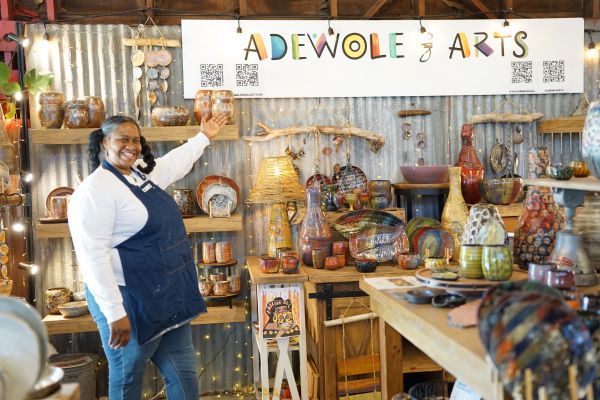
February is a month filled with celebrations and tributes to Black history, but for many Black entrepreneurs, it often highlights a stark contrast between corporate allyship and actual community support. April Adewole, a pottery artist based in San Pedro, California, exemplifies the challenges and opportunities faced by Black-owned businesses during this month.
Amid the corporate marketing campaigns that proliferate during Black History Month, Adewole’s experience reflects a broader narrative of resilience and self-determination. For her, this month brings visibility, but it does not equate to meaningful change within the community she serves. Adewole has spent over 15 years honing her craft, starting her journey at Long Beach Community College and later teaching pottery at various local centers before establishing her studio at Crafted, a shared marketplace in San Pedro.
At Crafted, Adewole teaches workshops and sells her functional stoneware, often attracting a crowd eager to learn and engage with her work. “I feel like Black History Month is a time where I have more eyes on me because I’m Black,” she noted. Yet, she has observed that the month often passes without a significant increase in engagement specific to its purpose.
This year marked a notable shift, as Adewole observed an increase in Black vendors at Crafted. She initiated a collective presence for Black History Month, fostering conversations about the cultural impact of Black creators and the historical significance of Black entrepreneurship in San Pedro. “This is actually the first year we’ve had an influx of Black businesses here at Crafted,” she explained.
While institutions may fall short in their support, Adewole demonstrates how Black communities can create their own opportunities. Her work at Crafted is not just about visibility; it embodies a commitment to building a robust local economy and mentoring future generations. “As a solo Black entrepreneur, it can be difficult to access opportunities or be included in broader conversations about local business and culture,” she said.
The programming surrounding Black History Month often emphasizes individual accomplishments while neglecting structural issues such as local hiring practices and access to capital. Adewole’s approach counters this trend by emphasizing consistent, year-round contributions rather than fleeting recognition. Her workshops and collaborations are not limited to February; they represent an ongoing commitment to her craft and community.
Recognition can often feel transient, leaving many to question its impact. Adewole’s determination to maintain her studio and continue engaging with her community speaks volumes about the spirit of entrepreneurship among Black creatives. “What matters is that the studio stays open, the community keeps gathering, and the economy keeps moving through my hands,” she asserted.
The current landscape raises questions about the true purpose of Black History Month. Adewole offers a nuanced perspective: “For Black people, when we go to the movies, we don’t go saying we’re going to go see a white movie, we’re just going to see a movie,” she explained. This highlights the ongoing need for representation in various sectors, including business. Until systemic biases in hiring and investment are addressed, February remains a vital platform for recognition, albeit one that is imperfect and often performative.
In conclusion, while corporate initiatives during Black History Month may serve as a form of recognition, they often lack the substantive change needed to uplift Black communities. Entrepreneurs like April Adewole are redefining what it means to celebrate Black history by actively engaging and contributing to their communities every day of the year. Her story is a reminder that real change happens not just in recognition but in the consistent effort to build and support local economies.