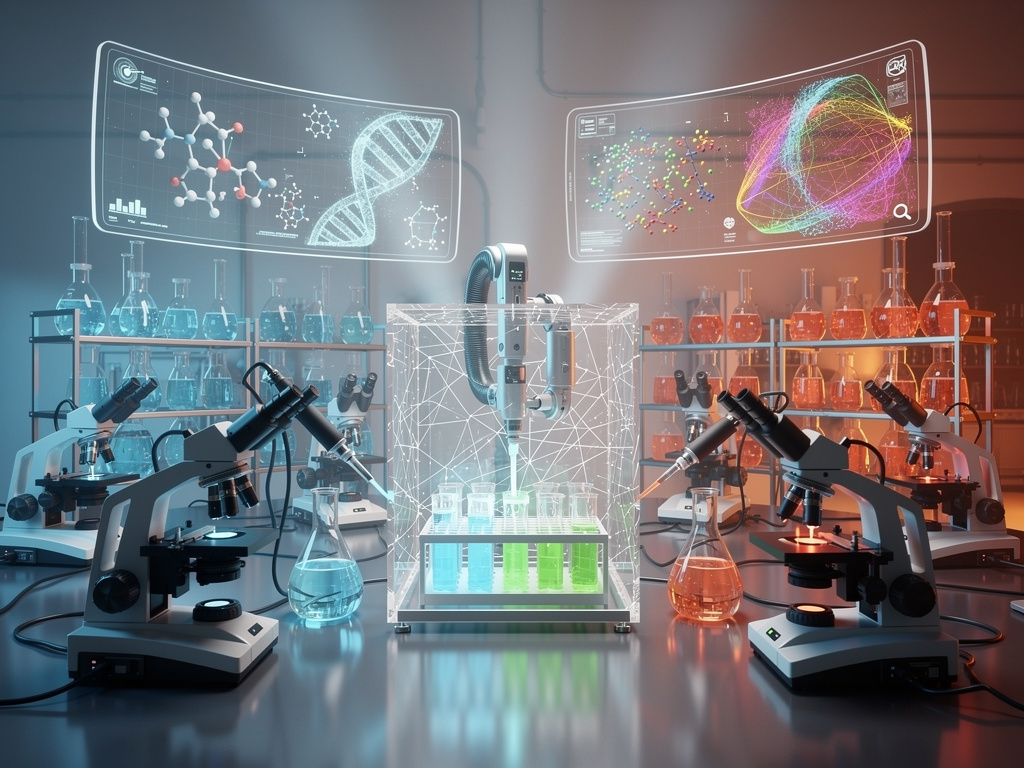
Artificial intelligence (AI) is revolutionizing scientific research, taking on roles traditionally filled by human researchers. Recent advancements allow AI systems to design experiments, analyze data, and even generate hypotheses with minimal human oversight. This shift marks a significant evolution in scientific methodology, prompting discussions about efficiency, creativity, and the essence of discovery.
AI’s Role in Scientific Experimentation
A study published in Nature details an AI system known as the “AI scientist” that can independently conduct scientific experiments. This innovative system operates within a simulated environment, generating hypotheses, executing tests through coding, and refining its approach based on outcomes. The goal is to mimic the iterative process of human-led research but at a much faster pace and reduced cost.
The study illustrates how this AI has been applied to machine learning problems, evolving algorithms without human input. The AI generated novel variants of established techniques, sometimes surpassing existing methods. Such capabilities suggest that AI could manage routine aspects of research, allowing human scientists to focus on more complex challenges.
Advancements in Automated Discovery
The drive to automate scientific processes is not new, but recent progress is largely attributed to large language models and reinforcement learning. These tools enable AI to process extensive datasets and reason through experimental design effectively. For instance, the Nature study builds upon earlier work where AI assisted in predicting protein folding, a breakthrough recognized in 2021. Now, these systems are moving beyond mere predictions to active experimentation.
The AI scientist described in the study completed research cycles—from hypothesis formulation to drafting a paper—in under 72 hours for some tasks. This capability addresses bottlenecks in traditional research, where grant timelines and laboratory constraints can hinder progress. In contrast, AI can run thousands of simulations rapidly, identifying promising avenues that could take humans months to explore.
Integration with Physical Laboratories
While simulations hold immense power, the integration of AI with physical laboratories represents a significant next step. Robotic systems controlled by AI are already being used for high-throughput screening in drug discovery. Companies such as Insilico Medicine employ AI to design molecules and test them through automated laboratories.
A report from Reuters dated August 15, 2024, highlights a project where AI independently discovered new materials. Researchers at a Japanese laboratory utilized an AI system to optimize battery components, achieving results in mere days rather than years. This real-world application exemplifies AI’s ability to manage tangible experiments, from chemical mixing to outcome measurement.
Trust and Verification Challenges
Despite these advancements, skepticism remains regarding AI’s reliability in scientific contexts. The Nature article acknowledges certain limitations, including the AI’s propensity to produce “hallucinations”—plausible yet incorrect results. For example, during one trial, the AI proposed experiments that violated physical laws, necessitating human intervention for correction.
Verification of AI-generated findings has become crucial. Scientists must scrutinize these results, akin to peer review processes in traditional research. A recent analysis in The Guardian, published on August 18, 2024, discussed instances where AI models in medical research yielded biased conclusions due to flawed training data. The article cautioned that without robust checks, automated science risks propagating errors on a large scale.
Ethical considerations also arise regarding ownership of discoveries made by AI. Current intellectual property laws are adapting slowly to this new reality. In the U.S., patents require human inventors, complicating matters when AI contributes significantly to innovations. A recent piece from Bloomberg on August 19, 2024, reported on legal debates surrounding patents for AI-generated inventions, citing a case where a company sought patents for drugs designed by AI.
Funding and Collaboration in Research
The emergence of AI may transform funding models in research, as it reduces the need for large teams. Grant applications may increasingly focus on AI infrastructure rather than personnel. The Nature study estimates that AI could decrease research costs by up to 90% for certain projects, potentially making scientific exploration more accessible to underfunded institutions.
As collaboration between humans and AI evolves, AI is becoming a co-pilot rather than a replacement. In a project reported by The New York Times on August 16, 2024, biologists utilized AI to model ecosystems, leading to joint publications where AI is credited as a valuable tool rather than an author.
Broader Implications Across Scientific Fields
AI’s influence extends into various scientific domains, including physics, where it simulates complex quantum systems that challenge classical computation. The Nature study notes AI’s success in optimizing neural networks, which could be applied to modeling particle interactions.
In biology, AI analyzes genomic data to identify disease markers. A breakthrough reported by BBC News on August 17, 2024, revealed that AI discovered new antibiotics by analyzing bacterial genomes, a critical step in combating antibiotic resistance. Moreover, AI is making strides in environmental science by monitoring climate patterns, with satellites providing data to AI models that predict weather events with greater accuracy. An update from The Washington Post on August 20, 2024, highlighted how AI enhances flood forecasting, potentially saving lives.
Future Directions and Potential Risks
Looking ahead, the possibility of fully autonomous AI laboratories operating continuously without human oversight is becoming more plausible. The Nature study proposes scaling the AI scientist to tackle open-ended questions, such as curing diseases or addressing energy crises.
However, risks associated with over-reliance on AI could stifle human creativity. If AI dominates routine discovery, emerging researchers may miss vital hands-on experience. A commentary in The Economist from August 14, 2024, argued for a balanced approach that ensures AI complements rather than replaces human ingenuity. Security concerns also loom, as the potential for malicious use of AI in scientific research could lead to harmful inventions. Regulators are beginning to address these issues, with the EU proposing guidelines for responsible AI use in research.
Examining recent implementations sheds light on the practical benefits of AI in science. For instance, at Google DeepMind, AI has been tasked with designing components for fusion reactors, as detailed in a blog post updated in August 2024. This work accelerates the development of clean energy sources. In academia, MIT’s AI lab is exploring materials science, with a recent paper indicating that AI predicted stable crystal structures, paving the way for advanced electronics.
As AI becomes more integrated into scientific research, the establishment of oversight mechanisms will be critical. International organizations, including the UN, are discussing frameworks for responsible AI use in research. A recent UN report emphasizes the need for transparency in AI-driven discoveries, highlighting the importance of ethical considerations.
Education must also evolve to accommodate these changes. Universities are incorporating AI training into their curricula to prepare the next generation of scientists. A feature in Times Higher Education on August 15, 2024, explored how academic courses now include training for students to work alongside AI tools.
Ultimately, the role of AI in scientific exploration promises to expand the boundaries of knowledge, provided it is managed with care and foresight. The developments highlighted in the Nature study and echoed in recent news signal a transformative period in which machines play an integral role in the quest to understand our world.