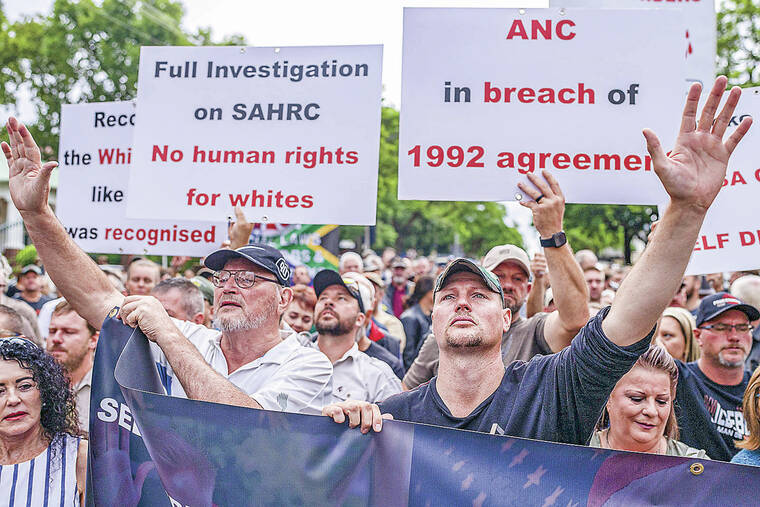
UPDATE: Afrikaners are experiencing a surge in engagement with U.S. officials as the Trump administration pivots its foreign policy towards South Africa, creating unprecedented access for this historically marginalized group.
In a striking shift, prominent Afrikaner leaders including Theo de Jager recently met with officials from Vice President JD Vance’s office, marking a significant change from previous U.S. administrations. De Jager expressed surprise at the warm reception during their visit to Washington, where he discussed the plight of Afrikaners in South Africa, a topic that had received little attention in the past.
Since President Donald Trump took office this year, he has enacted sweeping changes that directly impact U.S.-South Africa relations. These include halting U.S. aid to South Africa, imposing 30% tariffs on South African imports, and declaring the country unwelcome at the upcoming Group of 20 summit in Florida next year. Trump has cited the alleged persecution of Afrikaners as justification for these actions, inaccurately claiming they face genocide.
The administration’s shift has allowed Afrikaners to engage with U.S. diplomats as never before. They are now invited to social gatherings and receive direct feedback on U.S. policies affecting their community. The U.S. Embassy in Pretoria has even begun sharing social media posts in Afrikaans, further indicating the administration’s commitment to this demographic.
“The extent of our access and engagement has increased tremendously in the past 10 months,” stated Jaco Kleynhans, an official with the Solidarity Movement, an Afrikaner rights organization. Kleynhans reported weekly conversations with U.S. officials, discussing critical issues such as farm killings and trade tariffs.
Former U.S. Ambassador to South Africa, Patrick Gaspard, remarked on the astonishing rise of Afrikaners in U.S. diplomatic circles. “During my term, Afrikaner organizations were marginal actors with no real sway,” he said. “Now, they are receiving significant attention.”
This newfound popularity has sparked controversy back in South Africa, with some lawmakers calling for investigations into Afrikaner organizations for treason, accusing them of spreading misinformation detrimental to U.S.-South Africa relations.
Despite historical reluctance from foreign missions to engage openly with Afrikaners, the Trump administration appears unbothered by potential backlash. “The U.S. is currently interested in distancing itself from South Africa due to its ties with countries considered adversaries, such as Iran,” noted Kallie Kriel, CEO of AfriForum.
The annual Independence Day celebration at the U.S. Embassy in Pretoria featured a larger-than-usual attendance of Afrikaners, further illustrating their elevated status. Gerhard Papenfus, an Afrikaner business leader, attended for the first time this year and praised the administration’s outreach. “Here’s an administration that reaches out and says, ‘We hear you,’” he stated.
Afrikaners are not barred from U.S. Embassy events, but the current level of interest from the Trump administration has taken many by surprise. De Jager recalled a recent encounter with a U.S. diplomat who recognized him from an open letter he wrote to Trump regarding the new refugee status for Afrikaners. “It’s good to see that at least somebody in the embassy read it,” he quipped.
With tensions rising in South Africa over this newfound influence, the situation is evolving rapidly, and the implications for U.S.-South Africa relations remain to be seen. As Afrikaners gain more visibility in the U.S. political arena, observers are keenly watching how this will affect both domestic and international dynamics.
Stay tuned for more updates on this developing story as Afrikaners navigate their increasing prominence in U.S. foreign policy discussions.