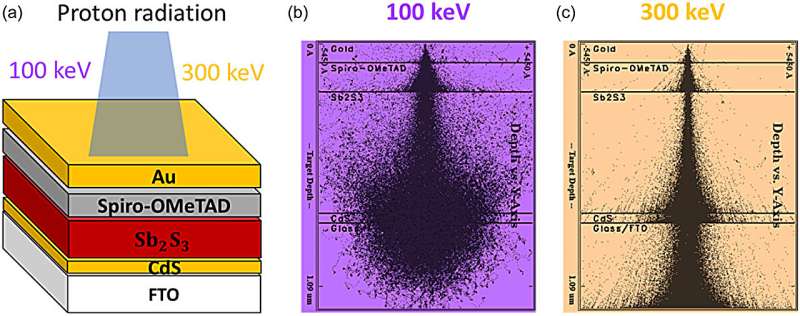
Physicists at the University of Toledo are advancing solar cell technology specifically designed for deployment in outer space. This initiative is part of a large-scale research project supported by the Air Force Research Laboratory. The team aims to address the significant challenges faced by solar cells in space, where extreme environmental conditions can severely limit their efficiency and lifespan.
One recent breakthrough involves the use of antimony compounds as light-absorbing semiconductors. Researchers from the Wright Center for Photovoltaics Innovation and Commercialization at the university recently published an assessment in the journal Solar RRL. This study, which has been recognized on the journal’s front cover, evaluates the potential of antimony chalcogenide-based solar cells for space applications.
Alisha Adhikari, a doctoral student in physics and co-leader of the research team, stated, “Antimony chalcogenide solar cells exhibit superior radiation robustness compared to the conventional technologies we’re deploying in space. But they’ll need to become much more efficient before they become a competitive alternative for future space missions.”
The research team, led by Dr. Randall Ellingson, a professor in the Department of Physics and Astronomy, is committed to exploring innovative strategies to harness solar energy under the extreme conditions encountered in space. These conditions include high particle radiation and drastic temperature fluctuations.
In addition to Adhikari, the research team includes postdoctoral researcher Dr. Vijay Karade, doctoral student Scott Lambright, as well as Dr. Yanfa Yan and Dr. Zhaoning Song. Their collective efforts reflect a growing interest in antimony compounds as essential materials for developing more resilient solar cells.
The findings from this research highlight the urgent need for advancements in solar technology as space missions become increasingly ambitious. As humanity aims to explore beyond Earth, the role of robust and efficient solar cells will be critical in ensuring sustainable energy sources in the cosmos.
The study titled “Assessing Proton Radiation Hardness of Antimony Chalcogenide Solar Cells” was published in Solar RRL in 2025, with the DOI: 10.1002/solr.202500699, showcasing the promising future of solar energy in outer space.