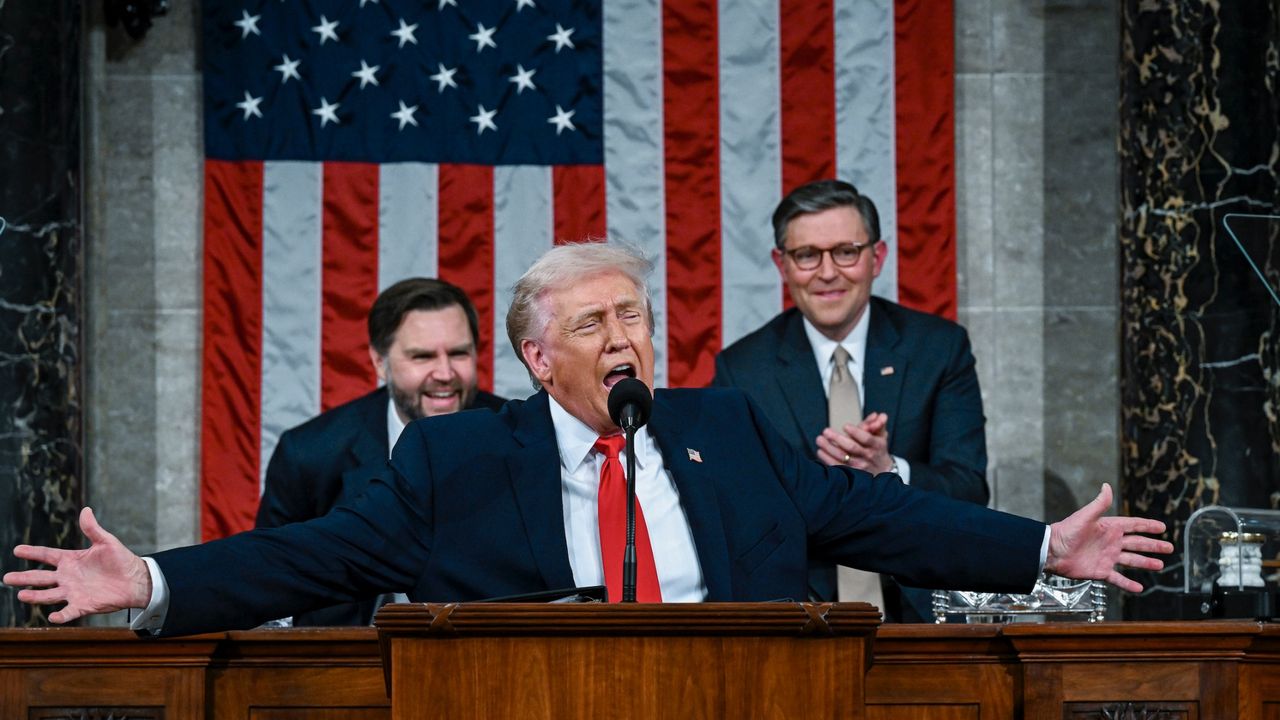
President Donald Trump delivered the longest State of the Union address in recorded history on February 24, 2024, lasting over 107 minutes. While the speech highlighted the United States’ leadership role on the global stage, it notably skipped mentioning the upcoming NASA Artemis 2 mission, which is poised to be America’s first crewed lunar flight in over half a century.
During the address, Trump emphasized the significance of the U.S. Space Force, a military branch he established in December 2019. He stated, “The Space Force is my baby, because we did that. My baby’s becoming so important.” This declaration came approximately 90 minutes into the speech, as he praised the military’s evolving capabilities. The Space Force played a role in recent military operations, including the capture of Venezuelan President Nicolas Maduro as part of Operation Absolute Resolve.
Despite the Space Force’s prominence in Trump’s remarks, the Artemis 2 astronauts—Reid Wiseman, Victor Glover, Christina Koch, and Jeremy Hansen of the Canadian Space Agency—attended the event as guests of Mike Johnson, Speaker of the House of Representatives. Their presence was a poignant reminder of the missed opportunity to highlight the Artemis program, which aims to launch four astronauts around the moon as soon as April 1, 2024.
The absence of a mention for Artemis 2 was surprising, given the program’s significance. The mission will mark the first crewed flight beyond low Earth orbit since Apollo 17 in 1972. The Artemis program was initiated during Trump’s first term, with aspirations for astronauts to land on the moon by late 2024. However, multiple delays have hindered progress, including a recent issue with the Space Launch System rocket that has postponed the launch date.
Trump’s speech touched upon the broader accomplishments of the United States, stating, “Together, we mastered the world’s mightiest industries… and we launched mankind into the stars on rockets powered by sheer American will.” While the president celebrated the nation’s achievements, the omission of Artemis 2 was felt by space enthusiasts and industry observers alike.
NASA had initially planned for Artemis 2 to launch on March 6, but due to technical difficulties, the rocket will be rolled back for troubleshooting on February 25. This setback pushes the anticipated launch back to April at the earliest, creating uncertainty around the timeline.
The Artemis 2 crew, which entered quarantine on February 21 in preparation for the flight, garnered limited attention during the address. The only astronaut visibly featured in media coverage of the speech was U.S. Senator Mark Kelly, a former NASA astronaut who has recently faced censure from the Trump administration for his participation in a video advising military personnel against illegal orders.
In comparison, last year’s State of the Union featured a more expansive vision for space exploration, with Trump asserting that Americans would pursue their “manifest destiny into the stars.” The contrast highlights an evolving narrative around space exploration and the priorities of the current administration.
As the Artemis 2 mission approaches, all eyes will be on NASA to overcome the latest challenges and fulfill its ambitious goals. The implications of these endeavors extend beyond national pride; they represent a critical chapter in humanity’s journey into space.