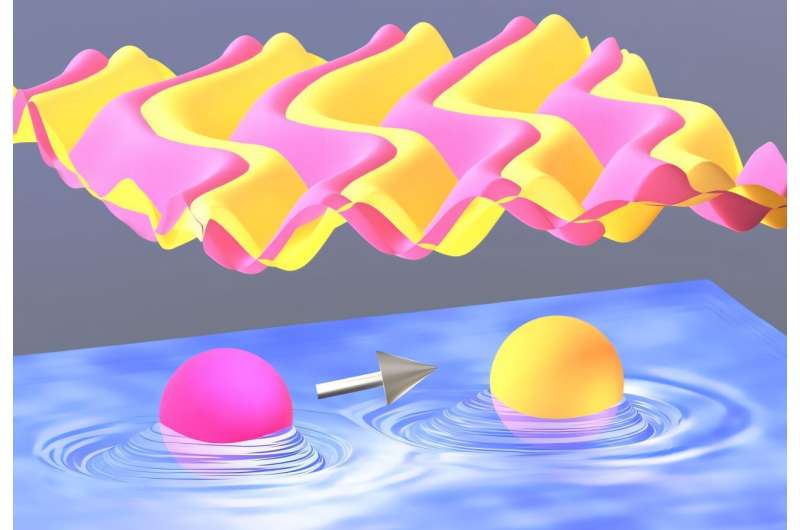
Researchers at the Max Planck Institute for Dynamics and Self-Organization (MPI-DS) have uncovered how certain molecular interactions can lead to stable order within seemingly chaotic systems. Their findings, published on November 5, 2025, in the journal Physical Review Letters, highlight the role of non-reciprocal interactions in generating collective movement among particles.
In nature, ordered structures are vital for maintaining stability and functionality in living systems. These structures often arise from complex molecules and repeating patterns. One key principle behind this order is the phenomenon of non-reciprocal interactions, where one type of molecule attracts another while being repelled by it. This can result in the formation of intricate structures and patterns.
Defining Collective Movement Through Non-Reciprocal Interactions
The study’s first author, Giulia Pisegna, explains that the dynamics of these non-reciprocal interactions lead to spontaneous collective motion on a larger scale. “While such activity might appear chaotic at first glance, it actually facilitates the emergence of remarkably stable and ordered structures,” she states.
To test the robustness of this system, the researchers introduced noise and disturbances to disrupt the established order. Their experiments revealed that the motility patterns remained remarkably stable, as noted by Suropriya Saha, a group leader at MPI-DS. “The results were achieved by linking the model of non-reciprocal interactions to two seemingly unrelated theories: flocking dynamics and surface growth dynamics,” Saha adds.
Exploring Stability in Fluid Environments
The research team further examined how these patterns behaved when the particles were immersed in a fluid medium. Typically, such an environment can disrupt collective motion. However, the study found that the stability of the moving patterns persisted when driven by non-reciprocal interactions. This indicates a significant resilience to complex experimental conditions.
“These findings suggest that non-reciprocal interactions are fundamental to primitive self-organization in complex chemical environments and will aid in predicting and describing the properties of living systems,” concludes Saha.
For further details, refer to the study by Giulia Pisegna et al., titled “Nonreciprocal Mixtures in Suspension: The Role of Hydrodynamic Interactions,” published in Physical Review Letters, DOI: 10.1103/gbg1-lwwt.