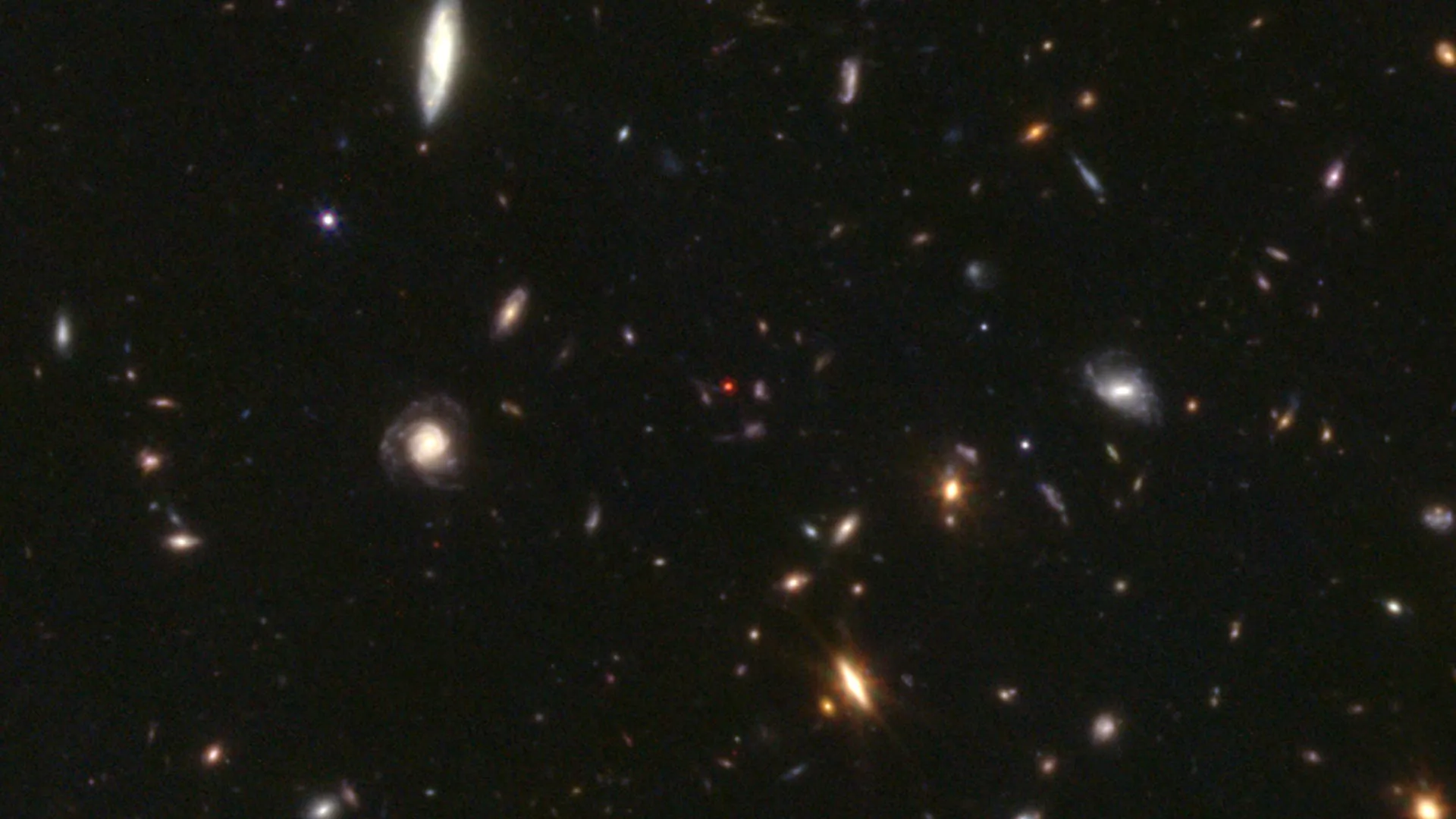
Researchers from the University of Copenhagen have solved a longstanding mystery surrounding peculiar red dots observed in images captured by the James Webb Space Telescope (JWST). These dots, identified as young black holes hidden within dense clouds of gas, provide critical insights into cosmic activity during the early universe, as detailed in a study published in the journal Nature on January 14, 2026.
Since JWST commenced scientific operations, astronomers have been intrigued by these red points of light emerging from the depths of space. The telescope, situated approximately 1.5 million kilometers from Earth, began sending back its first images in December 2021. Among the stars and galaxies, researchers discovered small, unexplained red dots that defied existing models of the early universe.
Red Dots Identified as Young Black Holes
The red dots, nicknamed “little red dots,” appeared during a period when the universe was merely a few hundred million years old. They remained visible for approximately a billion years before seemingly vanishing from view. Initially, some scientists theorized that these dots might represent massive galaxies, detectable across 13 billion years of cosmic history. However, this notion conflicted with existing knowledge about galaxy formation, which suggests that such large galaxies could not have existed so soon after the Big Bang.
After two years of data analysis, the team at the Niels Bohr Institute’s Cosmic Dawn Centre determined that the red dots are, in fact, powered by black holes. These findings offer a rare glimpse into the formation and rapid growth of the universe’s earliest black holes. According to Professor Darach Watson, one of the lead authors of the study, “The little red dots are young black holes, a hundred times less massive than previously believed, enshrouded in a cocoon of gas, which they are consuming to grow larger.” The process generates immense heat, radiating through the gas cocoon and resulting in the unique red color of these objects.
Understanding Growth Patterns of Black Holes
Astronomers have now identified hundreds of these young black holes, which, despite being the smallest ever observed, still possess substantial mass, weighing up to 10 million times that of the Sun. Black holes increase in size by drawing in surrounding gas and dust. Due to their relatively small event horizons, incoming material becomes extremely hot and bright before crossing the threshold. This phenomenon releases more energy than nearly any other known event in the universe, causing some material to be expelled rather than consumed.
“When gas falls towards a black hole, it spirals down into a kind of disk or funnel. The gas accelerates and becomes so dense that temperatures reach millions of degrees, illuminating the area. However, only a small fraction of this material is swallowed; much of it is expelled from the poles as the black hole rotates. This is why we refer to black holes as ‘messy eaters’,” explains Watson.
The findings also shed light on the formation of supermassive black holes at the centers of galaxies, including our own Milky Way, which contains a black hole with a mass approximately four million times that of the Sun. Despite their significance, the origins of these supermassive black holes remain a subject of ongoing research. The new observations provide clarity on how such massive objects could have existed just 700 million years after the Big Bang, some reaching masses billions of times greater than the Sun.
Watson notes, “We have captured the young black holes in the midst of their growth spurt at a stage we have not observed before. The dense cocoon of gas surrounding them provides the fuel they need to grow very quickly.” This discovery not only enhances our understanding of black hole formation but also contributes to the broader narrative of cosmic evolution during the universe’s formative years.