The quest to capture black holes in three dimensions has taken a significant leap forward with a new £4 million research initiative. Led by Dr. Kazunori Akiyama, a key figure behind the first images of black holes, and Professor Yves Wiaux from Heriot-Watt University, this project aims to produce dynamic films that illustrate the complex behaviors of plasma and magnetic fields around these enigmatic cosmic entities.
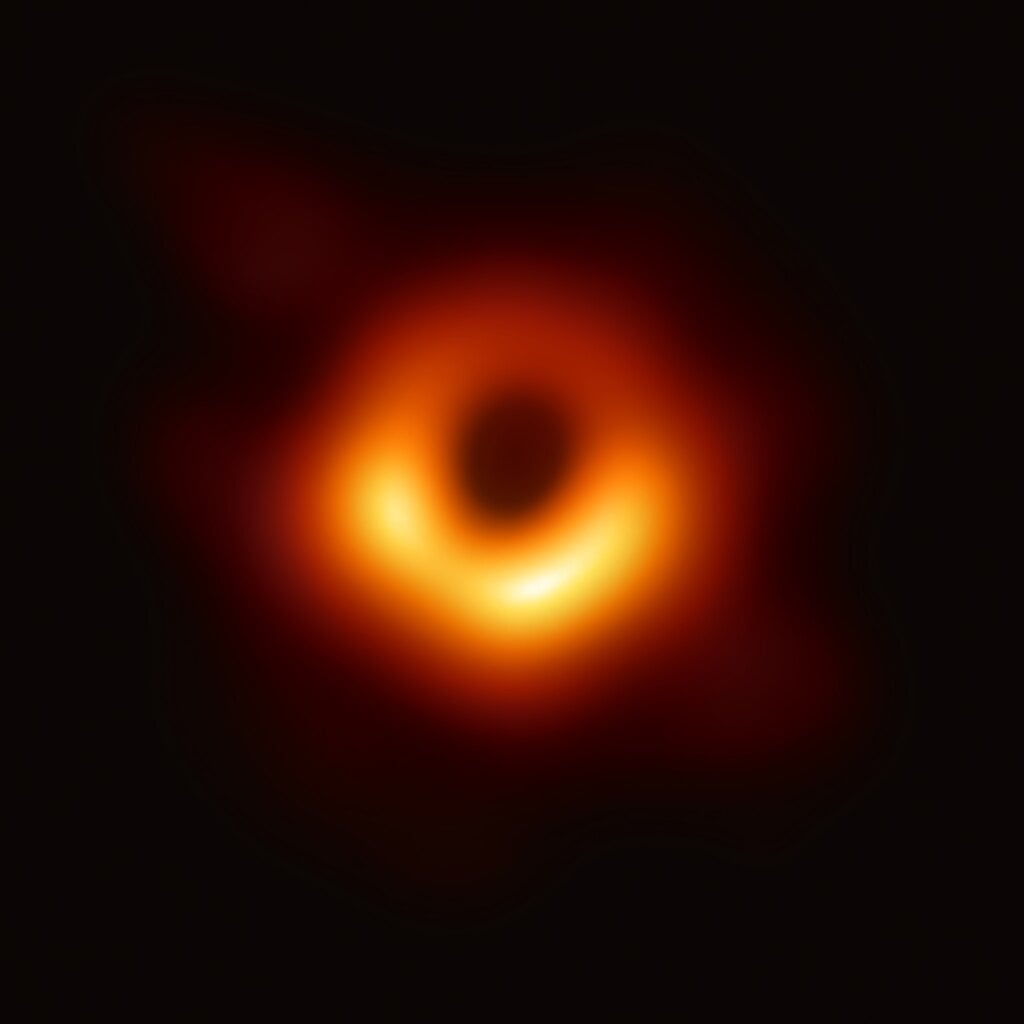
The groundbreaking achievement in 2019 was the first photograph of a black hole, which revealed the supermassive black hole M87*, located approximately 55 million light years from Earth. This image showcased a striking orange ring of superheated plasma, providing a visual confirmation of black holes’ existence. Three years later, the imaging team captured Sagittarius A*, the black hole at the center of our own Milky Way galaxy. While these 2D images captivated global audiences, they only hinted at the intricate phenomena occurring around these gravitational giants.
Akiyama and Wiaux’s project, termed “dynamic gravitational tomography,” seeks to move beyond static visuals. By creating three-dimensional movies, the researchers will clarify how matter moves around black holes over time. The Event Horizon Telescope (EHT), which produced the initial images, operates by merging data from radio telescopes worldwide, forming a virtual Earth-sized telescope with exceptional resolution. However, the challenge lies in transforming the incomplete data collected into coherent images, a process that demands advanced computational algorithms.
Dr. Akiyama has previously developed imaging algorithms for the initial black hole photographs, while Professor Wiaux has been at the forefront of artificial intelligence techniques that reconstruct images from incomplete data. Together, their expertise aims to unveil the hidden dynamics of black holes that have remained elusive until now.
Revealing the Mysteries of Black Holes
The new TomoGrav project promises to illuminate the spinning nature of black holes, which plays a crucial role in determining how energy is extracted from infalling matter. This energy powers colossal jets that can extend thousands of light years, significantly influencing the formation and evolution of galaxies. While scientists have been able to observe these jets, the processes governing their formation have yet to be fully understood.
By producing time-resolved three-dimensional maps of magnetic fields and plasma surrounding black holes, this research will provide unprecedented insights into how matter spirals inward and generates the magnetic fields that channel energy outward. The implications of this work extend beyond understanding black holes; it also presents an opportunity to conduct rigorous tests of Albert Einstein’s general theory of relativity under extreme conditions.
The team will collaborate with the proposed Black Hole Explorer space mission, which aims to conduct precise measurements of photon rings—light that has orbited a black hole multiple times before escaping. These measurements will probe the gravitational effects where spacetime is most severely warped, further enhancing our understanding of the universe.
With this ambitious project, Akiyama and Wiaux are poised to reveal the intricate workings of black holes, shifting our comprehension of these cosmic phenomena and potentially reshaping fundamental theories of physics. The promise of dynamic visualizations not only excites the scientific community but also holds the potential to engage the public in the mysteries of our universe.