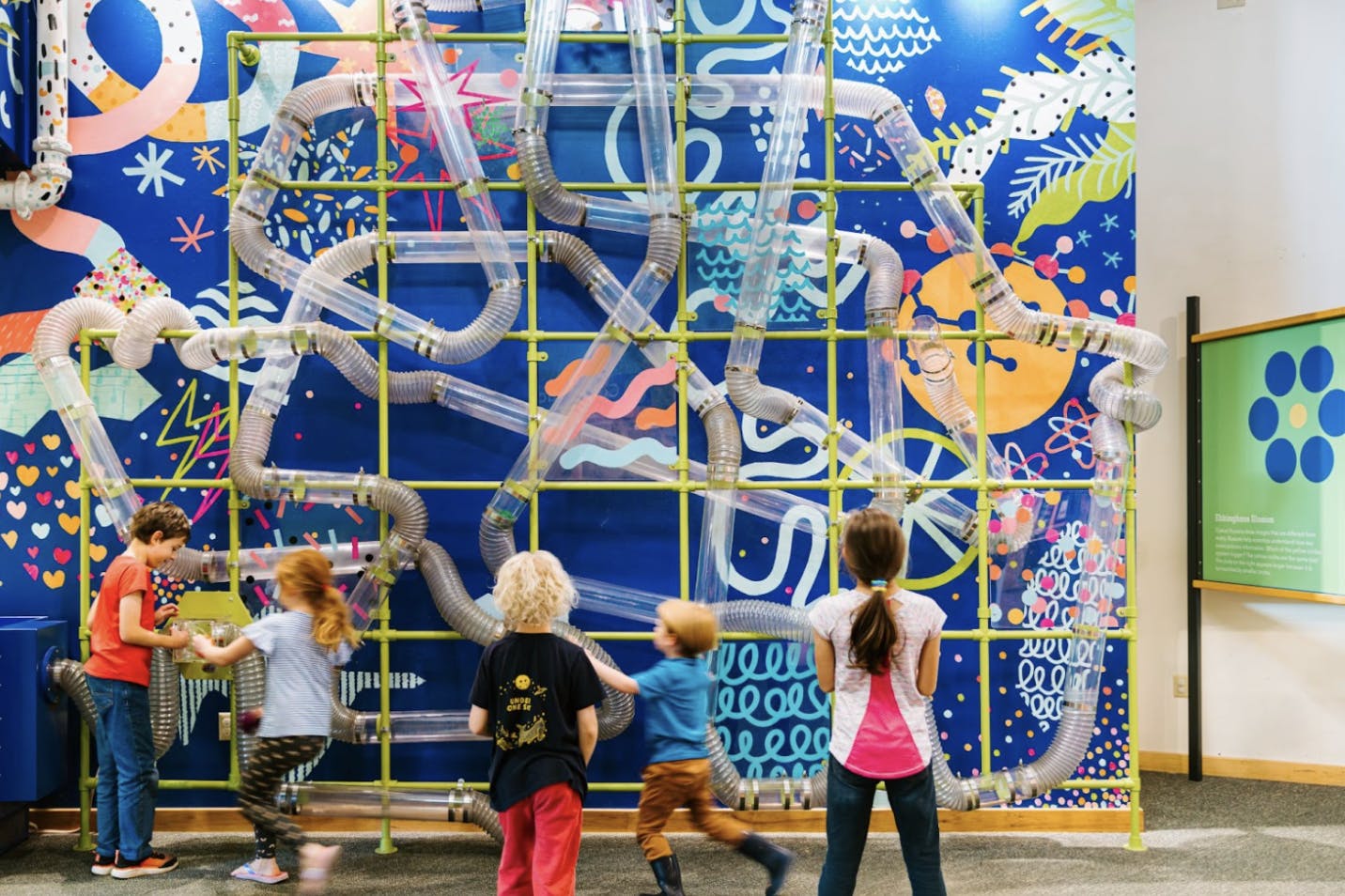
Inside the Sciencenter in Ithaca, New York, a unique atmosphere permeates the air. Visitors engage in hands-on exploration, free from the distractions of modern technology. Instead of staring at screens, guests immerse themselves in the sounds of a kinetic ball machine and the joyful laughter of children discovering the wonders of science. Here, learning is not a passive experience but an interactive journey that sparks curiosity.
Sierra Coathup, the Sciencenter’s volunteer program manager, recently witnessed a memorable moment in the Saltonstall Animal Room. This vivarium houses a variety of amphibians, reptiles, and fish from diverse ecosystems. “I overheard a child tell their parents, ‘See, I told you it was real!’” Coathup recounted, describing how the child rushed towards the axolotl tank. The mother’s response, “Okay, you’re so right,” illustrated the joy of shared discovery, where the child assumed the role of teacher.
The Sciencenter has dedicated itself to this mission for over 30 years, aiming to “cultivate an engaged community of curious, collaborative, critical thinkers,” as stated on its website. As formal education increasingly prioritizes memorization over exploration, opportunities for curiosity-driven learning are becoming scarce. Professor Chris Schaffer, a biomedical engineer, noted that science remains a favorite subject until the end of middle school. He emphasized the importance of environments that promote active exploration, stating, “It really is an exploratory process for discovery that keeps them [the visitors] engaged in science.”
Research supports Schaffer’s assertions. A comprehensive 33-year study tracked a national sample of Generation X individuals from middle school into their 40s, finding that early experiences with hands-on activities, such as science laboratory work, significantly shaped lifelong interests in science. The Sciencenter’s approach to fostering curiosity involves much more than simply placing colorful exhibits in a room; it requires years of audience research, prototyping, and rigorous testing.
One example of this meticulous process is the development of Bridges to Bioengineering. This traveling exhibition, created in collaboration with faculty and students from Cornell University‘s Meinig School of Biomedical Engineering, aims to connect complex biomedical concepts with public understanding. Now in its third year, the 1,500-square-foot exhibition is available in both Spanish and English.
The project began with “front-end evaluation,” as described by Adrienne Testa, director of exhibitions. The team conducted interviews with professionals, students, and parents across middle schools in Tompkins County and Groton, New York. By the second year, they moved into the ‘proof of concept’ phase, testing whether the exhibit captured attention, communicated its scientific message effectively, and could be feasibly built within budget constraints.
In a workshop located in the Sciencenter’s basement, phase three is currently underway. Here, the exhibition is being constructed and refined based on feedback from initial public prototyping. “We’re monitoring and evaluating how the children interact. Did they seem to have fun? What knowledge did they take away?” Schaffer explained. The feedback from this phase informs the final design and construction process.
Over the next two years, project teams will continue to refine the exhibition with the goal of creating an experience that encourages visitors not only to observe but to actively participate in science. The Sciencenter strives to create an environment where visitors feel empowered to play, question, and seek answers.
The Sciencenter’s influence extends far beyond its Ithaca location. In 2025 alone, its 11 completed traveling exhibitions reached 14 states and two Canadian provinces, captivating hundreds of thousands of visitors. Plans are also in place for an exhibition to travel to a children’s science museum in Chengdu, China, further expanding the reach of its curiosity-driven model.
At the Sciencenter, curiosity is treated as a valuable trait that should be nurtured rather than allowed to fade with age. Through the dedication of staff, researchers, and thousands of volunteers, the Sciencenter ensures that discovery remains tangible, hands-on, and most importantly, fun. Ultimately, it all comes down to moments like a child standing in front of an aquarium, confidently asserting, “See? I told you it was real!”