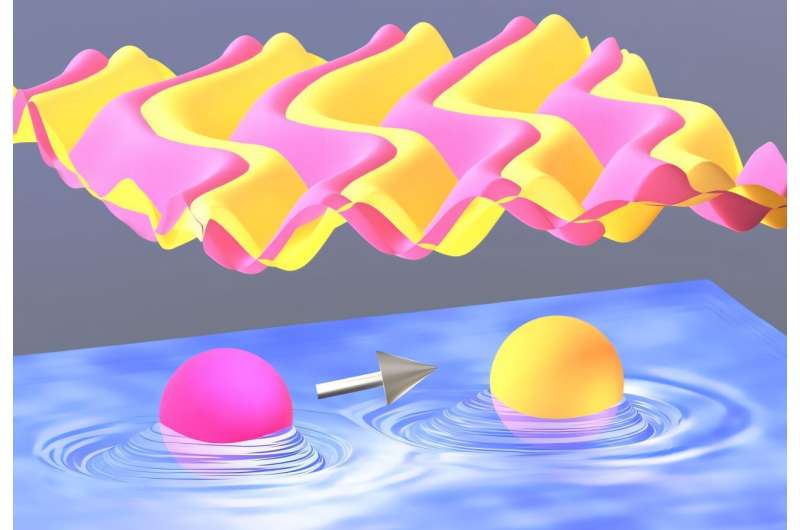
Recent experiments have revealed a surprising shift in the behavior of quantum particles, specifically excitons, during extreme conditions. Researchers found that excitons, which are typically seen as maintaining stable partnerships, can abandon their long-held associations when faced with crowded environments. This discovery challenges existing assumptions about how quantum particles interact and move within materials.
The study, led by Mohammad Hafezi and his team, focused on the dynamics of excitons, which are formed when an electron pairs with a hole—an absence of an electron that carries a positive charge. Traditionally, excitons have been viewed as “monogamous” due to the energy required to separate them. They behave like bosons, in contrast to individual electrons, which are fermions and do not share quantum states.
Under specific conditions, researchers anticipated that increasing the density of fermionic electrons would hinder exciton movement. Surprisingly, the opposite occurred. As the electron density increased, exciton mobility significantly improved. Lead author Pranshoo Upadhyay, a graduate student at the Joint Quantum Institute (JQI), expressed disbelief at the initial results, stating, “No one wanted to believe it.”
Unexpected Findings in Quantum Interactions
The research employed a meticulously constructed layered material that organized electrons and excitons into a structured grid. At lower electron densities, excitons behaved as expected, but as more electrons filled the system, excitons were forced to navigate around occupied sites. Remarkably, once most of the grid was filled with electrons, excitons began to move more freely, covering greater distances than before.
The team conducted extensive tests across various samples and setups, confirming that the phenomenon was consistent. Former JQI postdoctoral researcher Daniel Suárez-Forero noted, “We repeated the experiment in a different sample, in a different setup, and even in a different continent, and the result was exactly the same.”
The findings indicate that at high electron densities, the dynamics of excitons change. Rather than maintaining exclusive bonds, holes within excitons began to treat surrounding electrons as equivalent partners. This led to a phenomenon dubbed “non-monogamous hole diffusion,” enabling excitons to traverse the material efficiently without the usual obstacles.
Implications for Future Technology
The ability to control exciton movement through voltage adjustments presents significant potential for advancements in electronic and optical devices. This research opens avenues for exciton-based technologies, including solar energy applications.
The study has been published in the journal Science, providing a crucial stepping stone in understanding the complex interactions within quantum materials. As physicists continue to explore these dynamics, the implications for both theoretical and applied physics remain vast. The revelations about excitons not only enhance our grasp of quantum mechanics but also pave the way for innovative developments in technology.