Astronomers are set to embark on a groundbreaking mission to find an Earth-like planet as a new telescope project, the Terra Hunting Experiment, launches in the Canary Islands in mid-December 2023. This endeavor marks the first systematic effort to identify planets resembling Earth that orbit stars similar to our sun. Led by Didier Queloz from the University of Cambridge, who shared the 2019 Nobel Prize in Physics, the project aims to fill a critical gap in our understanding of planetary systems.
The quest for Earth-like planets has proven challenging due to the limitations of current detection methods. Astronomers have identified over 6,000 exoplanets in the past three decades, yet none bear a striking resemblance to our own. Most discoveries have been large planets, such as gas giants and rocky sub-Neptunes, that orbit close to their stars. These findings often come from observing the gravitational tug that planets exert on their stars, which creates a detectable wobble. However, the subtlety of the wobble from smaller, Earth-like planets makes them difficult to spot, as their signals can be overshadowed by the noise from their sun.
Queloz emphasizes the frustration among astrophysicists regarding the absence of solar system analogs. He expresses a desire to uncover planets that could resemble our own, stating, “We want to find a planet like Earth. The fact we don’t have any Earth-like systems is very frustrating.”
Innovative Technology Poised to Revolutionize the Search
The development of a new instrument, known as HARPS3, is central to the Terra Hunting Experiment. This state-of-the-art spectrograph will enable researchers to analyze starlight with unprecedented precision, breaking it down into its component wavelengths. By achieving an accuracy capable of measuring stellar motion as slight as 10 centimeters per second, HARPS3 can help distinguish the subtle signals from Earth-like planets amidst the stellar noise.
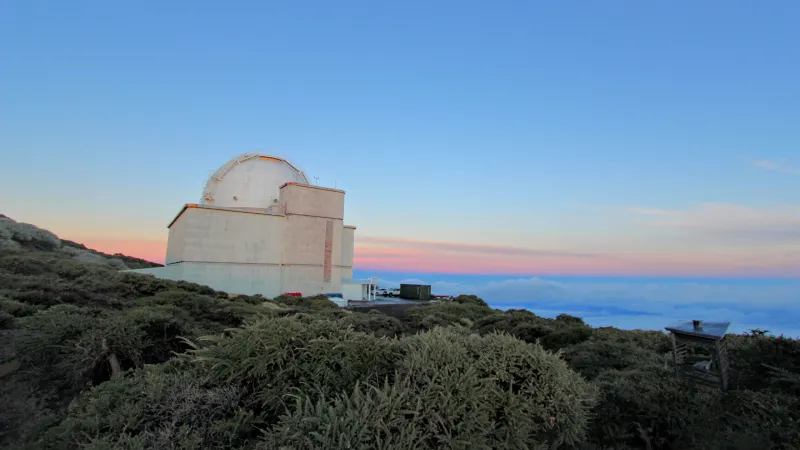
The telescope used for this project has a storied history, originally established in the 1960s for the Royal Greenwich Observatory before being relocated to La Palma in the 1980s. According to Clark Baker, an astrophysicist at the University of Cambridge, refurbishing this existing telescope was a cost-effective choice compared to constructing a new one. The team plans to observe up to 50 sun-like stars each night for the next decade, continuously collecting data to improve the chances of detecting Earth-like planets.
Researcher Samantha Thompson notes the emotional weight of transporting the telescope and equipment, worth approximately £10 million, to La Palma. She expresses hope that this ambitious project will yield compelling evidence of planets akin to Earth, referencing the iconic “pale blue dot” image captured by NASA’s Voyager 1.
Global Collaboration and Future Implications
The Terra Hunting Experiment is not an isolated initiative. It is part of a broader global effort to enhance our understanding of exoplanets. Based on existing data from NASA’s Kepler mission, which identified around 2,600 exoplanets during its operation, the team anticipates discovering at least two Earth-like planets within the habitable zone, where conditions might allow for liquid water. Such planets would become prime candidates for future missions aimed at detecting signs of life.
Sarah Rugheimer, an astronomer at the University of Edinburgh, highlights the significance of this project in addressing a critical gap in exoplanet research, particularly in the search for planets with longer orbital periods around sun-like stars. Paul Rimmer, an astrochemist at the University of Cambridge, emphasizes the potential for this project to provide the strongest evidence of extraterrestrial life beyond Earth.
The implications of these discoveries could extend to future missions like the planned NASA Habitable Exoplanet Observatory and the Large Interferometer for Exoplanets, which would investigate the atmospheres of planets identified by the Terra Hunting Experiment for biosignatures.
Queloz regards this project as a crucial test case, stating, “If it works, we’ll need way more of them.” He acknowledges that if the Terra Hunting Experiment yields no findings over the next ten years, it would still provide valuable insights, suggesting that humanity may be more unique than previously thought.
As the search for an Earth-like planet unfolds, astronomers remain hopeful that this endeavor will illuminate the mysteries of planetary systems and potentially guide us in the search for extraterrestrial life.