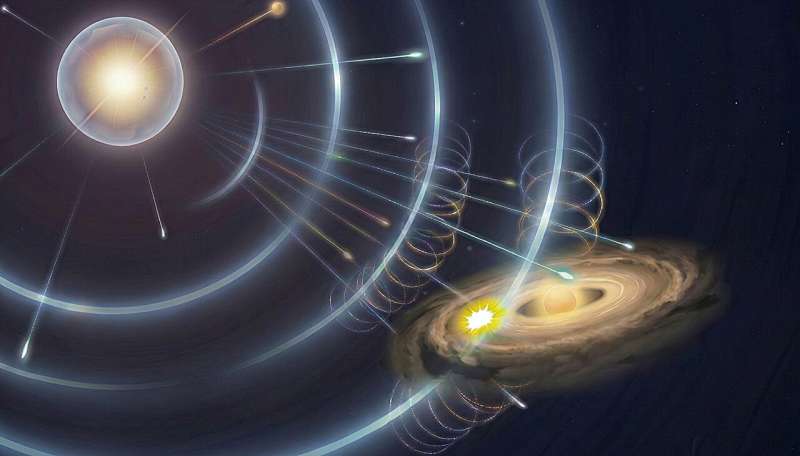
Recent research published in the journal Science Advances indicates that rocky planets, resembling Earth, may be significantly more prevalent in the universe than previously assumed. The study suggests that the formation of our solar system was influenced by a nearby supernova, which is the explosive death of a star, releasing cosmic rays filled with essential radioactive materials. These materials are crucial for the development of rocky, arid worlds.
The research explores how supernovae could play a vital role in the formation of planetary systems across the galaxy. The findings highlight that the cosmic rays emitted during such stellar explosions may provide the building blocks needed for rocky planets. This process appears to be common and could explain why Earth-like planets may be more widespread than earlier theories suggested.
The authors of the study conducted extensive simulations to model the effects of supernovae on the surrounding cosmic environment. They discovered that the presence of cosmic rays can enhance the formation of solid materials, leading to the development of rocky planets. This insight shifts the current understanding of planetary formation, emphasizing the significance of supernovae in creating conditions conducive to the emergence of terrestrial worlds.
By examining various scenarios, the researchers concluded that the process initiated by supernovae is not limited to our solar system but may be a universal phenomenon. This could mean that many of the rocky planets detected in exoplanet studies might have originated under similar influences.
The implications of this research extend beyond mere planetary science; they raise intriguing questions about the potential for life on these Earth-like planets. If rocky planets are indeed more common, the likelihood of finding habitable environments elsewhere in the universe increases, which could have profound implications for astrobiology.
As scientists continue to explore the cosmos, this study marks a significant step forward in understanding how planets like Earth form. The findings not only offer a new perspective on the origins of our own solar system but also provide a framework for future research into the conditions necessary for life to exist on other worlds.
In conclusion, the research underscores the importance of supernovae in the cosmic landscape and their role in shaping the universe’s diversity of planetary systems. As more data becomes available, the scientific community looks forward to uncovering further insights into the origins of rocky planets and their potential to host life.