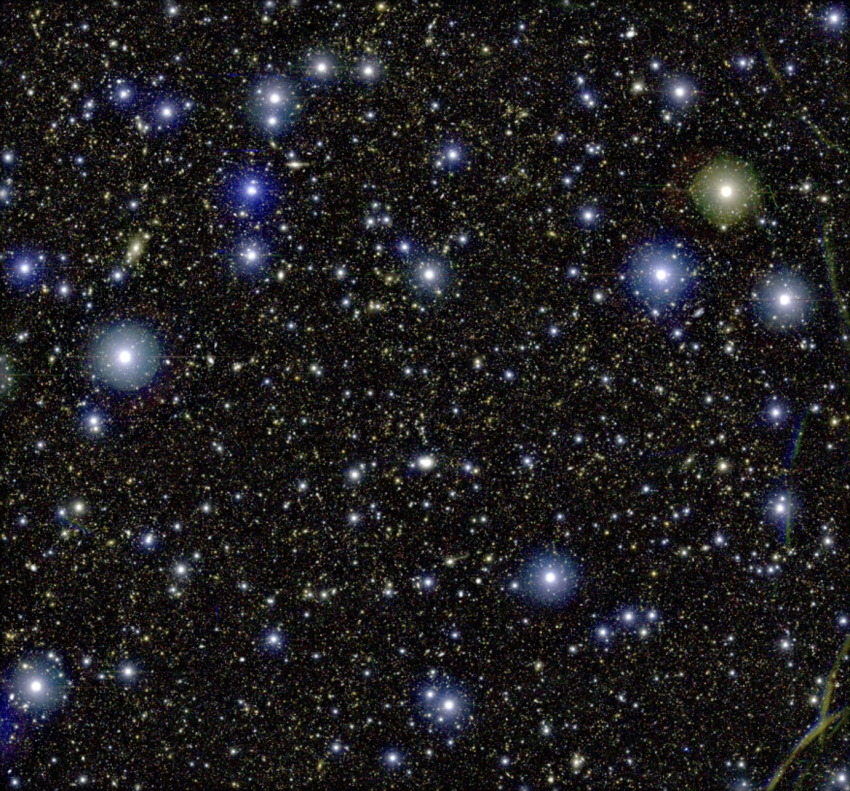
New findings from the Deep Extragalactic Visible Legacy Survey (DEVILS) suggest that the growth of galaxies is significantly influenced by their surrounding environments. This research, conducted by the International Centre for Radio Astronomy Research (ICRAR) alongside the University of Western Australia, has released its first comprehensive data set, detailing the characteristics of thousands of galaxies.
Published in the Monthly Notices of the Royal Astronomical Society, the study titled “Deep Extragalactic VIsible Legacy Survey (DEVILS): First Data Release Covering the D10 (COSMOS) Region” is led by Luke Davies, an Associate Professor at the University of Western Australia. This release marks a decade of meticulous observations and data analysis, providing valuable insights into galactic evolution.
The survey focuses on galaxies that existed up to five billion years ago, allowing researchers to compare their characteristics with those of contemporary galaxies. This approach offers a deeper understanding of how galaxies have transformed over time. The data release includes catalogues of morphological, redshift, photometric, spectroscopic data, as well as details regarding group environments and dark matter halo characteristics.
Insights into Galactic Growth
One of the crucial findings from the DEVILS research is that galaxies located in crowded environments tend to grow at a slower pace than their isolated counterparts. According to Davies, “Galaxies that are surrounded by lots of other galaxies – the bustling city centres of the cosmos – tend to grow more slowly and have very different structures compared to their isolated counterparts.”
The researchers categorize galaxies into two main types: blue, gas-rich, star-forming systems, and red, gas-poor, quiescent systems. As the universe evolves, the proportion of quiescent systems gradually increases. The study elucidates how dense environments, such as galaxy clusters or groups, can disrupt the supply of cold gas necessary for star formation, leading to a phenomenon known as “quenching.”
Several physical mechanisms contribute to this quenching effect, including ram-pressure stripping and tidal interactions. These factors alter the movement of star-forming gas between galaxies, facilitating star formation in some while inhibiting it in others.
The Future of Galaxy Research
Davies draws an analogy between the growth of galaxies and human development, illustrating how environmental factors shape both. “Our upbringing and environment influence who we are,” he said. “Someone who has lived their whole life in the city may have a very different personality compared to someone who lives remotely or in an isolated community. Galaxies are no different.”
The DEVILS data will play a vital role in the research of other astrophysicists, similar to the way data from various surveys has been utilized in the past. Looking ahead, Davies and his team plan to expand the scope of the DEVILS project. “DEVILS forms the basis of our future plans in exploring this key area of astrophysics research,” he noted.
Next year, they will commence data collection for the WAVES (Wide Area VISTA Extragalactic Survey), which aims to significantly broaden the number of galaxies and environments under study. This initiative promises to enhance our understanding of how the universe has evolved to its current state.
The results from this research not only deepen our comprehension of galactic dynamics but also pave the way for future explorations in astrophysics, highlighting the intricate relationships between galaxies and their environments.