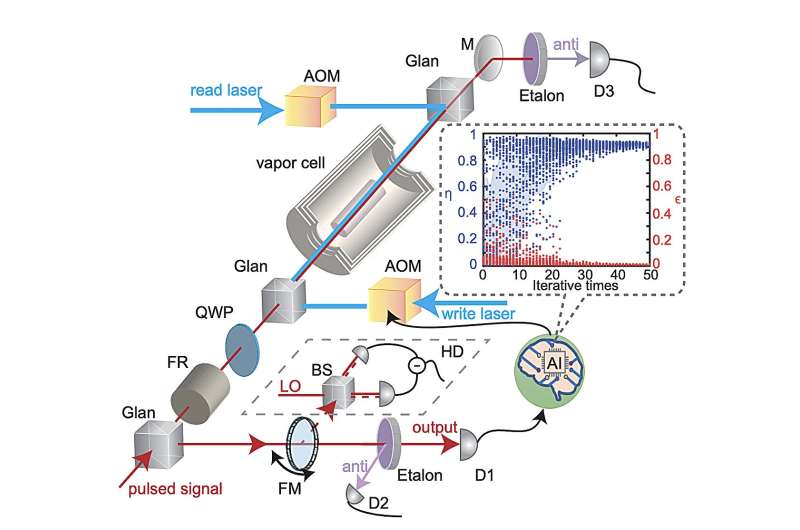
Researchers at Shanghai Jiao Tong University and East China Normal University have achieved a significant breakthrough in quantum memory technology, demonstrating a new approach that combines high efficiency and fidelity. Their quantum memory system, detailed in a paper published on November 15, 2025, in Physical Review Letters, boasts an impressive efficiency of 94.6% and a fidelity of 98.91%, marking a pivotal advancement in the field of quantum information processing.
Quantum memories have been crucial in harnessing quantum mechanics for various applications, including quantum computing and secure communication. For practical use, these systems must not only store quantum information but also retrieve it with minimal degradation. Traditionally, efforts to develop effective quantum memories encountered challenges due to random fluctuations that compromised the integrity of stored information.
Innovative Control Technique Enhances Performance
The research team, led by Professor Weiping Zhang and Professor Liqing Chen, introduced a novel method to manage atom-light interactions while storing quantum information. This technique employs what is known as a far-off resonant Raman scheme, which not only enhances quantum storage but also allows for faster processing of optical signals compared to previous methods.
Zhang explained, “Quantum memory with near-unity efficiency and fidelity is indispensable for quantum information processing. Achieving such performance has long been a central challenge in the field.” Their findings reveal a precise and robust technique that uses atom-light spatiotemporal mapping, mathematically referred to as the Hankel transform, to improve quantum memory capabilities.
Breaking the Efficiency-Fidelity Trade-Off
This innovative approach has successfully addressed the “efficiency–fidelity trade-off” that has hindered the development of ideal quantum memories. By applying their mathematical framework to a Raman quantum memory based on warm rubidium-87 (87Rb) vapor, the researchers have laid the groundwork for future advancements in quantum technologies.
The implications of this work extend beyond improved memory systems. Enhanced quantum memories could facilitate advances in long-distance quantum communication, the development of quantum computers, and the establishment of distributed quantum sensing networks. Zhang’s team aims to further explore new physics-driven principles and integrate their quantum memory into quantum repeaters, which are essential for fault-tolerant quantum computing architectures and expansive quantum networks.
In summary, this research represents a significant step forward in the quest for optimal quantum memory, potentially reshaping the landscape of quantum technologies. The successful demonstration of high-efficiency and high-fidelity quantum memory could lead to practical applications that were previously thought unattainable, opening new avenues for innovation in the field.