Scientists using NASA’s James Webb Space Telescope have uncovered a remarkable exoplanet, designated PSR J2322-2650b, that challenges existing theories about planetary formation. This extraordinary discovery, made public on January 1, 2026, reveals a planet with an unusual carbon-rich atmosphere, orbiting a neutron star. The findings suggest that the planet’s unique characteristics could redefine our understanding of what constitutes a planet.
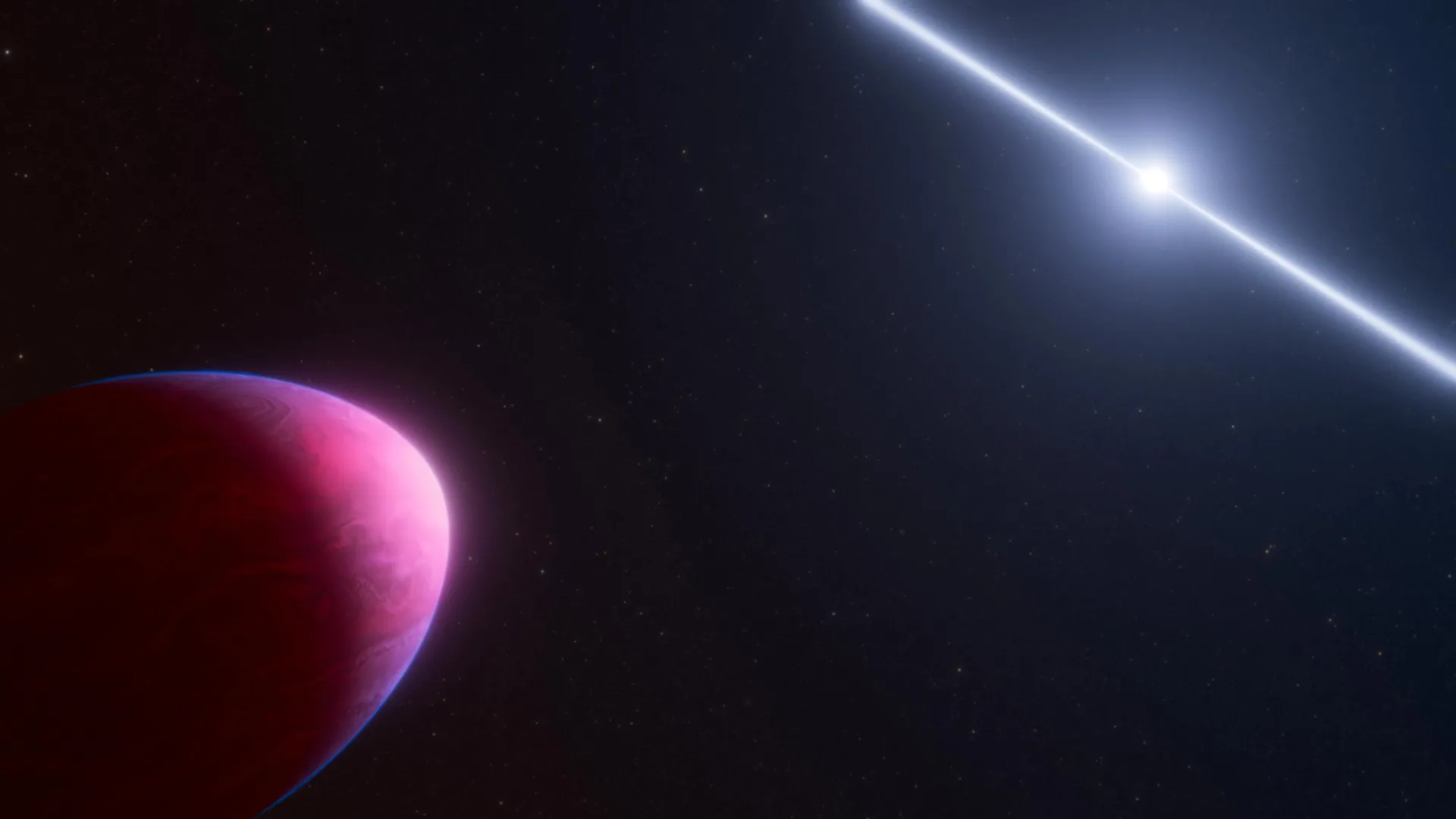
The exoplanet, comparable in mass to Jupiter, exhibits a distinct lemon-like shape due to the extreme gravitational forces exerted by its host star, a rapidly spinning neutron star. This planet completes a full orbit in an astonishing 7.8 hours, a stark contrast to Earth’s yearly cycle. Its atmosphere is dominated by helium and carbon, with dark soot-like clouds and the possibility of diamonds forming under immense pressure.
A Planet Unlike Any Other
According to the principal investigator, Michael Zhang from the University of Chicago, the composition of PSR J2322-2650b deviates significantly from typical exoplanets. “This is a new type of planet atmosphere that nobody has ever seen before,” Zhang stated. The atmosphere’s unexpected molecular signature includes carbon compounds, C3 and C2, rather than the usual suspects like water or methane.
The neutron star this planet orbits is unique in its own right. It is the mass of our Sun but compressed into a size comparable to a city. The pulsar emits powerful beams of electromagnetic radiation, mainly gamma rays, which complicate how we observe celestial bodies in its proximity. Nevertheless, the positioning of the James Webb Space Telescope allows for unobstructed views of the planet, providing researchers with a pristine spectrum for analysis.
Peter Gao, a researcher at the Carnegie Earth and Planets Laboratory, expressed disbelief at the discovery. “This was an absolute surprise,” he remarked. “Our collective reaction was, ‘What the heck is this?’”
Understanding a Unique System
The proximity of PSR J2322-2650b to its host star—merely 1 million miles away—leads to intense gravitational forces that reshape the planet. For context, Earth orbits the Sun at a distance of about 100 million miles. This gravitational interplay is believed to stretch the planet into its distinctive shape and may contribute to its unusual atmospheric composition.
The research team has put forth a hypothesis regarding the formation of this exoplanet. Given the extreme carbon enrichment of its atmosphere, Zhang noted that conventional formation theories do not adequately explain its existence. “It seems to rule out every known formation mechanism,” he added.
There is a possibility that PSR J2322-2650b belongs to a rare category of systems known as black widow binaries, where a pulsar gradually strips material from a companion object. However, in this case, the companion is classified as a planet, not a star. The peculiar environment raises questions about its formation and the processes keeping other elements like oxygen and nitrogen at bay.
Experts like Roger Romani from Stanford University are eager to delve deeper into the mystery. He proposed that as the companion cools, a mixture of carbon and oxygen could crystallize, leading to the presence of pure carbon crystals in the atmosphere.
The James Webb Space Telescope’s advanced infrared sensitivity played a crucial role in this groundbreaking discovery, as it can detect faint signals from distant celestial objects without interference from Earth’s atmospheric heat. Zhang emphasized the importance of Webb’s location, stating, “It’s absolutely not feasible from the ground.”
This discovery not only opens new avenues for research but also highlights the potential for uncovering more exotic worlds in the universe. The findings from this study have been accepted for publication in The Astrophysical Journal Letters and were supported by funding from NASA and the Heising-Simons Foundation. As scientists continue to investigate PSR J2322-2650b, they hope to unravel the complexities of this enigmatic planet and its dynamic environment.