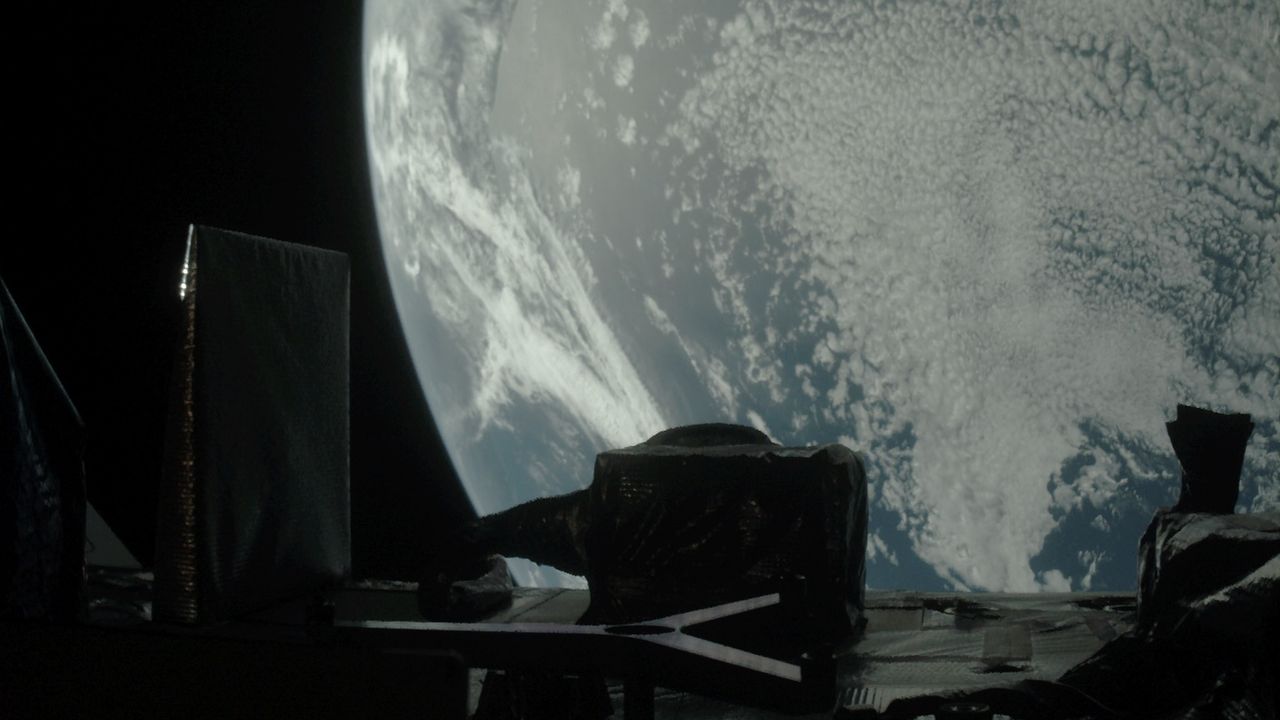
NASA’s OSIRIS-APEX spacecraft has recently captured remarkable images of Earth and the Moon during a high-speed slingshot maneuver designed to accelerate its journey toward the asteroid Apophis. The flyby occurred on September 23, 2025, when the probe passed just 2,136 miles (3,438 kilometers) above the planet’s surface, providing stunning visuals of swirling clouds and vast oceans.
During its closest approach, OSIRIS-APEX, which stands for “Origins, Spectral Interpretation, Resource Identification and Security-Apophis Explorer,” demonstrated its advanced imaging capabilities. The spacecraft’s cameras recorded striking details of Earth’s landscapes and weather patterns. The following day, OSIRIS-APEX captured a dramatic image of the Moon from approximately 370,000 miles (595,000 kilometers) away.
Milestones and Future Plans
OSIRIS-APEX is part of the second phase of NASA’s OSIRIS-REx mission, which successfully returned samples from the near-Earth asteroid Bennu in 2023. After that historic accomplishment, NASA redirected the spacecraft toward Apophis, an asteroid composed primarily of metal. Apophis is of particular interest due to its previous classification as a potential threat to Earth, having been thought to pose a significant impact risk.
The recent images signify a key milestone for the mission, confirming that OSIRIS-APEX’s instruments are fully operational after years in deep space. The September flyby utilized Earth’s gravity to increase the probe’s velocity, setting it on a course for Apophis, which is expected to make a close approach to Earth on April 13, 2029. This encounter will bring the asteroid within a distance closer than many satellites orbiting the planet, allowing for significant gravitational interactions that could alter its rotation or trajectory.
Once in orbit around Apophis, the spacecraft will spend approximately 18 months mapping the asteroid’s surface, studying its composition, and collecting high-resolution imagery. Mission planners aim to hover just above the surface, using the probe’s thrusters to disturb dust and reveal material that has been hidden from view.
Technical Achievements and Future Insights
The images of Earth were taken using OSIRIS-APEX’s MapCam imager, which incorporates red, green, and blue filters, alongside StowCam, which can capture both still and video images. These tools are essential for verifying the safe storage of collected asteroid samples.
As the mission progresses, OSIRIS-APEX will continue to provide trajectory updates and perform additional instrument checks. The impending interactions with Apophis are anticipated to yield valuable insights into the characteristics and behaviors of near-Earth asteroids under the influence of gravitational forces. This mission represents a significant step in understanding how such celestial bodies evolve and respond to their environments.
NASA’s ongoing commitment to exploring our solar system through missions like OSIRIS-APEX not only enhances scientific knowledge but also contributes to planetary defense strategies for the future.