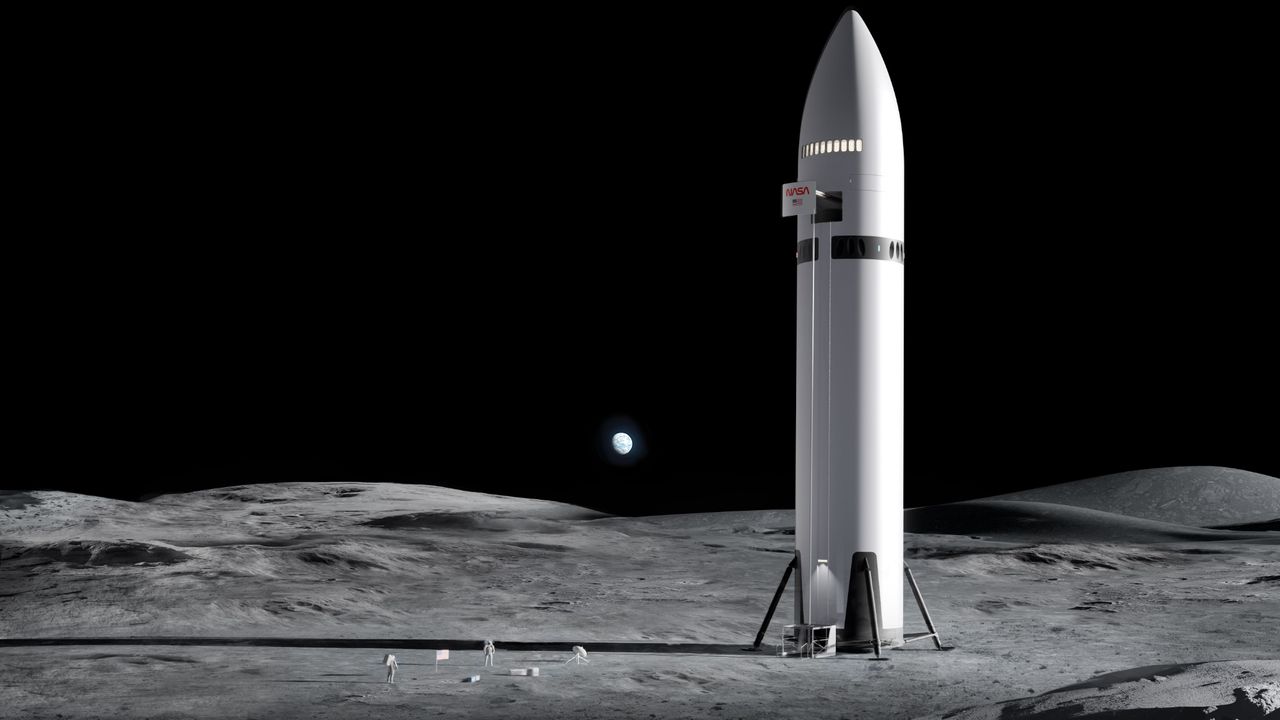
NASA has announced significant changes to its Artemis 3 mission, which will no longer involve landing astronauts on the moon using SpaceX’s Starship. On February 27, 2024, the agency revealed a revamped architecture for its Artemis lunar exploration program, shifting its focus away from lunar landings for the upcoming mission.
The revised plan for Artemis 3 now aims for a launch in 2027, but it will operate in low Earth orbit instead of heading to the lunar surface. NASA officials stated that the mission will focus on demonstrating various technologies and capabilities, including a rendezvous and docking procedure between the Orion crew capsule and commercial landers from SpaceX and Blue Origin, an aerospace company founded by Jeff Bezos.
Blue Origin is developing its lunar lander, called Blue Moon, which was initially scheduled to carry astronauts during the Artemis 5 mission, planned for 2030. However, NASA has indicated that it may expedite Blue Moon’s deployment for earlier missions. In a statement last October, then-Acting Administrator Sean Duffy expressed his dissatisfaction with the pace of Starship’s development, leading to a competitive bidding process for the Artemis 3 landing contract.
According to Don Platt, head of the Department of Aerospace, Physics and Space Sciences at the Florida Institute of Technology, NASA’s decision reflects a desire to avoid reliance on a single contractor. “NASA does not want to have to rely on only one contractor, either,” he stated. “I think that’s why they’re really kind of pushing this competition between Blue Origin and SpaceX.”
Blue Origin appears to be embracing this competition. In late January, the company announced a two-year pause on its suborbital space tourism flights to accelerate the development of its lunar capabilities. The company’s statement emphasized its commitment to the goal of returning to the moon and establishing a permanent human presence there.
The updated Artemis plan envisions the first crewed lunar landing since the Apollo missions to occur on Artemis 4 in 2028, with a potential second landing on Artemis 5 later that same year. This revision indicates a broader strategic shift towards a step-by-step approach, prioritizing an increased launch cadence. It has been over three years since the first Artemis mission launched, with NASA preparing for the Artemis 2 crewed mission around the moon in the coming months.
NASA officials also confirmed that they aim to maintain the current configuration of the Space Launch System rocket, keeping it as close to the “Block I” variant as possible. Previously, Artemis 4 had been set to utilize the “Block IB” variant, which would have featured a more capable upper stage.
The overarching goal of the Artemis program is to establish a permanent, sustainable human presence on and around the moon within the next five to ten years. NASA aims to land the first Artemis astronauts before China, which has plans to send its own astronauts to the moon by 2030.
With increasing competition from geopolitical adversaries, NASA Administrator Jared Isaacman emphasized the need for urgency in achieving these objectives. “With credible competition from our greatest geopolitical adversary increasing by the day, we need to move faster, eliminate delays and achieve our objectives,” he stated. He further noted that standardizing vehicle configurations and increasing flight rates would be essential for success, drawing parallels to the achievements of the Apollo program.