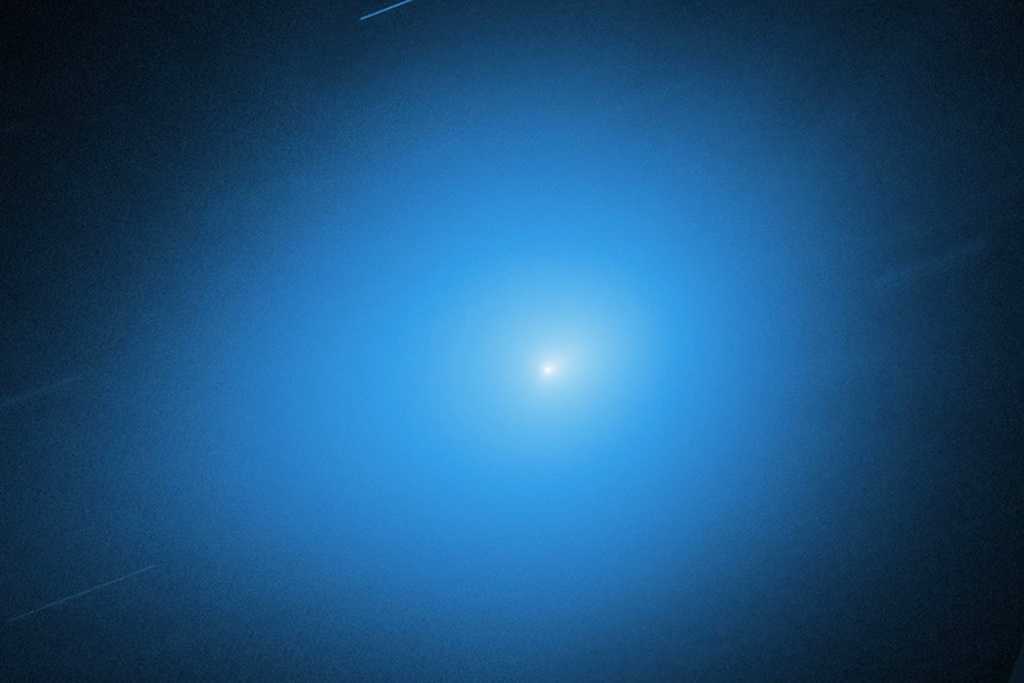
An interstellar comet, designated as 3I/ATLAS, is set to make its closest approach to Earth on Friday, November 3, 2023. This unique cosmic visitor, first identified in July, will pass within approximately 167 million miles (270 million kilometers) of our planet, although it will be on the opposite side of the sun. The distance from Earth to the sun is about 93 million miles (150 million kilometers), illustrating the vastness of our solar system.
While 3I/ATLAS will not be visible to the naked eye, enthusiasts wishing to observe the comet will require a telescope with a minimum aperture of 8 inches (20 centimeters). The optimal viewing opportunity has recently passed, but the Virtual Telescope Project will host a livestream of the comet on Saturday at 04:00 UTC (11 p.m. ET Friday), following a missed streaming chance due to poor weather conditions, according to Gianluca Masi, the project’s founder and scientific director.
Scientific Insights and Observations
The comet is anticipated to remain observable through telescopes and space missions for several months as it exits our solar system. Since its discovery, astronomers have diligently tracked 3I/ATLAS to gather insights into its composition and its origins beyond our solar system. Observations have been made across various wavelengths, including optical, infrared, and radio, with recent efforts yielding X-ray data, marking a significant advancement in understanding this interstellar body.
Comets, often described as “dirty snowballs,” consist of a solid nucleus made of ice, dust, and rocky debris. As these celestial bodies approach stars, heat causes them to release gas and dust, resulting in their characteristic tails. Understanding the materials ejected from comets is crucial, as it can reveal information about their primordial composition.
According to findings from the European Space Agency (ESA), the emissions from 3I/ATLAS have included significant compounds such as carbon dioxide, water, and carbon monoxide. Preliminary studies indicate that the comet may be between 3 billion and 11 billion years old, suggesting it has a long history predating our solar system, which formed approximately 4.6 billion years ago.
Tracking 3I/ATLAS and Future Observations
After fading from view for ground-based telescopes in October, 3I/ATLAS continued to be monitored by missions like PUNCH (Polarimeter to Unify the Corona and Heliosphere) and SOHO (Solar and Heliospheric Observatory). The comet made its closest approach to Mars on October 3, coming within 18.6 million miles (30 million kilometers) of the planet, where it was observed as a faint dot by the ExoMars Trace Gas Orbiter.
While data sharing from NASA missions has been limited due to a government shutdown, ESA’s missions have been active in capturing imagery of the comet. For instance, the Jupiter Icy Moons Explorer (Juice) will attempt to observe 3I/ATLAS in November, although results may not be available until February 2024.
A significant breakthrough came when Japan’s X-Ray Imaging and Spectroscopy Mission (XRISM) successfully captured X-rays emanating from 3I/ATLAS, marking the first detection of X-rays from an interstellar comet. This observation, which lasted 17 hours, revealed X-rays extending 248,000 miles (400,000 kilometers) from the comet’s nucleus. Such emissions may result from interactions between gases released by the comet and the solar wind, providing further opportunities for scientific discovery.
The combination of X-ray data and other observations across different light wavelengths will enhance our understanding of 3I/ATLAS and its similarities or differences compared to comets native to our solar system. As scientists continue to study this interstellar visitor, the potential for groundbreaking discoveries remains high, offering a glimpse into the building blocks of our universe.