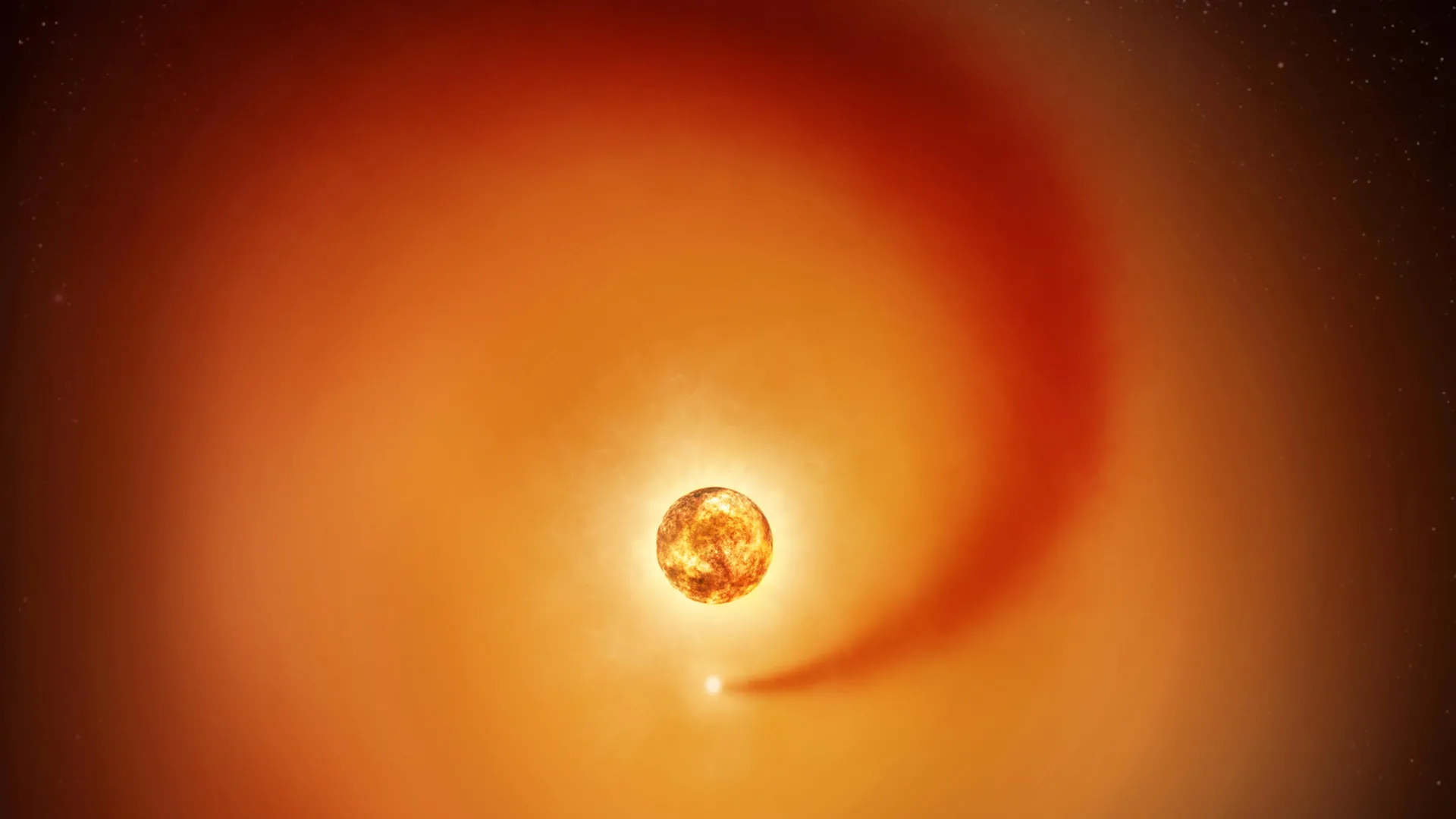
Astronomers have confirmed the presence of a hidden companion star orbiting Betelgeuse, a discovery made possible by nearly eight years of observations from the Hubble Space Telescope and ground-based observatories. The companion star, named Siwarha, has been identified as a significant influence on Betelgeuse’s behavior, generating a visible wake of gas as it traverses the giant star’s outer atmosphere.
The findings were presented at a news conference during the 247th meeting of the American Astronomical Society in Phoenix and will be published in The Astrophysical Journal. This revelation provides clarity on Betelgeuse’s unusual brightness fluctuations and atmospheric dynamics that have puzzled scientists for years.
Decoding Betelgeuse’s Mysteries
Researchers at the Center for Astrophysics | Harvard & Smithsonian meticulously analyzed changes in Betelgeuse’s light over an extended period. Their analysis revealed patterns consistent with the gravitational effects of Siwarha, a companion star that had been speculated about but not confirmed until now. The companion star disrupts the surrounding gas, producing a dense trail that is now observable.
Betelgeuse, located approximately 650 light-years from Earth in the constellation Orion, is a red supergiant that dwarfs our sun. Its immense size allows for direct observation of its surface and atmosphere, making it a prime candidate for studying stellar evolution. The discovery of Siwarha not only resolves long-standing questions about Betelgeuse but also sheds light on the life cycles of other massive stars.
Observational Evidence and Implications
Utilizing data from both Hubble and ground-based observatories, including the Fred Lawrence Whipple Observatory and the Roque de Los Muchachos Observatory, scientists documented notable variations in Betelgeuse’s spectrum. These alterations, linked to the companion star’s influence, support the theory that Siwarha is responsible for the changes in the star’s outer layers.
“It’s a bit like a boat moving through water. The companion star creates a ripple effect in Betelgeuse’s atmosphere that we can actually see in the data,” noted Andrea Dupree, an astronomer at the CfA and lead author of the study.
The team observed that the dense wake becomes apparent shortly after Siwarha passes in front of Betelgeuse approximately every 2,100 days, aligning with earlier theoretical predictions. This discovery is significant, as it provides the strongest evidence to date of a companion star affecting Betelgeuse’s atmospheric behavior.
Historically, astronomers have monitored Betelgeuse’s variability for decades, especially after a notable dimming event in 2020, which was likened to a stellar “sneeze.” Researchers had identified two major cycles of variability: a shorter cycle of 400 days linked to pulsations within the star and a more prolonged cycle believed to be influenced by an orbiting companion.
The confirmation of Siwarha resolves one of the enduring mysteries surrounding Betelgeuse, providing insights into how massive stars evolve, lose material, and ultimately transition into supernovae.
Future Observations and Continued Exploration
Currently, Betelgeuse is eclipsing Siwarha, limiting observations of the companion star. Astronomers plan to conduct further studies when Siwarha becomes visible again in 2027. This breakthrough could also enhance our understanding of other giant stars exhibiting similar behaviors.
The Hubble Space Telescope, operational for over 30 years, continues to deliver vital discoveries that enhance our comprehension of the universe. Managed by NASA and the European Space Agency, Hubble plays a crucial role in astronomical research, with ongoing contributions to our understanding of stellar dynamics and evolution.
This latest discovery surrounding Betelgeuse exemplifies the importance of long-term observational studies in astrophysics, offering a unique glimpse into the complex interactions between stars and their environments.