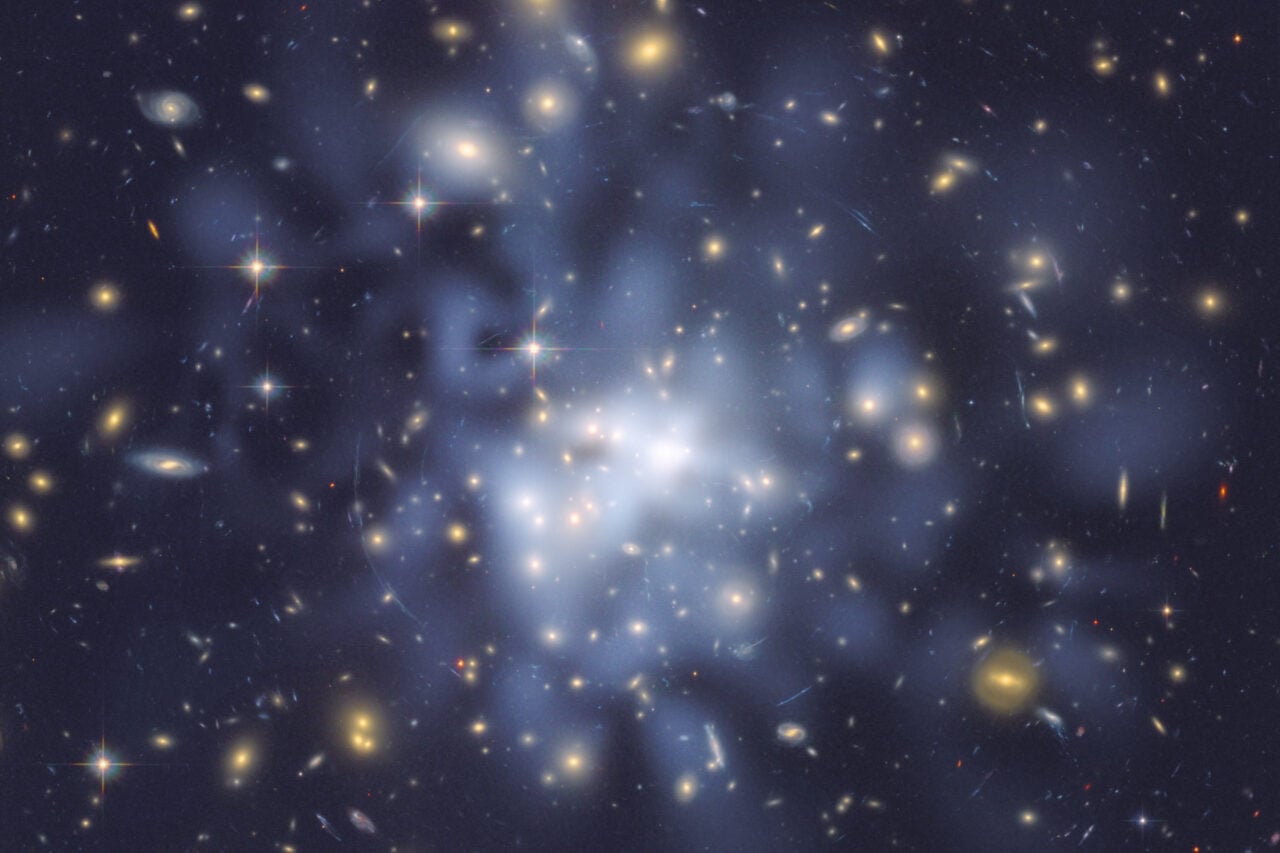
Dark matter, the elusive substance believed to constitute approximately 85% of the universe’s mass, remains one of the most profound mysteries in modern astrophysics. Unlike ordinary matter, dark matter does not absorb, emit, or reflect light, making it undetectable by traditional means. Despite this, its gravitational influence can be observed across numerous astronomical phenomena. Researchers continuously grapple with the implications of dark matter, as it provides essential context for understanding various cosmic observations, from black holes to distant galaxies.
The concept of dark matter is pivotal for explaining several astronomical enigmas. Here are seven key phenomena that highlight its significance.
1. The Universe’s Missing Mass
The most fundamental issue related to dark matter is the apparent deficiency of mass in the universe. Ordinary matter, which includes everything visible such as stars and planets, accounts for only about 15% of the total mass. This discrepancy has led scientists to posit that dark matter is the missing component exerting gravitational forces on visible matter. Without dark matter, current theories of cosmic structure face significant challenges.
2. Spiral Galaxies and Their Behavior
The existence of dark matter gained traction in the 1970s thanks to the work of American astronomer Vera Rubin. Her observations of spiral galaxies revealed that stars at the outer edges moved at speeds that could only be explained if a vast amount of unseen mass existed. According to established physical laws, these stars should not have been able to maintain their speeds without being pulled back by additional gravitational forces, which dark matter conveniently accounts for.
3. Traits of the Galactic Center
The Milky Way’s center is another area of research where dark matter plays a crucial role. A recent study by a team from Johns Hopkins University suggested that a surplus of gamma rays detected at the Galactic Center could be the result of dark matter particle collisions. Furthermore, researchers from Argentina’s Institute of Astrophysics La Plata have proposed that a significant “dark matter core” might influence the stellar populations within our galaxy.
4. Gravitational Lensing Effects
The phenomenon of gravitational lensing provides a striking illustration of dark matter’s influence. When massive entities like galaxies bend spacetime, the light from more distant objects is distorted, allowing astronomers to observe them more clearly. Dark matter’s substantial mass contributes to this effect, often creating visual anomalies that reveal the presence of invisible matter.
5. The Bullet Cluster Revelation
One of the most compelling pieces of evidence for dark matter comes from the 2006 observations of the Bullet Cluster, documented by NASA’s Chandra X-ray Observatory. During a collision of two galaxy clusters, the distribution of visible mass, primarily hot gas, was found to be separate from the majority of the mass detected through gravitational lensing. This finding underscored the existence of dark matter, as the observed mass was located around the galaxies rather than being concentrated in the gas.
6. Connections to Supersymmetry
The search for dark matter is closely linked with theories of supersymmetry. This theoretical framework posits that every fundamental particle has a partner, which could help explain discrepancies in the Standard Model of particle physics. According to CERN, many supersymmetric theories suggest that these partner particles would fulfill the criteria for dark matter, being stable, electrically neutral, and weakly interacting with visible matter. While no direct evidence has been found yet, researchers remain hopeful about discovering these connections.
7. Anomalies in the Cosmic Microwave Background
The cosmic microwave background (CMB) serves as a remnant of the universe’s early moments following the Big Bang. Sensitive detectors have identified small temperature variations in the CMB, believed to be imprints left by dark matter. Although dark matter does not interact directly with radiation, its gravitational effects could create detectable anomalies, offering a window into the universe’s structure and evolution.
In summary, while dark matter remains undetected, its implications permeate our understanding of the universe. The phenomena described above illustrate the profound impact dark matter has on cosmic structures, challenging astronomers and physicists to explore its true nature. As research continues, the pursuit of understanding dark matter may ultimately reshape our comprehension of the cosmos.