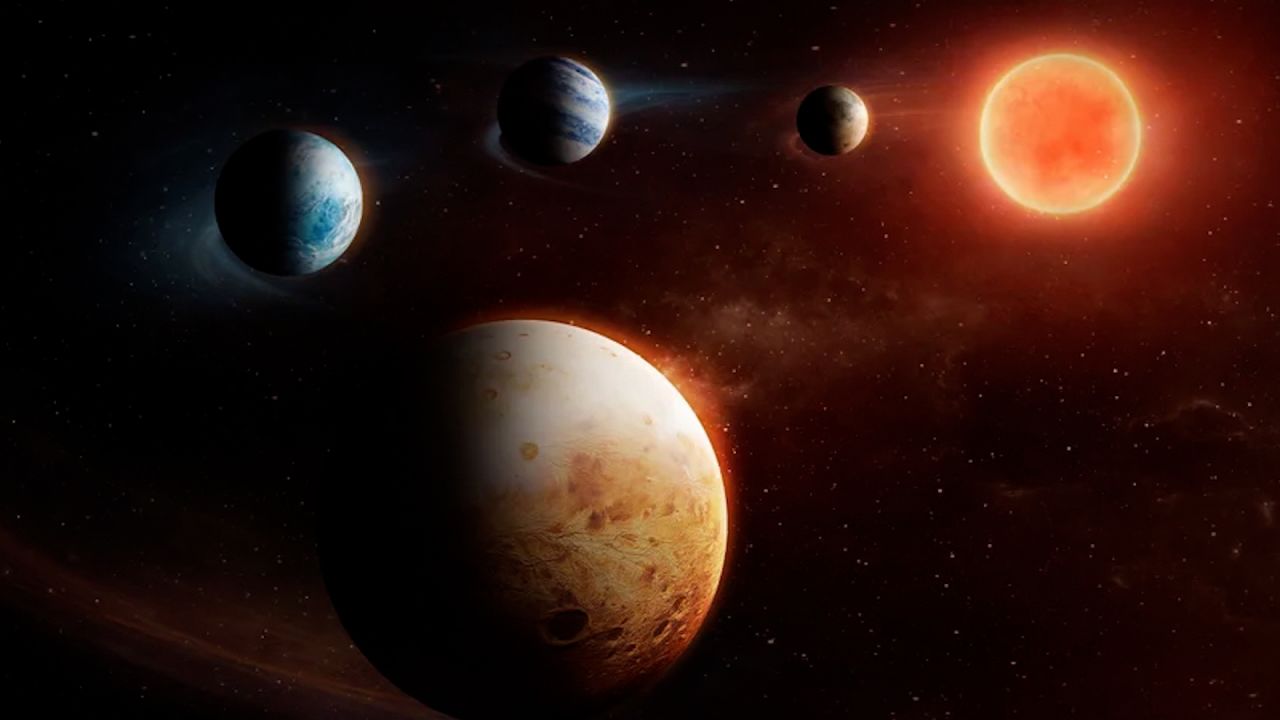
A team of astronomers has identified a unique planetary system that defies conventional understanding of planetary formation. This “inside-out” solar system, located approximately 40 light-years away in the constellation Aquarius, presents an unusual arrangement of its planets that has left scientists puzzled.
The system features several inner planets that are typically expected to be smaller and rocky, surrounded by larger gas giants. Instead, this formation shows a reversed order: the outer planets are significantly smaller and rocky, while the inner planets are larger and gaseous. This unexpected configuration challenges existing models of how planetary systems evolve.
Understanding the TRAPPIST-1 System
The planetary system, known as **TRAPPIST-1**, consists of seven planets, three of which lie within the habitable zone where conditions may support liquid water. Astronomers initially studied this system to understand the potential for life beyond Earth, but this new discovery shifts the focus to its formation and evolution.
According to a study published in *Nature Astronomy* in early January 2024, the astronomers involved have expressed their surprise at this configuration, which is not consistent with established theories. The lead author of the study, Dr. Emily Chen, an astrophysicist at the **California Institute of Technology**, stated, “This finding opens up new avenues for research on planetary dynamics and evolution.”
The TRAPPIST-1 planets are fascinating not only because of their size and composition but also due to their proximity to Earth, making them prime candidates for further study. The unusual arrangement raises important questions about the processes that govern planetary formation and migration.
Implications for Future Research
The implications of this discovery are significant for the field of astronomy. Existing models that describe how planets form within disks of gas and dust around stars may need to be reevaluated. The typical understanding is that smaller, rocky planets form closer to their stars, while larger gas giants develop farther out. The TRAPPIST-1 system suggests that these assumptions may not hold true in all cases.
This revelation also highlights the need for more advanced observational techniques and theoretical models to explain such anomalies. As astronomers continue to study TRAPPIST-1, future missions, especially those by **NASA** and other space agencies, may provide further insights into the nature of these planets.
The discovery of this “inside-out” solar system not only expands our understanding of planetary systems but also enhances our search for extraterrestrial life. As researchers delve deeper into the characteristics of these planets, they may uncover essential clues about the conditions necessary for life to thrive elsewhere in the universe.
In summary, the TRAPPIST-1 system’s peculiar arrangement poses intriguing challenges to our current understanding of planetary formation. As scientists work to unravel these mysteries, they stand on the brink of potentially rewriting the textbook definitions of how solar systems develop. The focus will remain on how these findings can inform future explorations and expand our knowledge of the cosmos.