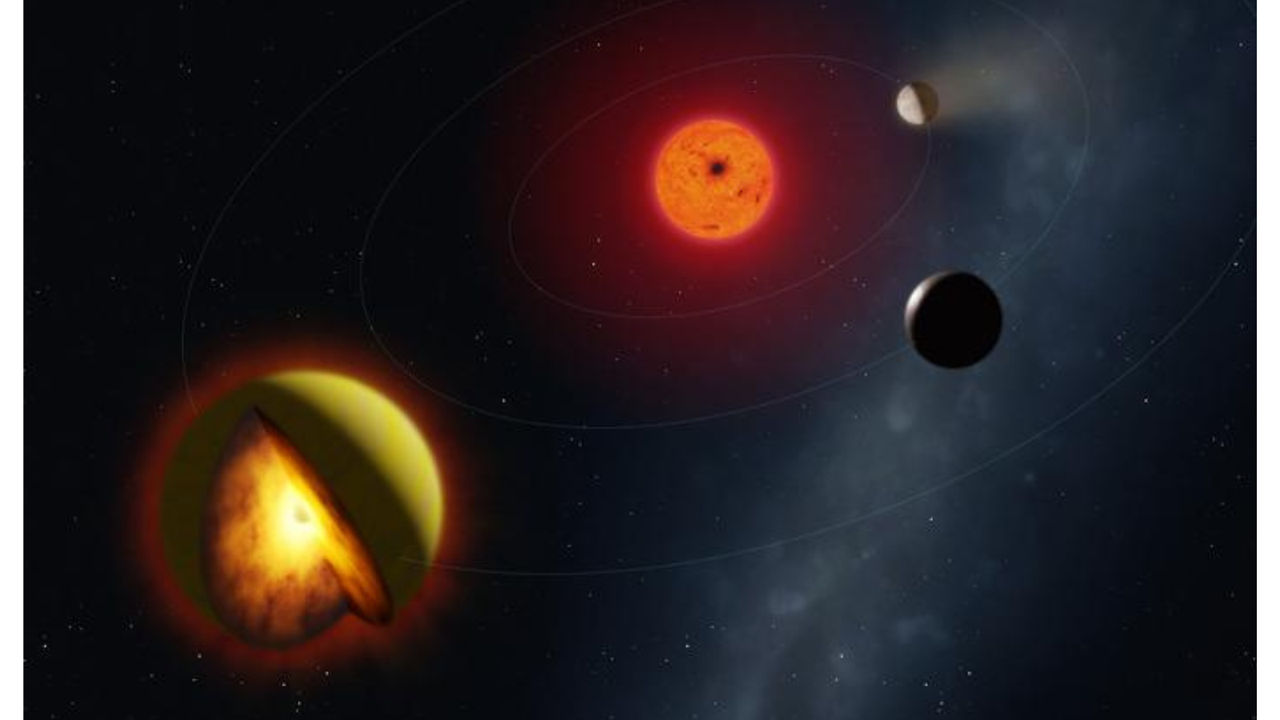
Astronomers using the James Webb Space Telescope (JWST) have discovered a new type of planet that may emit the scent of rotten eggs. The exoplanet, designated L 98-59 d, orbits a small red star located approximately 35 light-years from Earth. This finding highlights a previously unrecognized diversity of worlds beyond our solar system.
L 98-59 d is about 1.6 times the size of Earth and exhibits extremely low density. Data from the JWST, combined with observations from an array of Earth-based telescopes, indicate that its atmosphere is rich in hydrogen sulfide—a compound notorious for its characteristic odor. Traditionally, planets like L 98-59 d would be classified as either rocky gas dwarfs, with hydrogen-rich atmospheres, or as water-rich “hycean” ocean worlds. However, this exoplanet defies those categories, necessitating the establishment of a new classification for planets with significant sulfur compounds.
According to Harrison Nicholls, team leader at the University of Oxford, “This discovery suggests that the categories astronomers currently use to describe small planets may be too simple. While this molten planet is unlikely to support life, it reflects the wide diversity of the worlds which exist beyond the solar system.” He poses an intriguing question: what other types of planets remain to be uncovered?
Understanding L 98-59 d’s Unique Composition
Nicholls and his research team conducted advanced computer simulations to explore the nearly 5 billion-year history of L 98-59 d. By comparing these models to actual telescope data, they reconstructed the planet’s internal processes. Their analysis suggests that L 98-59 d likely possesses a mantle of molten silicate, akin to the lava found on Earth, and a global ocean of magma. This extensive magma ocean enables the planet to sequester substantial amounts of sulfur over extended periods.
The release of sulfur-rich gases into the atmosphere has occurred over billions of years, with the JWST detecting sulfur dioxide and other sulfur-based molecules in the planet’s upper atmosphere. The magma reservoir appears to have played a crucial role in preserving L 98-59 d’s hydrogen and sulfur-rich atmosphere, shielding it from being lost to space due to X-ray bombardment from its parent star.
Over time, the exchange of molecules between the atmosphere and the planet’s interior has shaped L 98-59 d into a new class of gas-rich sulfurous planets that maintain enduring magma oceans. The simulations indicate that this exoplanet likely formed with abundant volatile materials and may have initially been a larger sub-Neptune-like planet that shrank and cooled over billions of years, retaining part of its atmosphere.
Reconstructing the Past of Alien Worlds
Research team member Raymond Pierrehumbert emphasized the significance of their findings, stating, “What’s exciting is that we can use computer models to uncover the hidden interior of a planet we will never visit. Although astronomers can only measure a planet’s size, mass, and atmospheric composition from afar, this research shows that it is possible to reconstruct the deep past of these alien worlds—and discover types of planets with no equivalent in our own solar system.”
The team’s results were published on March 16, 2024, in the journal Nature Astronomy. This research not only enhances our understanding of L 98-59 d but also opens up new avenues for exploring the vast diversity of planets that lie beyond our own solar system. As astronomers continue to uncover these celestial bodies, they may discover even more unique worlds, each with its own characteristics and mysteries.