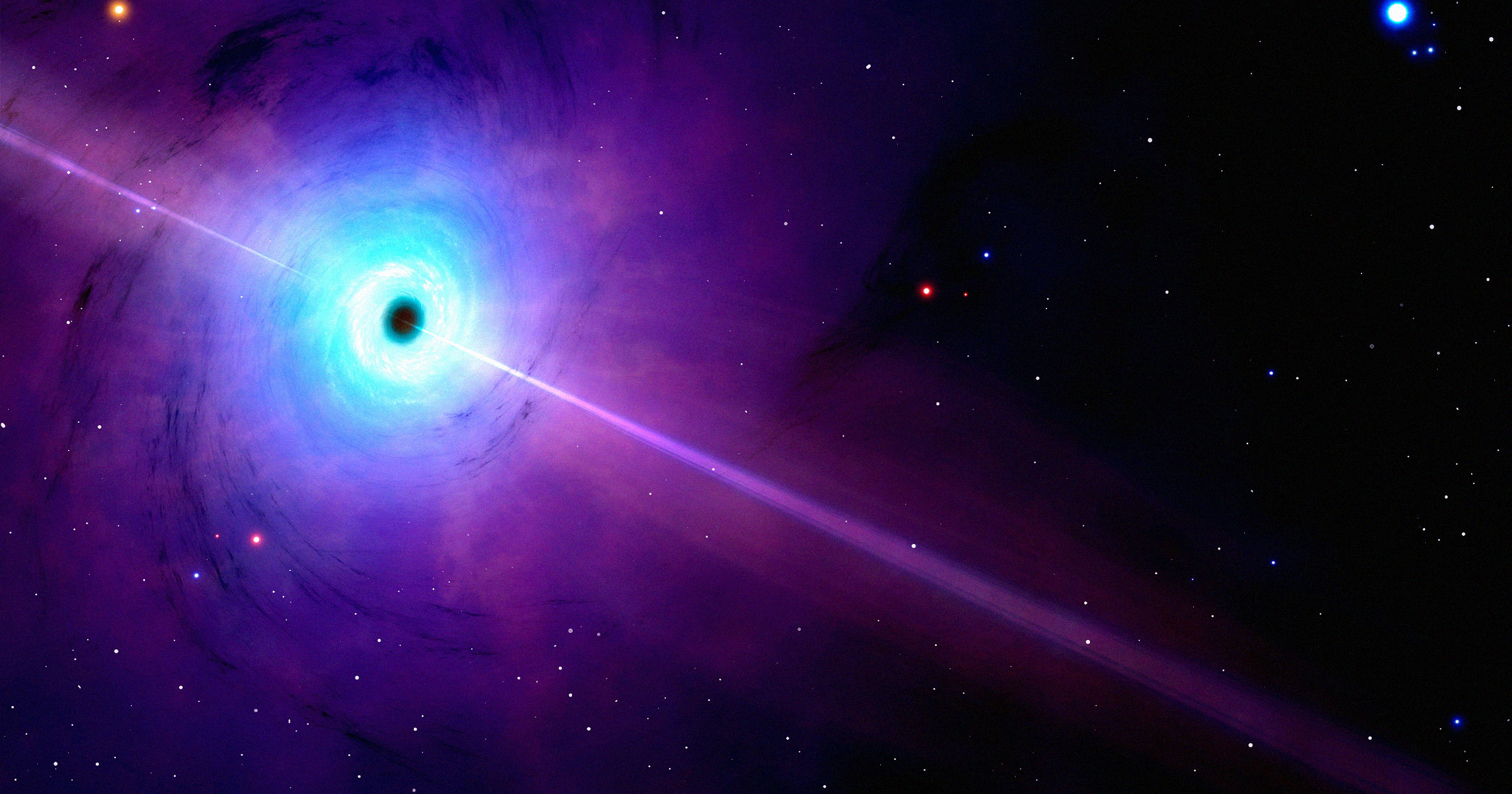
An international team of astronomers has identified a runaway supermassive black hole, marking a significant breakthrough in astronomical research. Using data from the James Webb Space Telescope, the team observed this extraordinary black hole traveling at an astonishing speed of 2.2 million miles per hour. This discovery could redefine our understanding of black holes and their formation.
Located in the interacting pair of galaxies known as the Cosmic Owl, approximately eight billion light-years from Earth, this supermassive black hole is estimated to have a mass 10 million times that of the Sun. The object is not only moving rapidly but is also pushing a “bow-shock” of matter ahead of it, while forming stars in a remarkable 200,000 light-year-long tail of gas.
Groundbreaking Observations
The lead author of the study, Pieter van Dokkum, an astronomer at Yale University, expressed his astonishment at the findings. “It boggles the mind! The forces that are needed to dislodge such a massive black hole from its home are enormous,” van Dokkum stated. He added that while it was predicted that such escapes should occur, this is the first instance of a black hole being found far from its original location.
Initial identification of this black hole occurred in 2023 using the Hubble Space Telescope. However, the object’s event horizon, which absorbs light, made it challenging to detect as it moved through space. The capabilities of the James Webb telescope enabled the team to analyze the extensive gas being displaced by the black hole’s movement.
“It is moving at approximately 620 miles per second, faster than just about any other object in the universe,” van Dokkum noted. This remarkable speed is thought to have allowed the black hole to escape the gravitational pull of its former home galaxy.
Theories Behind the Ejection
The researchers propose that the supermassive black hole may have experienced a violent collision with another black hole, resulting in an immense wave of gravitational waves that propelled it at high speeds. An alternative theory suggests a collision with a binary black hole system may have caused instability, leading to the black hole’s ejection.
Van Dokkum emphasizes that mergers of black holes are common in the life cycle of a galaxy. “Each galaxy with the size and mass of the Milky Way has experienced several mergers during its lifetime,” he explained. He also pointed out that while black hole binaries are formed frequently, the rate at which they merge and whether such mergers can lead to the ejection of a black hole remains largely unknown.
Now that astronomers have identified this runaway supermassive black hole, van Dokkum believes that future observations will uncover additional examples, allowing researchers to gather more data and refine their understanding of these cosmic phenomena. “My view is empirical: now that we know how to look for them, we can find other examples — and then we can answer the question directly from data, by counting the number of escapes,” he stated.
The discovery of this runaway supermassive black hole not only enriches our knowledge of black holes but also poses new questions about their dynamics and the evolution of galaxies. As research continues, the implications of this finding could significantly enhance our understanding of the universe and the forces that govern it.