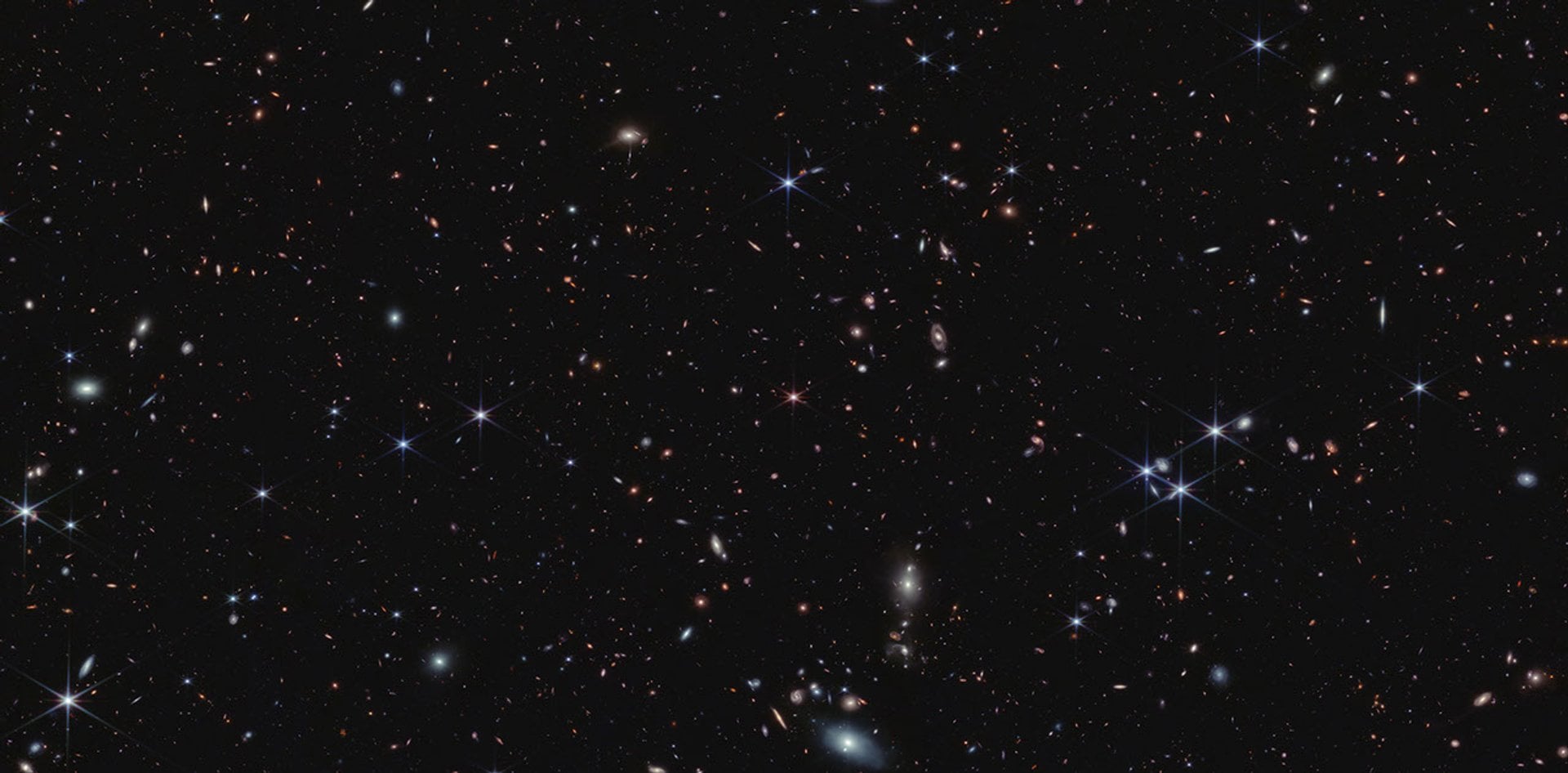
Astronomers have made a groundbreaking discovery regarding the early Universe, revealing the first compelling evidence of “monster stars” that could have contributed to the formation of supermassive black holes (SMBHs). Using the James Webb Space Telescope (JWST), an international team has detected signs of these massive stars, estimated to weigh between 1,000 and 10,000 solar masses, existing less than a billion years after the Big Bang.
The existence of SMBHs, which can weigh millions to billions of solar masses, has puzzled scientists for over two decades. According to prevailing cosmological models, these black holes should not have had enough time to form through conventional processes, such as stellar collapse or mergers. Recent observations challenge these models, suggesting that SMBHs may have originated from direct collapse black holes (DCBHs) formed from collapsing clouds of gas, or from the remnants of Population III stars.
Led by Devesh Nandal, a Swiss National Science Foundation Postdoctoral Fellow from the University of Virginia and the Institute for Theory and Computation at the Harvard & Smithsonian Center for Astrophysics, the research team included notable scientists such as Muhammad A. Latif from United Arab Emirates University and Daniel Whalen, a Senior Lecturer in Cosmology at the University of Portsmouth.
Finding Evidence in Galaxy GS 3073
The team utilized the JWST to analyze the chemical signatures in a galaxy known as GS 3073, which was originally identified in 2022 by Latif, Whalen, and collaborators from various institutions, including the University of Edinburgh and the Herzberg Astronomy and Astrophysics Research Centre. The observations revealed an unusually high nitrogen-to-oxygen ratio of 0.46, a value that could not be explained by known types of stars or stellar explosions.
This finding led the researchers to hypothesize that the first stars, known as Population III stars, formed from turbulent flows of cold gas shortly after the Big Bang. GS 3073 also contains an actively feeding black hole at its center, which could be a remnant of one of these large stellar objects. The existence of such stars could explain why the JWST has detected multiple quasars that emerged less than a billion years post-Big Bang, phenomena caused by SMBHs at the centers of galaxies.
How Monster Stars Contribute to Black Hole Formation
Nandal emphasized the significance of modeling how these monster stars evolve and the chemicals they produce. The researchers identified a specific mechanism that accounts for the observed nitrogen-to-oxygen ratio in GS 3073. The process begins with these massive stars fusing helium in their cores to form carbon. This carbon then mixes with hydrogen in the outer layers of the star, generating nitrogen, which is ultimately expelled into space.
This cycle of helium fusion and nitrogen production may continue for millions of years, enriching the surrounding gas cloud until the observed nitrogen-to-oxygen ratio is achieved. Significantly, the team’s model suggests that these monster stars collapse directly into massive black holes at the end of their life cycles, rather than exploding as supernovae. This mechanism could account for the “seeds” of the SMBHs observed today.
The researchers also noted that this nitrogen signature is not present in stars that fall outside the specific mass range of 1,000 to 10,000 solar masses. If confirmed, these findings would address two significant mysteries arising from previous JWST observations and provide new insights into the Universe during the period known as the “Cosmic Dark Ages,” which spans from 380,000 to 1 billion years after the Big Bang.
Until recently, this era was nearly impossible to study due to the faintness of light emitted during that time, necessitating advanced infrared technology like the JWST. The researchers anticipate that future surveys will uncover more galaxies exhibiting similar nitrogen excesses, allowing for further investigation into the existence of monster stars.
In summary, this discovery represents a significant advancement in our understanding of the early Universe and the formation of massive celestial objects. As the JWST continues to unveil the secrets of the cosmos, scientists remain hopeful for even more insights into the conditions and processes that shaped the formation of the Universe as we know it today.