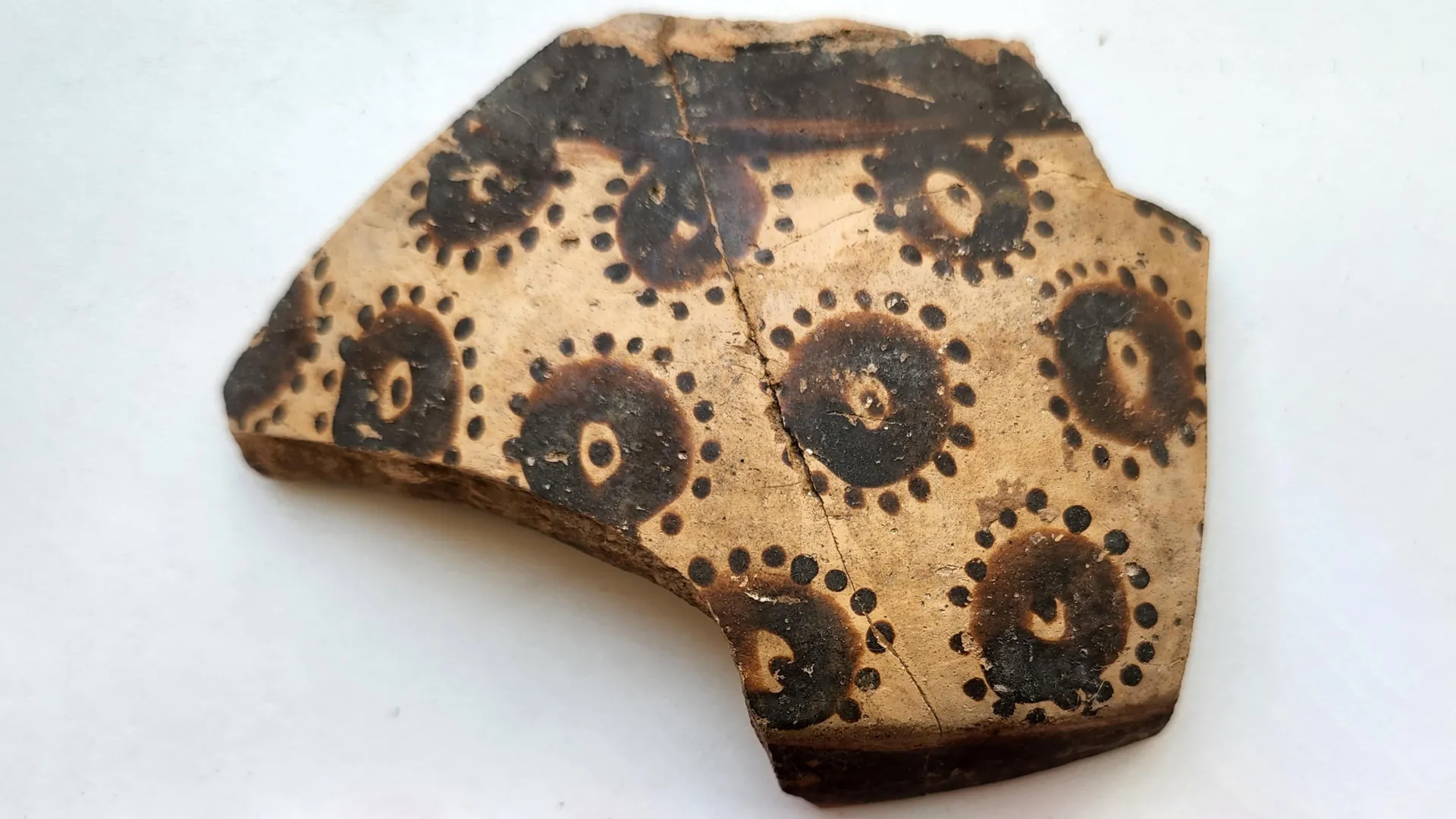
Early farming communities in northern Mesopotamia displayed a remarkable understanding of mathematics over 8,000 years ago, long before written numbers emerged. A recent study published in the Journal of World Prehistory reveals that intricate floral designs found on Halafian pottery demonstrate advanced geometric thinking and numerical patterns.
Researchers from the Hebrew University of Jerusalem, including Prof. Yosef Garfinkel and Sarah Krulwich, investigated artifacts from this ancient culture, dating from approximately 6200 to 5500 BCE. Their analysis indicates that the decorative motifs on pottery were not merely ornamental but instead reflected an early form of mathematical reasoning.
Significance of Botanical Imagery
Unlike previous artistic periods that primarily focused on human and animal figures, Halafian pottery introduced a variety of plant motifs as significant subjects in visual culture. The researchers examined artifacts from 29 archaeological sites, documenting hundreds of plant designs. They noted that both realistic and abstract representations displayed intentional design, pointing to a cognitive evolution linked to the advent of village life.
The authors state, “These vessels represent the first moment in history when people chose to portray the botanical world as a subject worthy of artistic attention.” This shift reflects a growing awareness of aesthetics and symmetry among early societies.
Mathematical Patterns in Floral Designs
One of the most striking findings relates to the arrangement of flowers on the pottery. Many vessels feature floral motifs with petal counts following specific numerical sequences, including numbers like 4, 8, 16, 32, and 64. This evidence suggests a deliberate planning process rather than random decoration, showcasing an advanced understanding of spatial organization.
According to Garfinkel, “The ability to divide space evenly, reflected in these floral motifs, likely had practical roots in daily life, such as sharing harvests or allocating communal fields.” This research contributes to the field of ethnomathematics, which studies the cultural expression of mathematical concepts.
Interestingly, the designs do not depict edible plants, suggesting that the focus on flowers may stem from their emotional associations rather than agricultural documentation. The authors propose that these visually appealing subjects were chosen for their ability to evoke positive responses.
The implications of this research challenge traditional views of mathematical origins. While written numerical systems began to appear much later in Sumer, the findings from Halafian pottery illustrate an intuitive form of mathematical reasoning based on visual organization and symmetry.
Krulwich emphasizes this point, stating, “These patterns show that mathematical thinking began long before writing. People visualized divisions, sequences, and balance through their art.” By documenting these plant-based designs and revealing their mathematical structures, the study offers new insights into how early societies interacted with their environment and exhibited complex cognitive abilities well before formal mathematics emerged.