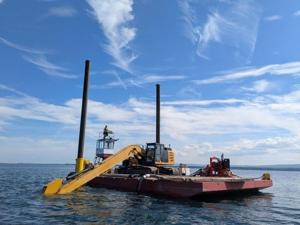
Recent efforts to enhance the habitat for lake trout in Lake Erie have involved a cutting-edge technique using high-velocity jetting. This innovative method, carried out by the **Seaway Marine Group**, targets the underwater environment of **Brocton Shoal** in **Chautauqua County**. The project aims to improve conditions for the fish population, ensuring a healthier ecosystem.
The operation employs a powerful water jetting system to remove accumulated organic material from the lakebed. This process helps restore the natural habitat for lake trout, which have faced challenges in their environment due to sediment buildup and other factors. According to **Pascal Wilkins**, a fish biologist with the **Lake Erie Fisheries Research Unit**, the technique shows promise in revitalizing areas critical for fish spawning and growth.
Assessing the Impact
The project includes comprehensive assessments before and after the jetting process. **Aleksandr Davis**, a fish technician with the **New York State Department of Environmental Conservation**, has been closely monitoring the progress using an underwater drone. Initial dive assessments indicate that the jetting has successfully transformed the lakebed, providing a clearer and cleaner environment for fish.
These evaluations are crucial for understanding the effectiveness of the jetting technique. The underwater imagery reveals significant differences in the lakebed’s condition, showcasing a successful reduction of unwanted materials that can hinder fish populations. This aligns with ongoing efforts to sustain and enhance the biodiversity of **Lake Erie**, which is vital for local fisheries and the broader aquatic ecosystem.
The lake trout population has historically struggled due to ecological changes and environmental pressures. Initiatives like this jetting project highlight the commitment of environmental agencies and researchers to employ innovative solutions for conservation.
As this project progresses, stakeholders remain optimistic about its long-term benefits for lake trout and other aquatic species. The collaboration among various organizations underscores a shared goal: to foster a sustainable environment that supports both wildlife and local communities dependent on the lake’s resources.
For ongoing updates on environmental initiatives in the region, interested readers can follow reports from local climate and environment journalist **Mackenzie Shuman**.