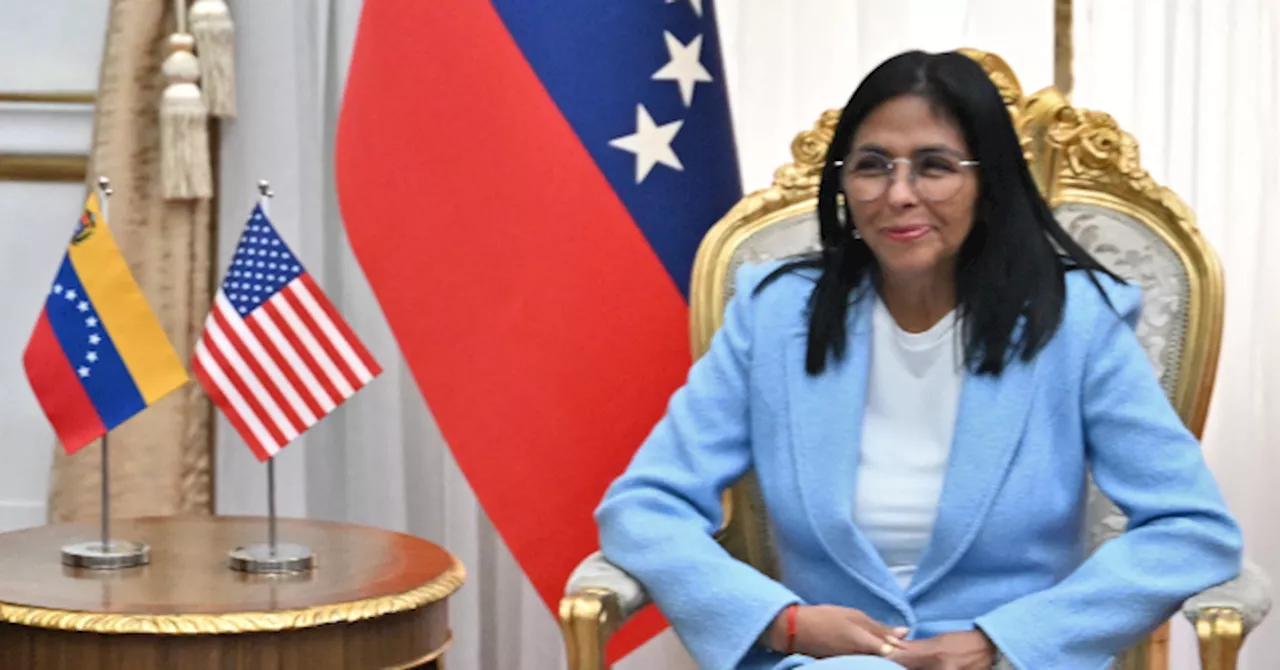
Venezuela’s interim leader, Delcy Rodríguez, has publicly expressed a desire for collaboration with the United States, referring to President Donald Trump as a “friend” and “partner.” This statement follows the arrest of former President Nicolás Maduro, marking a significant shift in the political landscape of Venezuela and raising expectations for improved US-Venezuelan relations.
During a recent event with Nicolás Maduro Guerra, Maduro’s son, Rodríguez underscored her hopes for an end to sanctions and blockades imposed on Venezuela. She highlighted that the country has never posed a threat to the United States and emphasized the potential for a new cooperation agenda. This marks a departure from the previous administration’s rhetoric and actions toward the US.
In his State of the Union address, Trump acknowledged the budding relationship between Venezuela and the United States. He noted that Venezuela had provided over 80 million barrels of oil to the US, surpassing earlier estimates. This oil exchange is part of an arrangement that allows American companies to operate in Venezuela, aimed at revitalizing its struggling oil industry, despite the country possessing the world’s largest known oil reserves.
Venezuela’s oil production has faced severe challenges due to socialist policies that led to the exodus or imprisonment of skilled engineers. Attempts by Maduro to address these issues through partnerships with Iranian engineers had limited success before his arrest. Rodríguez’s recent statements suggest a desire to rectify these challenges through renewed cooperation with the United States.
Rodríguez also addressed the implications of Maduro’s arrest, describing it as a military aggression but indicating that the circumstances might pave the way for enhanced relations. Cooperation between the two nations will likely hinge on improvements in Venezuela’s human rights record and a distancing from nations considered adversaries of the US, such as Cuba, China, and Russia.
Reports indicate that Rodríguez is overseeing the removal of Cuban agents who have historically held significant influence in the Venezuelan government. The Cuban regime has confirmed that 32 of its soldiers died during the operation to apprehend Maduro, although there have been no official reports of Venezuelan military casualties.
On the human rights front, Rodríguez and her brother, Jorge Rodríguez, have committed to releasing political prisoners. The Maduro administration has faced international criticism for its history of using violence to suppress dissent. Trump notably acknowledged the suffering of anti-socialist activists in Venezuela, inviting Enrique Márquez, a political figure who opposed Maduro in the 2024 election and was imprisoned, to attend his address. The reunion of Márquez with his niece, Alejandra González, during the event underscored the human impact of the political crisis.
The evolving dynamics between the US and Venezuela under Rodríguez’s leadership signal a pivotal moment for both countries. The future of Venezuela may increasingly depend on successful cooperation with the United States, alongside significant reforms within its political and economic frameworks. As both nations navigate this new chapter, the focus will remain on the potential for improved human rights and economic stability in Venezuela.