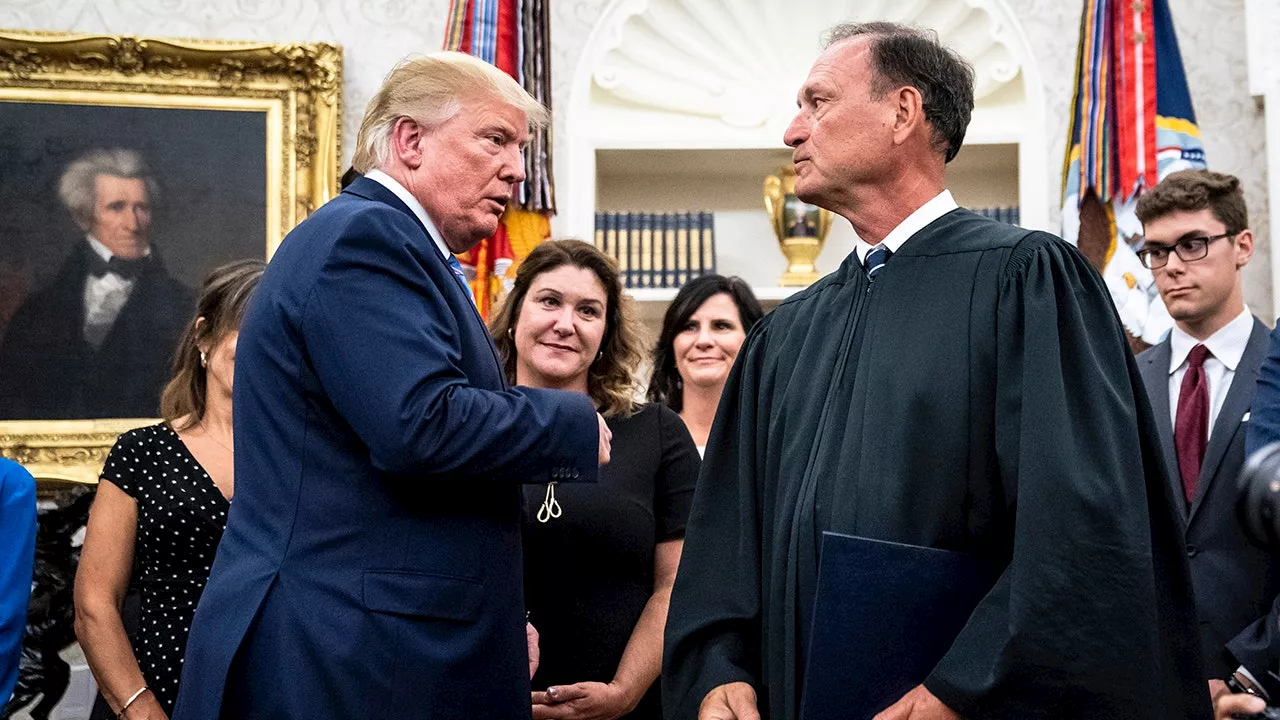
The Supreme Court has temporarily blocked President Donald Trump‘s deployment of the National Guard in Chicago, a ruling that has ignited a robust dissent from Justice Samuel Alito. The case centers around Trump’s invocation of a rarely used federal law to federalize the National Guard, aiming to protect federal personnel and buildings amid ongoing protests.
The Court’s decision, rendered in a 6–3 vote, upheld lower court findings, leading to heated discussions regarding the definition of ‘regular forces’ and implications under the Posse Comitatus Act. This act generally prohibits the military from acting as a domestic police force without explicit congressional authorization.
In his dissent, Justice Alito criticized the majority’s reasoning, labeling it as “unwise” and “imprudent.” He, along with Justice Clarence Thomas, argued that the majority accepted an “eleventh-hour argument” regarding the meaning of ‘regular forces,’ which could lead to unintended consequences. The legal conflict arose after Trump decided to invoke Title 10, federalizing approximately 300 members of the National Guard in response to what the administration described as protests that obstructed, assaulted, and threatened Immigration and Customs Enforcement (ICE) officers.
Illinois officials swiftly filed a lawsuit, which resulted in lower courts blocking the National Guard’s deployment. These courts cited Trump’s failure to meet the statutory requirements for utilizing reserved forces, which can only occur when “unable with the regular forces to execute the laws of the United States.” The Supreme Court’s ruling reinforced this stance, pending further developments in the judicial process.
Majority Opinion and Legal Arguments
The majority, in an unsigned order, clarified that ‘regular forces’ pertained to the U.S. military, not civilian law enforcement officers such as ICE. They contended that Trump had not sufficiently justified the use of regular military units for domestic purposes in Chicago, indicating that this option had not been exhausted before considering the National Guard’s deployment.
The majority also scrutinized the statute’s language concerning the execution of laws. They posited that if the National Guard’s role was solely to protect federal officers, it would not equate to executing laws. Moreover, if the National Guard were to engage in law enforcement, it could infringe upon the Posse Comitatus Act.
Alito expressed confusion over the majority’s focus on this act, asserting that the president has the authority to employ the military for various domestic purposes. He cited the Constitution’s provision allowing military use in response to war, insurrection, or “other serious emergency.” Alito warned that the majority’s decision could have broader implications, especially considering Trump’s attempts to deploy the National Guard in other cities for immigration enforcement and crime control.
State Sovereignty and Legal Challenges
In its legal arguments, Illinois maintained that the protests against ICE were largely peaceful and that local law enforcement had the situation under control. The state asserted that allowing Trump to deploy the National Guard would inflict irreparable harm, infringing on its sovereign rights to manage law enforcement resources.
Illinois’ attorneys emphasized their “sovereign right to commit its law enforcement resources where it sees fit,” describing this as an “intangible and unquantifiable interest” warranting judicial protection. Alito’s dissent highlighted the potential absurdity of the Court’s interpretation, suggesting that National Guard members could perform arrests for deportation but would lack the legal authority for protective functions.
As the legal landscape evolves, the challenges in California and Portland, Oregon remain less advanced than the Chicago case. The Supreme Court’s ruling is a pivotal moment that not only affects the current administration’s policies but also shapes the future discourse on the deployment of military forces in domestic matters.