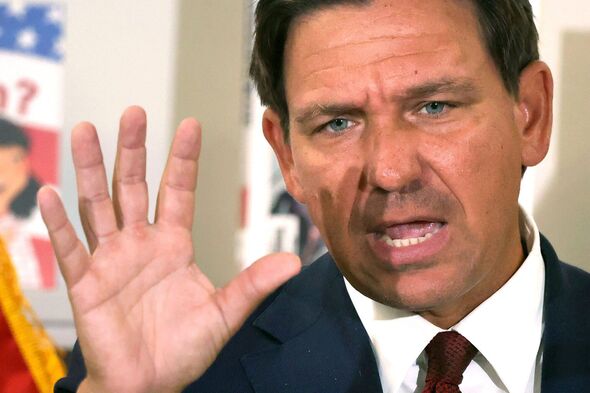
Florida Governor Ron DeSantis has urged state representatives to initiate a mid-decade redistricting plan, aligning with recent efforts in Texas and California. His announcement follows comments from Florida House Speaker Daniel Perez, who stated that the state currently has “no plan yet” for redistricting. In a succinct social media message, DeSantis encouraged supporters to “stay tuned,” hinting at his commitment to a strategy that could bolster Republican representation ahead of the 2026 midterm elections.
During a press conference in August, DeSantis expressed his support for former President Donald Trump‘s proposal for a mid-decade census aimed at redrawing district maps to benefit Republicans. This move could potentially increase the Republican congressional delegation from Florida, which currently holds 20 out of 28 seats. “We might have 29, 30, 31, maybe. Who knows?” DeSantis stated, emphasizing his belief that a new population census could lead to a larger representation for the state.
The initiative has faced criticism from Democratic leaders. Florida Democratic Party Chair Nikki Fried accused DeSantis of attempting to manipulate the electoral landscape in favor of Republicans. “After gutting representation for Black Floridians and stacking the court to uphold it, he wants to further gerrymander and suppress the vote of millions of Floridians,” Fried remarked in an August statement.
Redistricting Trends Across the U.S.
Trump’s call for redistricting has sparked a wave of mid-decade map changes in both Republican and Democratic-led states. According to The Associated Press, Democrats need to gain only three seats to regain control of the House. Historically, the party of the sitting president tends to lose seats during midterm elections, and Trump’s strategy aims to counter this trend.
Texas was the first state to respond, with Republican Governor Greg Abbott signing a new congressional map on August 29 that could potentially add five Republican seats. Currently, Republicans occupy 25 out of 38 seats in Texas, although the new map is facing legal challenges. Following Texas, states like Missouri, North Carolina, and Ohio are also in various stages of implementing redrawn maps that could favor Republicans.
Conversely, California, under Governor Gavin Newsom, has taken steps to counter Trump’s redistricting push. A new U.S. House map, approved by voters on November 4, replaces districts established by an independent commission after the 2020 census. This change could help Democrats gain five additional seats, as they currently hold 43 out of 52 seats. The U.S. Department of Justice has joined a Republican lawsuit challenging the new districts.
In Florida, Perez has established a special committee focused on congressional redistricting. DeSantis has indicated that a mid-decade adjustment is necessary, regardless of whether a new census is conducted. “Even if they don’t do a new census, I do think that it is appropriate to be doing it,” he stated.
Resistance in Other States
Meanwhile, the political climate surrounding redistricting is not uniform. In Indiana, Senate President Pro Tem Rodric Bray announced on October 6 that the state Senate would not convene in December to vote on redistricting, citing insufficient support from members. This decision significantly decreases the likelihood of redistricting in the state, as Indiana becomes the second Republican-controlled state to resist Trump’s call for new congressional maps.
Bray commented, “Over the last several months, Senate Republicans have given very serious and thoughtful consideration to the concept of redrawing our state’s congressional maps,” adding that there were not enough votes to move the proposal forward. Some Indiana Republicans have expressed concerns that gerrymandering could backfire politically or be viewed as unethical.
As the political landscape continues to evolve, DeSantis’s redistricting push exemplifies the broader national debate surrounding electoral map changes. The implications for representation and party control will be closely watched as states navigate their respective paths leading up to the pivotal midterm elections.