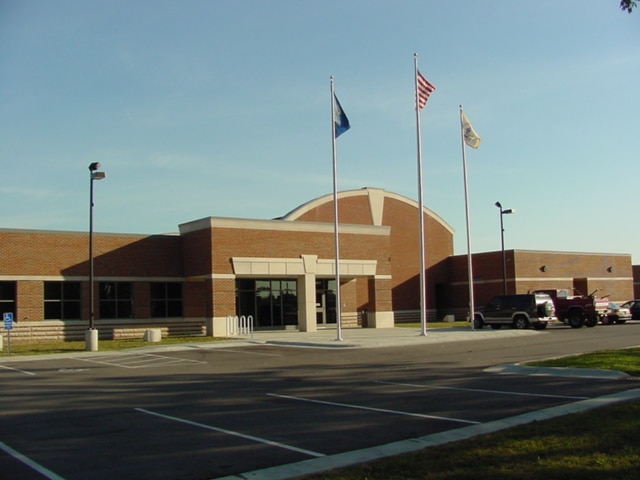
Community members from Boone County are calling for a comprehensive review of the local jail’s agreement with U.S. Immigration and Customs Enforcement (ICE). The group, known as Boone County is Better, is advocating for increased transparency and accountability following a federal court ruling that ordered a bond hearing or release for a detainee currently held at the Boone County Jail.
This appeal comes in the wake of ongoing concerns voiced at other local fiscal court meetings, including those in Kenton and Campbell counties. On Tuesday, four members of the Boone County is Better group addressed the county’s fiscal court, each presenting comments and requests related to immigration issues, with some donning yellow attire to signify their cause.
The Boone County Jail, which entered into an agreement with ICE in 2005, was the first of three detention centers in Northern Kentucky to do so. These agreements, which are effectively subcontracts with the U.S. Marshals, have come under scrutiny as community members question the ethical implications of profiting from the detention of individuals who have not been formally charged with crimes.
At the January 13 meeting of the Boone County Fiscal Court, Brian Maurer, the founder of Boone County is Better, submitted a memorandum requesting monthly transparency reports detailing operations at the jail. During the recent meeting, Maurer reiterated this request, linking it to a significant ruling in the case of Hernandez v. Maydak, a federal habeas corpus case involving Ricardo Adolfo Lemus Hernandez, a non-citizen detainee at the jail.
On January 16, Chief Judge David Bunning granted Hernandez’s habeas petition, mandating either his immediate release or a bond hearing within seven days. The court’s order also stipulated that a status report must be submitted by January 30 to confirm compliance. As of now, Hernandez remains listed as detained on the jail’s official website.
Maurer raised critical questions about the potential number of individuals in similar situations, stating, “How many more individuals are in there, in that facility whose constitutional rights are being ignored or violated?” He emphasized the need for further investigation into how many uncharged individuals are being held, raising concerns about the implications of the county’s contract with ICE.
The group’s memorandum outlines six specific transparency measures they are seeking from the county, including:
1. **Zero-Charge Census**: The daily average number of individuals held without pending charges.
2. **Average Length of Stay**: The average duration of detention for uncharged individuals.
3. **Medical Adequacy Audit**: Response times for medical requests from detainees.
4. **Language Access Audit**: Availability of detention-related materials in various languages and access to interpreters.
5. **Commingling Safety Audit**: Reports of safety incidents involving uncharged civil detainees and convicted offenders.
6. **Constitutional Liability Ledger**: A five-year account of legal expenses related to lawsuits over the detention of uncharged individuals.
Following Maurer’s statements, Soap Wolfe, a student from Erlanger’s Ignite Institute, shared her perspective, expressing concern about the impact of the jail’s contract with ICE on community trust. Wolfe referenced the recent death of Alex Pretti, shot by ICE agents, as a catalyst for her worries regarding public safety and the potential erosion of trust in local law enforcement.
“Public safety depends on trust, and trust cannot exist when people believe their county is benefiting from fear,” Wolfe stated. She urged the court to avoid implementing policies that blur the lines between local public safety and federal immigration enforcement.
After the community members spoke, Gary Moore, Boone County Judge/Executive, acknowledged the requests presented during the meeting. “We always consider any request that comes before us,” he said, noting that while the court cannot comment on pending litigation, they will review the concerns raised by the community.
The ongoing dialogue surrounding the Boone County Jail’s practices highlights a growing demand for accountability and transparency in the context of immigration enforcement. As community members continue to voice their concerns, the outcome of this situation may have lasting implications for both local policies and the individuals affected by them.