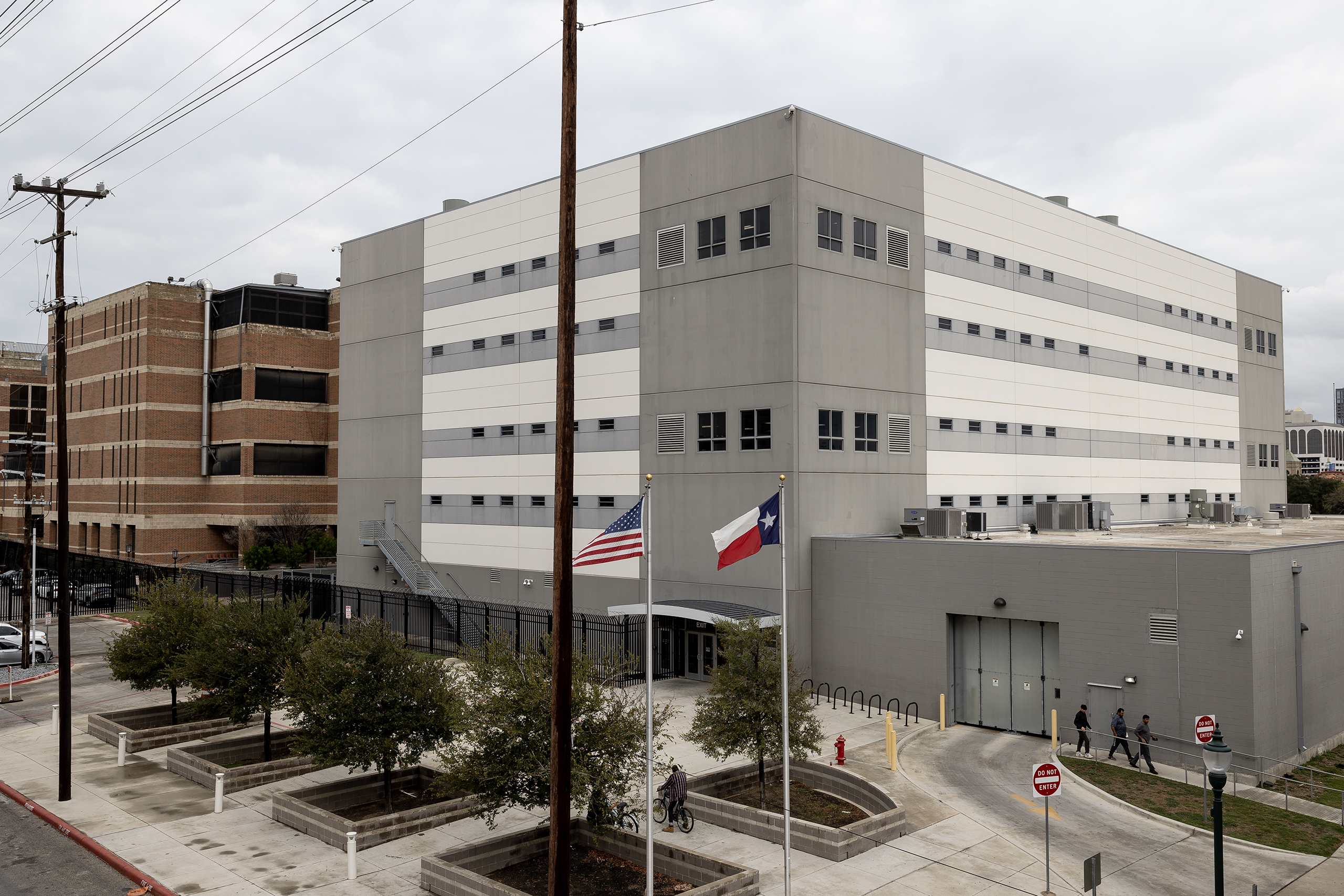
Bexar County has officially transitioned responsibility for jail intake mental health and substance use screenings from the Center for Health Care Services (CHCS) to University Health. This change ends a six-year contract with CHCS and marks the first time that medical and behavioral health assessments will be consolidated under a single provider since the opening of the Justice Intake and Assessment Annex (JIAA) in late 2018.
Previously, CHCS conducted mental health screenings while University Health managed medical intake within the facility. Once detainees entered the jail, University Health took over both medical and behavioral health treatment. In October 2023, Bexar County’s Office of Criminal Justice commissioned a study from the University of Texas Health Science Center at Houston to assess the efficiency of the annex in processing detainees and diverting those with behavioral health or substance use needs into appropriate treatment programs.
The study, led by Dr. Alexander Testa, revealed issues such as fragmented communication, inconsistent data sharing, and overlapping responsibilities among the various agencies operating within the annex. Based on these findings, Testa and his team recommended either consolidating screening and treatment under a single provider or creating a coordinated process that integrates behavioral health assessments into the medical intake already conducted by University Health.
Following the study’s recommendations, Bexar County’s Department of Public Health began to explore how to enhance diversion efforts. “We were thinking, what does that mean for the providers that are there?” said Dr. Andrea Guerrero, Bexar County Public Health Director. “University Health provides the physical services in the JIAA and also manages mental health once someone moves over to the jail.”
The decision to change providers was formally made in August 2023 and subsequently approved in the fiscal year 2026 budget on September 9. University Health President and CEO Edward Banos characterized the transition as part of a broader initiative to improve continuity of care. “This is an opportunity to enhance continuity of care,” he noted. “We will conduct assessments on intake and, if additional psychiatric services are required, they will be provided by us or referred to another facility. All information will be maintained on one medical record.”
Conversations regarding the transition began months prior, with University Health approached to potentially take over intake services if the existing agreement with CHCS was not renewed. The announcement of the change reportedly surprised CHCS, which had been conducting mental health screenings for years. Jelynne LeBlanc Jamison, CHCS President and CEO, stated that they were unaware this change was being considered until they received notice just before the county presented its recommendation to the Commissioners Court.
“We engaged Bexar County to understand the findings and their response,” Jamison said. “Much to our surprise, we learned the day before the presentation that they would recommend contracting with University Health for JIAA assessment services.” She expressed concern about the lack of a systemic process within the JIAA, noting the absence of a clear procedure for processing detainees.
CHCS concluded its role in the annex on September 30, 2023, with most staff members reassigned to other programs. University Health began conducting screenings on October 1, 2023, with Bexar Public Health assisting in staffing during the transition period. “CHCS left abruptly and did not assist in the transition,” Banos remarked. “However, Dr. Guerrero and her staff were dedicated to ensuring we had staff ready to operate.”
University Health is expected to fully take over staffing by November 10, 2023. Guerrero emphasized that discussions regarding the consolidation of screenings occurred with both agencies prior to the budget approval. She reaffirmed that CHCS remains a critical partner in the county’s behavioral health network.
“Mental health assessments at the JIAA are the only portion of that contract that has been transitioned over to University Health to streamline the process and increase diversions,” Guerrero stated. CHCS will continue to operate other mental health programs, including a jail-based competency restoration initiative and assisted outpatient treatment for the courts.
Looking ahead, Jamison indicated that CHCS will continue to focus on expanding diversion options outside of the jail system. “We provide all outpatient services as before,” she said, expressing optimism about discussions for a diversion center and the need for a psychiatric hospital in Bexar County.
While acknowledging the county’s intentions to streamline operations, Jamison raised questions about whether the change in provider would adequately address the structural issues highlighted in the UTHealth study. “If they do not address technological upgrades, staffing, and leadership coordination, then the changes may not lead to meaningful improvements,” she concluded.