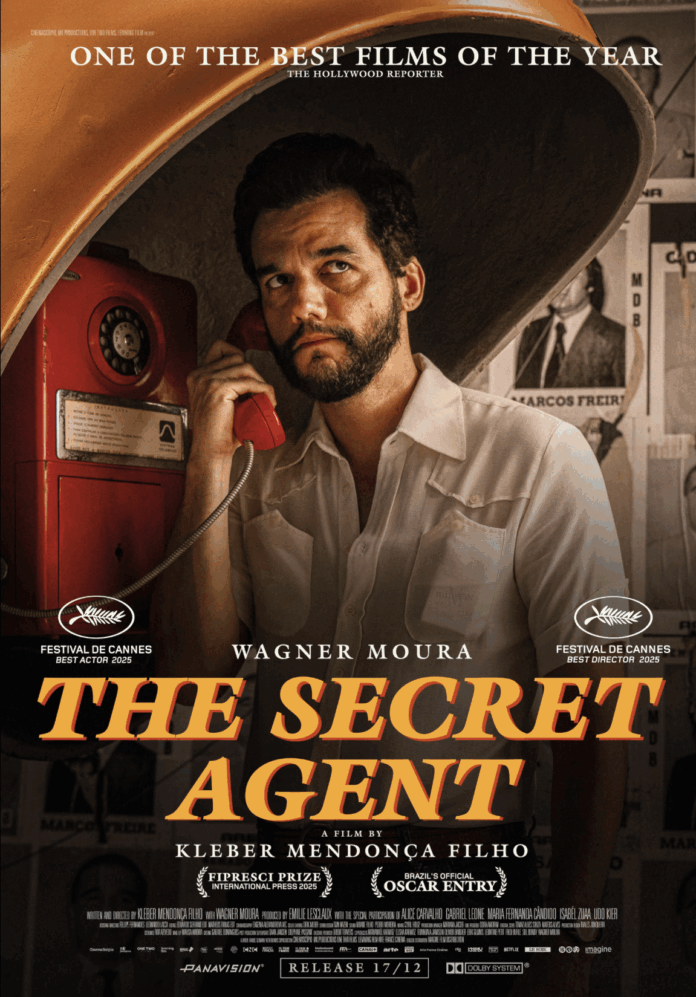
Brazilian film “The Secret Agent” has emerged as a powerful political thriller that addresses the harsh realities of life under authoritarian regimes. Directed by Kleber Mendonça Filho, the film follows the story of Armando Solimões, portrayed by Wagner Moura, who adopts a new identity to escape danger during Brazil’s military dictatorship. The film has garnered significant acclaim, receiving four Academy Award nominations, including Best Picture and Best Actor for Moura.
A Narrative of Memory and Resistance
The film’s narrative centers on the brutal atmosphere of Brazil’s past, as Armando flees his academic post after colleagues are threatened. He becomes Marcelo Alves in the city of Recife, where he must navigate a landscape fraught with danger and moral complexity. The nearly three-hour runtime is filled with tension, and while some may find the pacing slow, the emotional payoff is substantial.
Visually, “The Secret Agent” employs a neo-noir aesthetic that enhances its themes. The cinematography by Evgenia Alexandrova features techniques such as split-diopter shots, illustrating the emotional gaps between characters. For example, one split-diopter shot starkly contrasts Alves’ distance from his estranged son, emphasizing the personal toll of political turmoil.
Thematic Depth and Personal Connection
Filho has cited the New Hollywood movement as a key influence, echoing the work of directors like Martin Scorsese and Brian De Palma. This stylistic choice reflects the film’s exploration of ethical ambiguity, compelling audiences to confront the harsh realities faced by its characters. Alves’ collaboration with a corrupt police chief in Recife accentuates his precarious position, revealing the moral compromises demanded in oppressive environments.
Moura’s performance is particularly noteworthy, showcasing a character whose internal struggles unfold gradually. His portrayal of Alves is layered, moving from a confident academic to a man grappling with fear and loss. Flashbacks reveal the life he once led, which contrasts sharply with his current predicament, deepening the film’s emotional resonance.
The narrative also intertwines the present with the past through the character of Flavia, a historian who listens to recordings of Alves. This temporal structure invites viewers to reflect alongside her, considering how history shapes current realities. The film’s conclusion challenges the audience to engage with the past not as detached observers but as individuals connected to its emotional core.
Filho’s decision to frame the film within the context of contemporary Brazilian politics, marked by democratic backsliding, adds layers of relevance. The director won Best Director at the Cannes Film Festival for this work, recognizing its artistic and political significance.
Ultimately, “The Secret Agent” serves as a poignant reminder of how personal narratives intertwine with broader historical contexts. By portraying intimate moments of love and anguish, the film encourages viewers to reflect on the past’s impact on the present. Through its engaging storytelling and compelling performances, it illuminates the power of memory and the enduring struggle against authoritarianism.