South Korea’s efforts to enhance its critical mineral resource security are confronting significant workforce challenges. Industry officials and academics report that mining companies are struggling to recruit sufficient workers as government-funded training programs are set to conclude.
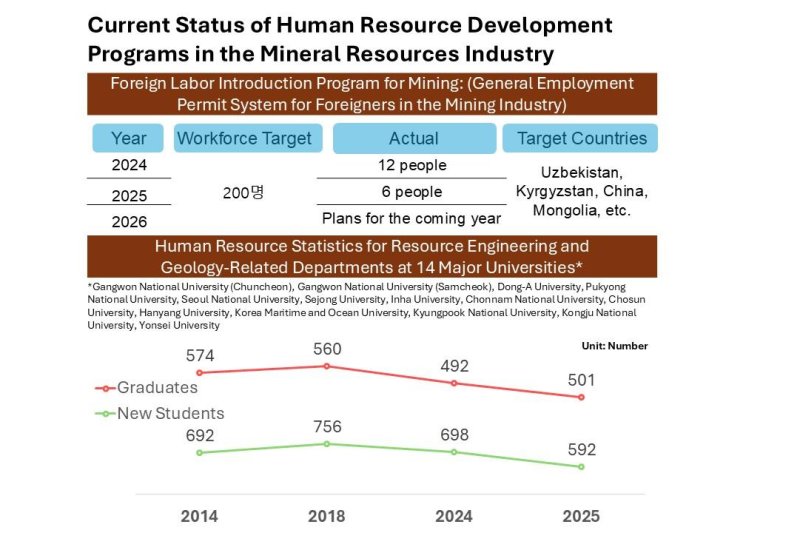
According to the Korea Mine Rehabilitation and Mining Industry Corporation, a foreign workforce introduction initiative under the employment permit system achieved only six hires this year, representing a mere 3% of its target of 200 workers. This figure marks a decline from the previous year when the program managed to secure twelve hires, leading to a combined two-year performance of just 4.5% of the overall target. The initiative was launched last year in response to escalating labor shortages in the mining sector.
Recent data from Statistics Korea indicates that mining sector employment fell by 8.7% compared to the previous year. Industry representatives note that efforts to incorporate foreign workers face various challenges. One official mentioned that permitting foreign workers to perform specific support tasks related to explosives could alleviate some labor shortages; however, such practices remain prohibited due to past safety incidents involving explosives at tunnel construction sites.
In addition to regulatory hurdles, companies have reported issues such as communication barriers, cultural differences, and a lack of necessary skills among foreign workers as practical impediments to hiring. Domestic workforce training programs are also on the verge of termination next year, raising concerns about the future availability of engineers and technicians in the industry.
Historically, resource development training programs in South Korea have been weakened since the Asian financial crisis. A government initiative that ran from 2009 to 2019 with a total investment of 87.5 billion won (approximately $66 million) was suspended for two years, and although it was resumed, current funding levels are insufficient. Furthermore, a request for a new project budget through the Ministry of Trade, Industry and Energy was not approved by the Finance Ministry, limiting the potential for future initiatives.
If local demand arises, training could potentially be pursued as a project under the Ministry of Education, yet no regional governments currently have plans to develop workforce initiatives. Universities, which previously merged or closed their resource engineering departments, also face increased pressure as support programs come to an end. For instance, Kangwon National University is set to admit only two students to its resource engineering major this year.
Professor Kim Jin-soo from Hanyang University highlighted that despite efforts to maintain training through industry and government initiatives, education programs related to resource development and mining have largely collapsed. The growing shortage of skilled labor could lead to a greater dependence on foreign technology and personnel, diminishing South Korea’s domestic expertise and complicating the acquisition of essential materials for key industries, including semiconductors.
Enrollment figures in resource engineering programs have also declined sharply. This year, 13 South Korean universities with resource engineering and geology-related departments reported a total of 592 students, a drop of 106 from the previous year. Specifically, resource engineering enrollment fell to 422 students, marking the first time in twelve years that numbers have dropped below 500. Overall, total enrollment in related programs has decreased to 1,597, down 477 since 2014.
In response to these challenges, the South Korean government has implemented a special act on national resource security this year and included critical minerals in the National Growth Fund support list. Experts emphasize the urgency of developing a skilled workforce as part of a comprehensive industrial ecosystem. Professor Nam Kwang-soo from Sangji University underscored the need for personnel with field experience and specialized capabilities for overseas resource development, urging the government to take a proactive role in creating a talent pipeline to meet these demands.